The BIEK Ungraded Rule: What Below 40 Percent Means for Pre-Medical Pupils
The BIEK ungraded rule 40 percent pre-medical question matters to every Intermediate pupil in Karachi, because the rule changed what a low mark in a single paper means. Under the new grading system, candidates securing less than 40% marks in any paper are declared ungraded and are not considered to have passed that paper. They must reappear in that paper if they meet other eligibility requirements. The 2026 Intermediate Part-I exams ran under this new system, which was introduced following decisions of the Inter Boards Coordination Commission (IBCC) and the Sindh government's Universities and Boards Department. This article explains the rule in plain language, what it means paper by paper, and how Pre-Medical pupils can study so that no paper falls below 40%. One important note: the Pre-Medical Part-I result itself is not yet announced, and any late-October expectation is unconfirmed.
What ungraded actually means
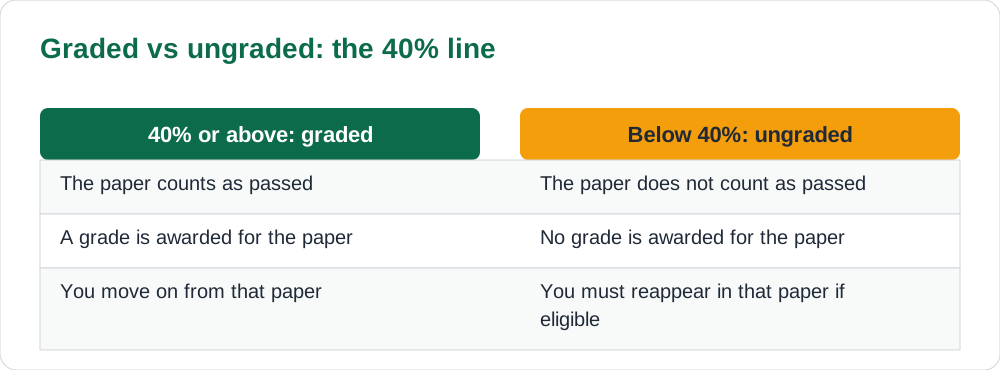
Ungraded is not a grade, and it is not a fail in the old sense of the word. It is a status the board applies to a paper in which a candidate scored less than 40% of the marks. The paper is not counted as passed, and the candidate must reappear in that paper if they meet other eligibility requirements. The rest of the result stands on its own: a paper above the line is passed, and a paper below it is ungraded.
The practical effect is that one weak paper can no longer hide inside a good overall total. A pupil who scores well in most papers but below 40% in one paper will have that one paper marked ungraded, and will need to deal with it separately. Understanding this early matters, because it changes how pupils should divide their study time.
Who decided the new grading system
The new grading system was introduced following decisions of the Inter Boards Coordination Commission (IBCC) and the Sindh government's Universities and Boards Department. That matters because it means the rule is a system-wide change, not a one-board experiment. Pupils should therefore treat it as the standing rule for Intermediate examinations, not as something that will quietly disappear.
Because the rule comes from above the board, the board's own notifications are the authoritative place to read how it is applied in each examination. If any detail seems unclear, the official notification and your school are the right sources. Rumours about the rule are common precisely because it is new, so checking the official wording is worth the effort.
What the rule means paper by paper
The 40% line applies to each paper separately. Pre-Medical pupils sit several papers across subjects such as Urdu, English, Islamiat or Pakistan Studies, Physics, Chemistry and Biology, and each paper is judged on its own marks. A strong performance in Biology does not rescue a Chemistry paper below 40%, and a strong Chemistry paper does not rescue Physics. Every paper needs its own attention.
This is a change in study strategy, not just in grading. The old habit of leaning on a favourite subject while neglecting a feared one is now the most expensive mistake a pupil can make. The safest plan is a minimum floor for every subject: enough steady work that no paper is left to chance, with extra time for the subject a pupil finds hardest rather than the one they enjoy most.
How to study so no paper falls below 40%
The most reliable way to stay above the line is to secure the easy marks in every paper first. Board papers reward pupils who attempt every question, write organised answers, and cover the full syllabus at least once. A pupil who has seen every chapter, even briefly, is far less likely to face a paper full of unknown questions than a pupil who mastered half the syllabus and ignored the rest.
Build the habit in three layers. First, finish the textbook for every subject, including the chapters that feel dull. Second, practise past-paper style questions under timed conditions so that speed and presentation improve together. Third, keep a short weekly review of the weakest subject, using class notes and solved exercises. Pupils who want structured practice can use our guide to preparing MCQs for Sindh board exams alongside their textbook work.
- Cover every chapter in every subject at least once before the exam
- Attempt every question in the paper, even the ones that feel hard
- Practise timed answers so presentation and speed improve together
- Give the weakest subject the most weekly revision time, not the least
- Use class notes, solved exercises and teacher feedback for weak topics
Pre-Medical Part-I result: not yet announced
As of the latest checks in mid-October 2026, BIEK has not announced the Intermediate Part-I Pre-Medical result. Secondary sources suggest late October, but this is an expectation, not a confirmed board date. Pupils should not treat any circulating date as confirmed, and should not plan around a date that the board has not announced.
The right move is to confirm the result only on biek.edu.pk, the board's official website, and through your school. While waiting, the most useful thing a Pre-Medical pupil can do is to keep studying: the 40% rule means every paper needs attention, and waiting time spent revising a weak subject is time that directly protects the result. For more on the waiting period, see our guide to the BIEK first-year Pre-Medical result expectations.
AI Help: Muse AI
Muse AI is Meta's personal AI assistant, and it can help you protect every paper against the 40% line. For example, you can ask it to turn a weak chapter into a set of short practice questions, then check your answers against your textbook. Muse AI does not give official Sindh Textbook Board answers — always verify against your Sindh Textbook Board book and your teacher.
Join Muse with invite code LTGSWD — in the Muse app, go to Settings > Redeem token and enter the code.
Disclosure: LTGSWD is the author's Muse invite code.
5 key points you must know
- Less than 40% marks in any paper means the paper is declared ungraded and not counted as passed.
- A pupil with an ungraded paper must reappear in that paper if they meet other eligibility requirements.
- The new system followed decisions of the IBCC and the Sindh Universities and Boards Department.
- The 40% line applies to each paper separately, so no strong subject can rescue a weak paper.
- The BIEK Pre-Medical Part-I result is not yet announced; a late-October release is an unconfirmed expectation only.
Frequently asked questions
What does ungraded mean in the BIEK result?
Ungraded means the candidate scored less than 40% marks in that paper. The paper is not considered passed, no grade is awarded for it, and the candidate must reappear in that paper if they meet other eligibility requirements.
Does one ungraded paper fail the whole result?
No. The rule applies paper by paper. Papers at or above 40% stand as passed, while only the paper below 40% is ungraded. That paper must be dealt with separately under the board's rules.
Who introduced the ungraded rule?
The new grading system was introduced following decisions of the Inter Boards Coordination Commission (IBCC) and the Sindh government's Universities and Boards Department. The 2026 Intermediate Part-I exams ran under this system.
Has the BIEK Pre-Medical Part-I result been announced?
No. As of the latest checks in mid-October 2026, BIEK has not announced the Intermediate Part-I Pre-Medical result. A late-October release is an unconfirmed expectation only. Confirm the result on biek.edu.pk. Our guide to the new BIEK grading system explains the rule in more detail.
How can I make sure no paper falls below 40%?
Cover every chapter in every subject, attempt every question, practise timed answers, and give your weakest subject the most revision time. The rule rewards steady work across all papers, not brilliance in one favourite subject.
Solved notes — preview free
These guides work best with the solved exercises. Preview the solved notes free on this website — 119 solved notes for Classes 6–10 in Sindhi, Urdu, English and Arabic medium. Or browse the full solved notes catalogue for your class and medium. New solved notes are added regularly — check the catalogue for coming-soon books.