Heredity and Traits: Why Families Resemble Each Other
This guide covers heredity traits families resemble, the biology idea that explains why children often look like their parents, grandparents, and siblings. You may share eye colour, hair texture, height pattern, or even the way you smile with family members. These similarities happen because parents pass instructions called genes to their children. Genes are carried in cells and guide how the body grows and works. This guide introduces genes, chromosomes, and inheritance through family traits you can observe safely, without any medical tests, for STBB biology in Classes 6 to 10, with safe observation activities, simple definitions, and everyday family examples.
What Are Genes and Chromosomes?
Genes are instructions inside cells that guide traits such as eye colour, hair type, and blood group. Genes are made of DNA and are found on structures called chromosomes inside the nucleus of a cell. Humans have chromosomes in pairs, with one set from each parent. When cells divide, they copy these instructions so new cells have the same information. This is why the nucleus, which you learned about in Cell Structure and Functions Explained Simply, is so important.
A trait is any feature you can observe, such as attached or free earlobes, tongue rolling, or dimples. Some traits are controlled mainly by genes, while others are also shaped by the environment. For example, your height is influenced by genes, but also by nutrition and health. Your skin colour is influenced by genes, but sunlight can darken it. When you study heredity, remember that genes give instructions, but the environment can affect how those instructions show up. This balance is a key idea in biology.
How Traits Pass from Parents to Children
Children get half their chromosomes from their mother and half from their father. This mixing is why siblings can look similar but not identical, unless they are identical twins. Each parent passes one copy of each gene. The combination a child receives helps decide which traits appear. Some versions of a gene are dominant, which means they show up even if only one copy is present. Others are recessive, which means they show up only if two copies are present. Your Sindh Textbook Board book may use simple examples to show how dominant and recessive traits work.
A helpful way to think about it is to picture two instruction cards for the same trait, one from each parent. If one card says show the trait and the other says hide it, the dominant card wins. If both cards say hide it, the recessive trait shows. This is a simplified model, but it helps you understand why a child can have a trait that neither parent shows, if both parents carry the hidden version. Always use the terms your book uses, and do not guess about medical traits.
Family Traits You Can Observe Safely
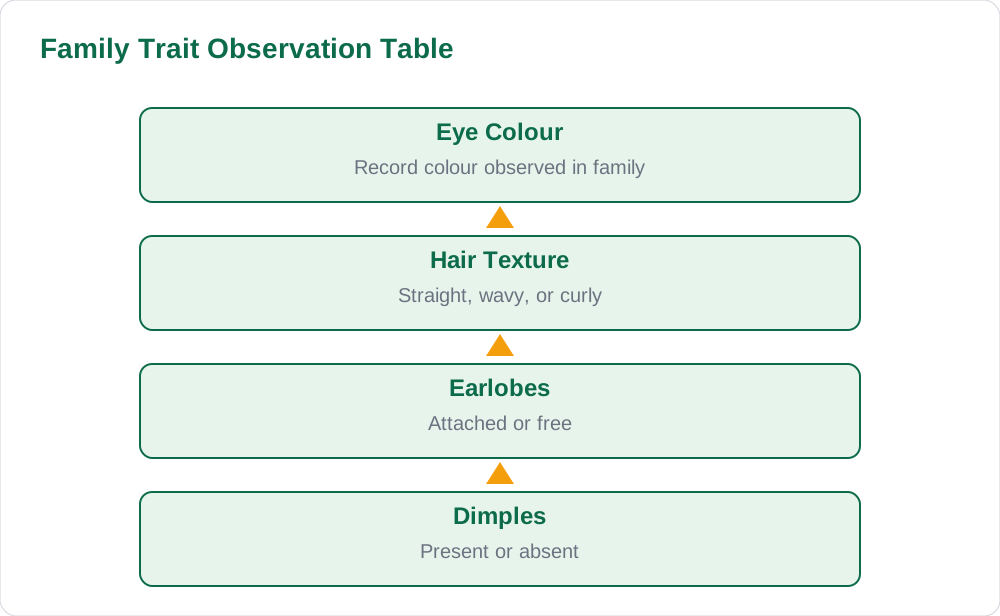
You can observe family traits without any tests or tools. Look at traits such as eye colour, hair colour and texture, earlobe shape, dimples, and whether you can roll your tongue. Ask family members if they are willing to share what they observe about themselves. Do not compare in a way that makes anyone feel judged. Every family has variation, and variation is normal. Record what you see in a simple table with columns for person, trait, and observation. This is a safe, respectful way to study heredity.
You can also look at family resemblances in photos. Notice how a child may have a parent nose, a grandparent smile, or a sibling hair type. These are examples of heredity in action. Variation within a family shows that genes mix in new ways each time. If you do a class activity, share only what you are comfortable sharing, and never collect personal health information. The goal is to see patterns, not to diagnose anything. For a broader life-science link, see Energy Flow in Ecosystems for Biology Pupils, where variation also matters.
Why Siblings Differ and Why Twins Matter
Siblings share about half their genes on average, but the exact mix is different for each child. That is why one sibling may look more like the mother and another more like the father. Environmental factors such as nutrition, health, and habits also add differences. Even identical twins, who start with the same genes, can differ slightly because of environment and life experiences. This is why heredity is about patterns, not exact copies.
Variation is important for the whole species. It means not everyone is the same, so a population can adapt to changes. In plants, variation helps some plants survive drought or disease. In animals, variation helps some survive predators or changes in food. When you study heredity, connect it to this bigger idea: variation within families and populations is normal and useful. This is a good point to make in an exam answer that asks why variation matters.
Common Misunderstandings and Revision Tips
A common misunderstanding is that children inherit only from one parent. In fact, they inherit from both parents. Another misunderstanding is that a trait you learn, such as speaking a language, is inherited. Learned skills are not passed through genes. A third misunderstanding is that dominant means better or more common in every case. Dominant only means it shows when one copy is present. Keep these distinctions clear.
To revise, make a glossary with gene, chromosome, DNA, trait, dominant, and recessive, each in one sentence. Then draw a simple family tree with three generations and label one trait that runs through it. Practise explaining in two sentences why children resemble parents but are not identical to them. Check your answers against your Sindh Textbook Board book and the solved notes on Solved Notes and the book list on Books.
AI Help: Muse AI
Muse AI is Meta's personal AI assistant, and it can help with heredity revision by helping you build a simple family trait table and explain dominant and recessive ideas in plain words. Muse AI does not give official Sindh Textbook Board answers — always verify against your Sindh Textbook Board book and your teacher.
Join Muse with invite code LTGSWD — in the Muse app, go to Settings > Redeem token and enter the code.
Disclosure: LTGSWD is the author's Muse invite code.
5 key points you must know
- Genes are instructions in cells that guide traits.
- Genes are carried on chromosomes inside the nucleus.
- Children receive half their chromosomes from each parent.
- Dominant traits show with one copy; recessive traits need two copies.
- Variation within families is normal and useful.
Frequently asked questions
What is heredity?
Heredity is the passing of genes and traits from parents to children.
What is a gene?
A gene is an instruction inside a cell that guides a trait, such as eye colour or hair type.
Why do siblings look different?
Each sibling receives a different mix of genes from the same parents, and environment also adds differences.
Are learned skills inherited?
No. Learned skills such as speaking a language are not passed through genes.
Solved notes — preview free
These guides work best with the solved exercises. Preview the solved notes free on this website — 119 solved notes for Classes 6–10 in Sindhi, Urdu, English and Arabic medium. Or browse the full solved notes catalogue for your class and medium. New solved notes are added regularly — check the catalogue for coming-soon books.