Plant Reproduction and Pollination Explained
This guide covers plant reproduction pollination explained, starting with a flower, because the flower is the reproductive part of a flowering plant. Inside the flower are male and female parts that make pollen and ovules. Pollination is the transfer of pollen from the male part to the female part. After pollination, fertilisation can happen, and seeds and fruit can form. This guide uses flower dissection and local plants you can see in Sindh, such as mustard, hibiscus, and rose, to make each step concrete. It is written for STBB pupils in Classes 6 to 10 and follows the way your biology book introduces flowers, pollination, and seed formation.
Parts of a Flower
A typical flower has four main sets of parts. Sepals are the green leaf-like parts that protect the bud. Petals are often colourful and attract insects. Stamens are the male parts. Each stamen has an anther that makes pollen and a filament that holds the anther. The carpel is the female part. It has a stigma that receives pollen, a style that connects stigma to ovary, and an ovary that contains ovules. Some flowers have one carpel, others have several joined together.
When you dissect a flower in class, pull the parts apart gently and place them in order on paper. Count the sepals, petals, stamens, and carpels. Look at the anther under a hand lens and notice the powdery pollen. Cut the ovary open carefully to see the small ovules inside. Drawing and labelling what you see is more memorable than copying a textbook diagram. Always follow your teacher safety instructions and use blunt tools for dissection. For cell ideas that support this topic, see Cell Structure and Functions Explained Simply.
Pollination: Transfer of Pollen
Pollination is the transfer of pollen from the anther to the stigma. It can happen within the same flower or between flowers. Self-pollination is transfer within the same flower or between flowers on the same plant. Cross-pollination is transfer between flowers on different plants of the same kind. Cross-pollination brings together different genetic material, which can increase variety in the next generation. Many plants have features that encourage cross-pollination.
Pollination can happen by wind, insects, birds, or other agents. Wind-pollinated flowers, such as wheat and maize, often have light pollen, feathery stigmas, and small dull petals. Insect-pollinated flowers, such as hibiscus and mustard, often have bright petals, scent, and nectar to attract insects. When an insect visits for nectar, pollen sticks to its body and is carried to the next flower. This is why protecting pollinators such as bees matters for food crops.
Fertilisation and Seed Formation
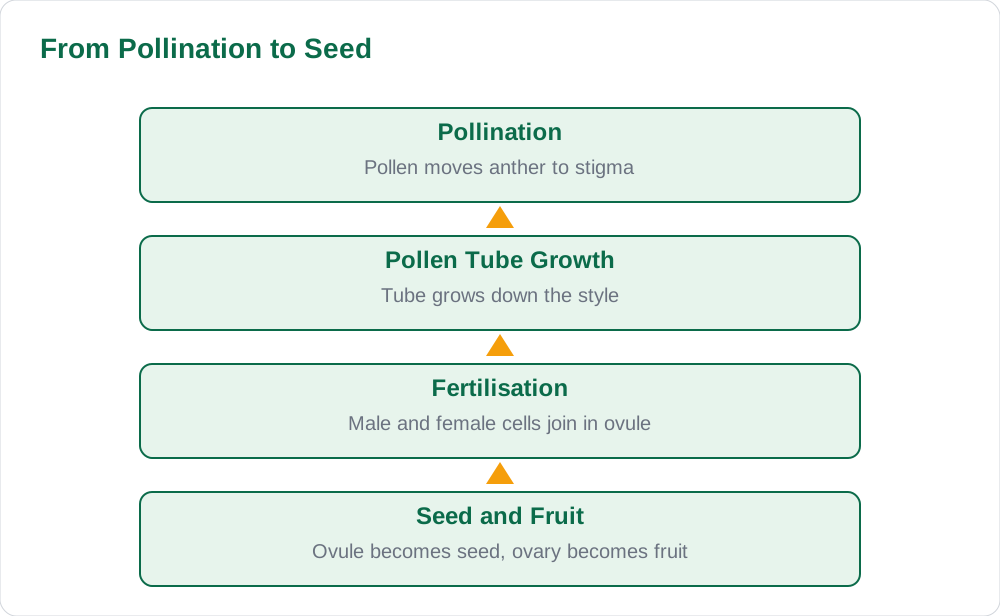
After pollen lands on a stigma, it grows a pollen tube down the style towards the ovary. The male cells travel through this tube to reach an ovule. Fertilisation is the joining of the male cell with the female cell inside the ovule. After fertilisation, the ovule becomes a seed, and the ovary often becomes a fruit. The fruit protects the seed and helps it spread. The seed contains an embryo, a store of food, and a protective coat.
Seeds can stay dormant, which means they wait until conditions are right for germination. When water, warmth, and air are present, the seed germinates: the embryo grows, the root appears first, then the shoot. If you plant mustard or mung bean seeds in class, you can watch this happen over a few days. Record the day the root appears and the day the shoot appears. This simple observation links reproduction to growth and to Energy Flow in Ecosystems for Biology Pupils, because new plants become food for others.
Seed Dispersal and Local Examples
Seed dispersal is the spreading of seeds away from the parent plant. This reduces competition for light, water, and nutrients. Seeds can be dispersed by wind, water, animals, or explosion of the fruit. Wind-dispersed seeds are often light or have wings. Animal-dispersed seeds may be eaten and passed out, or they may stick to fur or clothing. Water-dispersed seeds, such as coconut, can float. When you see seeds in your area, ask how they might travel. This question turns a walk into a biology lesson.
Local examples make this topic easy. Mustard has bright yellow flowers that attract insects. Hibiscus has large showy flowers with a clear stigma and stamens. Maize has wind-pollinated flowers with tassels. Mango fruit develops from the ovary after fertilisation and contains a single large seed. You can study these plants without expensive materials. Bring a flower to class, identify its parts, and note whether it looks wind-pollinated or insect-pollinated. Write one sentence of evidence for your answer.
Revision Tasks and Common Exam Questions
Common exam questions on this topic include labelling a flower, defining pollination and fertilisation, explaining the difference between self-pollination and cross-pollination, and describing seed formation. Another common task is to compare wind-pollinated and insect-pollinated flowers. Make a table with two columns and list features such as petal size, pollen amount, stigma shape, and nectar. Practising this table from memory will help you answer quickly.
To revise, dissect or draw a flower and label all parts without looking. Then write the sequence pollination, pollen tube, fertilisation, seed, fruit from memory. Finally, explain in two sentences why pollination alone does not guarantee seeds. Check your work against your Sindh Textbook Board book and the solved notes on Solved Notes and the book list on Books.
AI Help: Muse AI
Muse AI is Meta's personal AI assistant, and it can help with plant reproduction revision by turning a flower diagram into a labelled quiz you can practise on. Muse AI does not give official Sindh Textbook Board answers — always verify against your Sindh Textbook Board book and your teacher.
Join Muse with invite code LTGSWD — in the Muse app, go to Settings > Redeem token and enter the code.
Disclosure: LTGSWD is the author's Muse invite code.
5 key points you must know
- The flower is the reproductive part of a flowering plant.
- Pollination is the transfer of pollen from anther to stigma.
- Fertilisation is the joining of male and female cells inside the ovule.
- After fertilisation, the ovule becomes a seed and the ovary often becomes a fruit.
- Seed dispersal by wind, water, animals, or explosion reduces competition.
Frequently asked questions
What is the difference between pollination and fertilisation?
Pollination is the transfer of pollen to the stigma. Fertilisation is the joining of male and female cells inside the ovule.
What is self-pollination?
Self-pollination is pollen transfer within the same flower or between flowers on the same plant.
Why are insect-pollinated flowers bright and scented?
Bright petals, scent, and nectar attract insects, which carry pollen from flower to flower.
What does a seed contain?
A seed contains an embryo, a food store, and a protective coat.
Solved notes — preview free
These guides work best with the solved exercises. Preview the solved notes free on this website — 119 solved notes for Classes 6–10 in Sindhi, Urdu, English and Arabic medium. Or browse the full solved notes catalogue for your class and medium. New solved notes are added regularly — check the catalogue for coming-soon books.