Rechecking vs Re-totalling: What Is the Difference?
After results are announced, some pupils feel that their marks do not reflect the paper they wrote. When that happens, boards generally offer ways to have the result looked at again — most commonly called rechecking and re-totalling. The two terms sound almost the same, and many pupils use them interchangeably, but they describe different checks. Knowing the difference helps you choose the right option and set realistic expectations. This article explains what rechecking usually involves, what re-totalling usually involves, and when each option is generally used. Procedures, fees, and deadlines vary by board and by year, so always confirm the current rules with your school or the board's official notification before applying. Nothing here replaces the board's own instructions.
The Short Answer: Checking Work vs Checking Addition
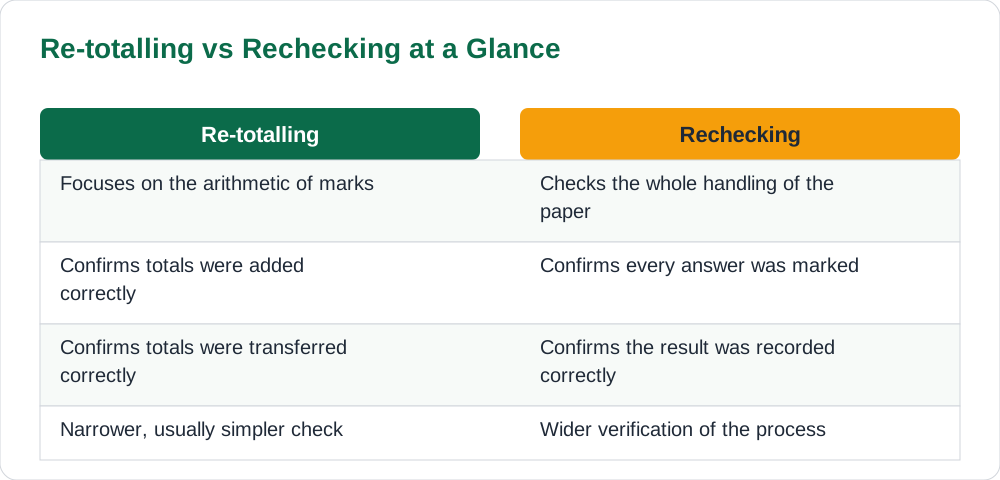
In simple terms, re-totalling is about the arithmetic: were the marks on your paper added up correctly? Rechecking is broader: it generally confirms that the whole paper was handled correctly, which may include checking that every answer was marked and that the marks were transferred and totalled properly. Think of re-totalling as checking the sum, and rechecking as checking the process around the sum.
Both options are about verifying the result, not about re-marking the paper with a fresh judgement of quality. That distinction matters, because many pupils expect a recheck to raise their marks. In most cases, the marks stay the same. The value of either option is certainty: you find out whether an administrative error affected your result.
What Re-totalling Usually Covers
Re-totalling generally focuses on the numbers. It checks that the marks awarded on each question or section were added correctly, that the total on the answer book matches the total recorded, and that the total was carried correctly onto the result sheet. If an addition error is found, the total is corrected.
Because the check is narrow, it is usually the simpler and quicker of the two options. It does not involve judging whether an answer deserved more marks — it only asks whether the marks already given were added up right. If your main doubt is a possible adding mistake, re-totalling is the option most pupils consider first.
- Addition of marks across questions and sections.
- Agreement between the answer-book total and the recorded total.
- Correct transfer of the total to the result record.
What Rechecking Usually Covers
Rechecking is generally the wider check. It usually confirms that every page and every answer in the answer book was marked, that no answer was left unmarked by mistake, that the marks were totalled correctly, and that the result was recorded properly. In some boards it may also include verifying that the correct answer book was attached to your roll number. The exact scope differs between boards, so confirm what your board's rechecking covers before you apply.
The important point is that rechecking is still a verification, not a fresh evaluation. The examiner's academic judgement of your answers is normally not reopened. A pupil who feels an answer was under-marked on merit is usually not helped by rechecking, because the check looks for handling errors, not for a second opinion on quality.
When Each Option Is Generally Used
Pupils usually consider re-totalling when the result seems inconsistent with the paper in a numerical way — for example, when a subject total looks far below the marks they expected across the questions. They usually consider rechecking when they worry that a whole answer, page, or section may have been missed, or when they want the fullest available verification of the paper's handling.
In both cases, the sensible first step is to talk to a teacher. A teacher can help you compare your expectations with the paper honestly, and can tell you whether a verification request makes sense or whether your time is better spent preparing for the next examination. Either way, decide calmly and on the facts, not on rumour or panic.
How to Decide, Step by Step
Start by reading your marksheet carefully and noting exactly which subject concerns you. Then speak to your teacher about the paper: which questions you attempted, how confident you felt, and what total you expected. A teacher's outside view often helps you judge whether a verification request is sensible. If you decide to apply, confirm the current procedure with your school or the board's official notification — including the fee, the deadline, the form or online process, and which subjects can be covered.
Keep copies of everything you submit, and note any reference or receipt number. While you wait, do not pause your studies. If the result changes, you will deal with it then; if it does not, you will already be prepared for the next step. Our guide on using extra time well when an exam is postponed shows how to keep momentum during an uncertain wait, and the books and notes library can support your revision.
- Identify the exact subject and the reason for your doubt.
- Discuss it honestly with a teacher before applying.
- Confirm the current fee, deadline, and procedure with your school or board.
- Keep copies and receipts of your application.
- Keep studying while you wait for the outcome.
Common Misunderstandings to Avoid
One common misunderstanding is that rechecking means the paper is marked again by a new examiner who might give more marks. In general, that is not what rechecking means. Another is that applying guarantees a change — most verifications confirm the original result. A third is that a late application will still be accepted; boards set deadlines for a reason, and missing one usually means the option is closed for that session.
The healthiest way to think about either option is as a fairness check, not a shortcut to higher marks. If an error is found, it is corrected, and that is a genuine win. If no error is found, you have certainty, and you can move on with your preparation without wondering. Either outcome is useful, and neither says anything about your worth as a pupil. For background on how board results are structured, see our guide on the Sindh board grading system.
AI Help: Muse AI
Muse AI is Meta's personal AI assistant. If you are weighing rechecking against re-totalling, you can ask Muse AI to explain the difference in simple words or to help you list the questions to ask your teacher and school. Muse AI does not give official Sindh Textbook Board answers — always verify against your Sindh Textbook Board book and your teacher.
Join Muse with invite code LTGSWD — in the Muse app, go to Settings > Redeem token and enter the code.
Disclosure: LTGSWD is the author's Muse invite code.
5 key points you must know
- Re-totalling checks the addition of marks; rechecking checks the handling of the whole paper.
- Both are verification checks, not a fresh re-marking of your answers.
- Discuss your doubts with a teacher before applying for either option.
- Confirm the current fee, deadline, and procedure with your school or board.
- Keep studying while you wait — a verification outcome is useful either way.
Frequently asked questions
Does rechecking mean my paper is marked again by a new examiner?
In general, no. Rechecking usually verifies that the paper was handled correctly — that every answer was marked and the marks were totalled and recorded properly. It does not normally reopen the examiner's academic judgement of your answers.
Which should I choose: rechecking or re-totalling?
If your doubt is mainly about addition, re-totalling is the narrower check. If you worry that an answer or section may have been missed, or you want the fullest verification, rechecking is the broader option. Talk to a teacher, and confirm what your board currently offers.
Will applying for rechecking or re-totalling raise my marks?
Not necessarily. Most verification checks confirm the original result. Marks change only if an actual handling or addition error is found. Treat the process as a fairness check rather than a way to gain marks.
Is there a deadline for applying?
Boards normally set a deadline for verification applications, and late applications are usually not accepted. Confirm the current deadline with your school or the board's official notification as soon as results are announced.
Can I apply for more than one subject?
That depends on the board's current rules. Some boards allow applications for more than one subject, sometimes with a separate fee per subject. Confirm the current procedure with your school or the board's official notification.
Solved notes — preview free
These guides work best with the solved exercises. Preview the solved notes free on this website — 119 solved notes for Classes 6–10 in Sindhi, Urdu, English and Arabic medium. Or browse the full solved notes catalogue for your class and medium. New solved notes are added regularly — check the catalogue for coming-soon books.