BSEK Karachi Exam Centre Inquiry: What Students Need to Know
An anti-corruption inquiry is under way over changes to examination centres during the 2026 matriculation examinations of the Board of Secondary Education Karachi, known as BSEK. News reports describe an investigation into how centres were changed — but many details are allegations or committee findings, not proven facts. This article separates what is confirmed from what is only alleged, and focuses on what students actually need to do.
What Is Confirmed
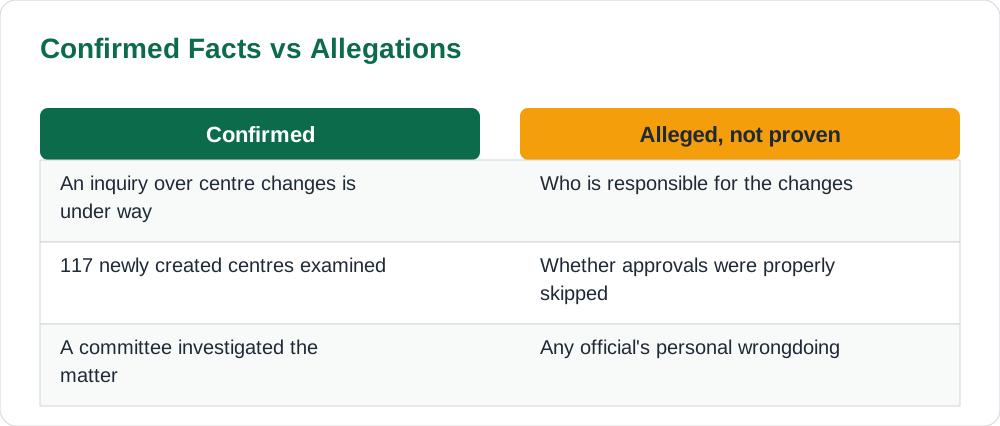
Here is what is confirmed. An anti-corruption inquiry is under way over changes to examination centres during the 2026 matriculation examinations of the Board of Secondary Education Karachi. Details were demanded for 117 newly created centres, including the date of creation, the justification for each centre, candidate allocation, and physical capacity.
A departmental inquiry was ordered by the Sindh Minister for Universities and Boards, Muhammad Ismail Rahu, and a committee including BSEK chairman Professor Musharraf Rajpoot investigated. That is the confirmed framework: an inquiry exists, it concerns centre changes, and it covers 117 newly created centres. Everything beyond that — who did what, and why — must be read with care, because it comes from committee findings and reports, not from proven conclusions.
- An anti-corruption inquiry is under way over BSEK exam centre changes.
- The inquiry concerns the 2026 matriculation examinations.
- Details were demanded for 117 newly created centres.
- A departmental inquiry was ordered by the Sindh Minister for Universities and Boards.
What Is Alleged, Not Proven
News reports describe committee findings that name officials and criticise decisions — but these are allegations and reported findings, not proven facts. According to the committee, the then administrative secretary Dr Naveed Ahmed was reportedly held responsible for administrative negligence, and the controller Ahmed Khan Chutto was reportedly criticised for changing centres without proper approval. The former controller Imran Tariq Butt was described as a central figure in the reports.
Read those sentences carefully: they use reportedly, according to the committee, and was described as. That language matters. An inquiry finding is not a court verdict, and an allegation is not a proven fact. Students should not repeat these claims as settled truth, and should not judge any official on the basis of an unfinished inquiry. What matters for students is not who is blamed, but whether the examination system becomes fairer and more transparent as a result.
- Committee findings are allegations, not proven facts.
- Dr Naveed Ahmed was reportedly held responsible for administrative negligence.
- Ahmed Khan Chutto was reportedly criticised for changing centres without proper approval.
- Imran Tariq Butt was described in reports as a central figure.
Why Exam Centres Matter to Students
Exam centres are not just addresses on a slip. A centre decides how far you travel, how early you must leave, what kind of room you sit in, and how fairly the exam is supervised. When centres are created or changed without clear justification, some students may face long journeys, overcrowded rooms, or uneven supervision — and uneven supervision means the exam is not equally fair for everyone.
That is why an inquiry into centre changes matters even if you never think about administration. A fair exam needs a centre that is properly justified, properly sized for its candidates, and properly supervised. If the inquiry leads to clearer rules for creating and changing centres, every honest student benefits, because the exam becomes more equal. For now, the practical question for students is simpler: how do you make sure you go to the right centre on exam day?
What Students Should Do
The single most important step is to rely on your official centre slip. Your roll number slip and centre slip, issued through your school or the board, tell you where to go. If you hear that your centre has changed, do not act on a rumour — confirm it with your school or the board's official announcements before exam day.
Second, check your slip early and plan your journey. Know the centre's location, how long the trip takes, and what time you must arrive. If anything on your slip looks wrong — a name, a subject, a centre — raise it with your school immediately rather than waiting until exam week. Keep copies of your slips safe, and follow only official announcements about centres. For general exam-day preparation, read our guide on how to manage your time during exams.
- Rely on your official centre slip for your exam centre.
- Confirm any reported centre change with your school or the board.
- Check your slip early and plan your journey to the centre.
- Raise any error on your slip with your school immediately.
What to Watch Next
Inquiries take time, and the outcome here is not yet known. What students should watch for is not the blame game, but the reforms: clearer rules for creating exam centres, transparent justification for any new centre, and better checks on candidate allocation and physical capacity. Those are the changes that would make the next exam season fairer.
Until then, your job is unchanged: study your Sindh Textbook Board books, practise with solved notes, and prepare honestly. Board administration is the board's responsibility; your preparation is yours. If official announcements about centres or procedures appear, your school will pass them on — and this site will explain them in plain language when they do.
- Watch for clearer rules on creating and changing centres.
- Watch for transparent justification of new centres.
- Watch for better checks on capacity and candidate allocation.
- Keep your own preparation steady while the inquiry runs.
AI Help: Muse AI
Muse AI is Meta's personal AI assistant. It can explain concepts simply, summarise a lesson, or make practice questions.
Muse AI can summarise this inquiry story in plain words, explaining the difference between a confirmed fact and an allegation so you can discuss it accurately.
Join Muse with invite code LTGSWD — in the Muse app, go to Settings > Redeem token and enter the code.
Disclosure: LTGSWD is the author's Muse invite code.
Muse AI does not give official Sindh Textbook Board answers — always verify against your Sindh Textbook Board book and your teacher.
5 key points you must know
- An anti-corruption inquiry is under way over BSEK Karachi exam centre changes in the 2026 matriculation exams.
- Details were demanded for 117 newly created centres, including justification, allocation, and capacity.
- Committee findings naming officials are allegations — use reportedly and according to the committee language.
- Students should rely on their official centre slip and confirm any change with their school or the board.
- Fair, well-justified exam centres matter because they make the exam equally fair for everyone.
Frequently asked questions
What is the BSEK Karachi exam centre inquiry about?
An anti-corruption inquiry is under way over changes to examination centres during the 2026 matriculation examinations of the Board of Secondary Education Karachi.
How many centres are involved?
Details were demanded for 117 newly created centres, including the date of creation, justification, candidate allocation, and physical capacity.
Have officials been proven guilty?
No. Committee findings reported in the news are allegations, not proven facts. The inquiry is under way, and allegations should not be repeated as settled truth.
What should I do if I hear my exam centre has changed?
Do not act on a rumour. Confirm it with your school or through the board's official announcements, and rely on your official centre slip.
Does this inquiry change my exam or my syllabus?
No. The inquiry concerns exam centre administration. Your syllabus, exam pattern, and preparation remain the same.
Solved notes — preview free
These guides work best with the solved exercises. Preview the solved notes free on this website — 119 solved notes for Classes 6–10 in Sindhi, Urdu, English and Arabic medium. Or browse the full solved notes catalogue for your class and medium. New solved notes are added regularly — check the catalogue for coming-soon books.