What the BSEK Matric Science Toppers 2026 Teach Us About Study Habits

Every year, the announcement of board position holders creates the same question in thousands of homes: what did the topper do differently? In the BSEK Matric Science Group Result 2026, the first position went to Muhammad Azlan Syed of Falcon House Grammar School, North Karachi, with 1,040 marks, 94.55 percent, and an A1 grade. More than 86,000 students secured A-1 and A grades in total, including 35,529 A-1 grades. This article does not invent details about any topper's daily routine, because no verified account of that routine is available. Instead, it draws honest, general lessons from what top performance requires: steady revision, strong basics, past-paper practice, careful paper presentation, and calm exam-day habits that any student can build.
What We Know About the BSEK Matric Science Top Position 2026
According to the board's announced results, the first position in the BSEK Matric Science Group 2026 went to Muhammad Azlan Syed of Falcon House Grammar School, North Karachi, with 1,040 marks, which is 94.55 percent, and an A1 grade. That is an exceptional result in a year when about 175,200 candidates appeared and about 141,688 passed. We name only the first position here because reports disagree on the exact names and order of the second and third position holders, so naming them would risk spreading an error. Responsible reporting matters as much in education news as in any other news.
The wider picture is just as important as the top mark. More than 86,000 students secured A-1 and A grades in total, including 35,529 A-1 grades. That tells us that high achievement was not limited to one student or one school. Many students across Karachi reached a high standard this year, which means the habits behind strong performance are learnable and repeatable. If you want the full result picture first, read our guide on how to check the BSEK Matric Science result and then return here to build the habits that raise marks steadily over time.
- First position: Muhammad Azlan Syed, Falcon House Grammar School, North Karachi
- Marks: 1,040, which is 94.55 percent, A1 grade
- More than 86,000 students secured A-1 and A grades in total
- A-1 grades alone: 35,529 students
- Second and third positions are not named here because reports disagree
What 1,040 Marks Really Means in Practice
A total of 1,040 marks at 94.55 percent means the topper lost only a small number of marks across all subjects combined. That level of accuracy does not come from a single night of hard work or from memorising one guess paper. It comes from months of steady coverage of the full syllabus, repeated revision of every chapter, and practice in writing complete, well-organised answers under time pressure. It also means very few careless errors, which is a skill in itself. Students who score at the top usually check their work, manage their time in the paper, and avoid the small slips that cost good students ten or twenty marks.
It is also worth remembering that marks measure performance in one examination, not intelligence or worth. A student who scores 850 marks with honest preparation has still achieved something real, and a student who scores less can still improve sharply with better methods. The useful question is not how to copy a topper's life, which we do not know, but how to copy the principles that every strong performance shares. Those principles are visible in classrooms everywhere: teachers who explain basics clearly, students who revise regularly, and practice that matches the real paper pattern.
- 1,040 marks means very few marks lost across all subjects
- Accuracy comes from full syllabus coverage plus repeated revision
- Careful checking and time management prevent careless mark loss
- Marks measure one examination, not intelligence or worth
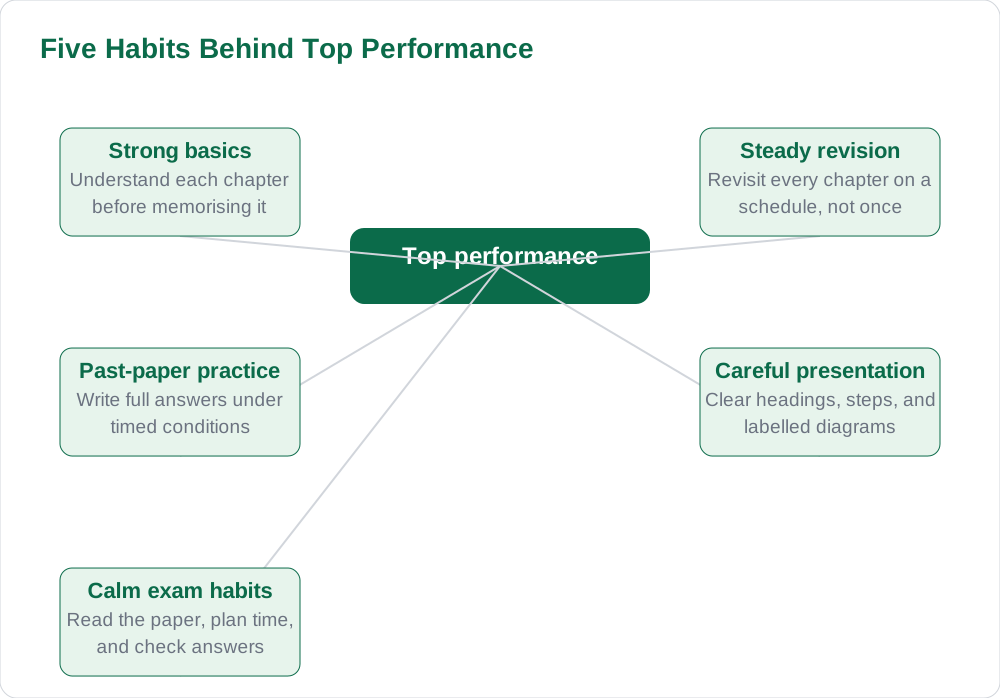
Study Habit 1: Build Strong Basics Before Memorising
The most common mistake in Matric Science is memorising answers without understanding the concept behind them. A student who memorises a Physics numerical without understanding the formula will fail the same question when the numbers change. A student who understands the formula can solve any version of the question. That is why toppers spend more time on understanding than on cramming. For every chapter, first read the textbook explanation, then explain it aloud in your own words, then solve the examples, and only then memorise the definitions and key points that must be exact.
Use your STBB textbooks as the base for every subject, because board papers are set from the board syllabus and the prescribed books. If a chapter confuses you, mark it and ask your teacher rather than skipping it, because skipped chapters become the questions you fear most in the paper. A short daily habit works better than a long weekly session: forty focused minutes on one difficult chapter beats four distracted hours on the night before the test. Keep a small notebook of formulas, definitions, and diagrams you forget, and revise that notebook every evening.
- Read the textbook explanation before memorising any answer
- Explain each concept aloud in your own words
- Solve textbook examples before attempting extra questions
- Keep a notebook of formulas and points you keep forgetting
Study Habit 2: Revise on a Schedule, Not Just Once
Forgetting is normal, and the only reliable cure is scheduled revision. A chapter read once in September is usually half-forgotten by December unless it is revised. Strong students revise each chapter at least three times: once when it is taught, once within a week, and once before the test or examination. Each revision is faster than the first reading, because the brain recognises the material and only needs to strengthen the weak parts. This is why a short daily revision slot beats a single long revision week at the end of the term.
Make your revision active. Instead of only re-reading notes, close the book and write down everything you remember from the chapter, then check what you missed. Solve two or three questions from the chapter without looking at the answer. Draw the diagram from memory and label it. Active recall feels harder than re-reading, but it produces far stronger memory. If you study with friends, test each other with short questions, because explaining an answer to someone else is one of the fastest ways to discover what you do not yet know.
- Revise each chapter at least three times: taught, within a week, before the test
- Use active recall: write from memory, then check what you missed
- Solve two or three questions per chapter without looking at answers
- Test each other with friends and explain answers aloud
Study Habit 3: Practise Papers the Way You Will Sit Them
Many students know the syllabus but lose marks because they have never practised writing a full paper in three hours. Past-paper practice solves that problem. Set a timer, sit without your book, and write complete answers in the same format you will use in the examination. Then mark your own paper honestly, noting where you lost marks: a missing step, an unclear diagram, a rushed final answer, or time spent on one question that starved the rest. That honest marking is where the real improvement happens, because it turns a vague feeling of weakness into a specific list of fixes.
Presentation matters more than students expect. Examiners mark what they can read and follow, so clear headings, numbered steps, neat diagrams, and labelled parts all help. In Science papers, show every step of a numerical, label every diagram, and write the final answer with its unit. In theory questions, open with the definition, explain the idea in two or three sentences, and close with an example where one fits. Practise this structure so often that it becomes automatic, and you will save time and marks on exam day. For more on honest verification, see how boards check results and our study tips collection.
- Practise full papers with a timer and without your book
- Mark your own paper honestly and list exactly where marks were lost
- Show every step in numericals and label every diagram
- Use a fixed answer structure: definition, explanation, example
AI Help: Muse AI
Muse AI is Meta's personal AI assistant, and it can help you build topper-style habits by explaining a difficult Science concept simply, quizzing you on a chapter, or turning your revision notes into practice questions.
Join Muse with invite code LTGSWD — in the Muse app, go to Settings > Redeem token and enter the code.
Disclosure: LTGSWD is the author's Muse invite code.
Muse AI does not give official STBB answers — always verify against your Sindh Textbook Board book and your teacher.
5 key points you must know
- First position: Muhammad Azlan Syed, Falcon House Grammar School, North Karachi, 1,040 marks, 94.55 percent, A1.
- More than 86,000 students secured A-1 and A grades, including 35,529 A-1 grades.
- Top performance rests on understanding, scheduled revision, and timed practice, not last-minute cramming.
- Active recall and honest self-marking turn vague weakness into specific fixes.
- Clear presentation, labelled diagrams, and careful checking protect marks you have already earned.
Frequently asked questions
Who topped the BSEK Matric Science Group Result 2026?
According to the board's announced results, the first position went to Muhammad Azlan Syed of Falcon House Grammar School, North Karachi, with 1,040 marks, 94.55 percent, and an A1 grade.
Why does this article not name the second and third position holders?
Reports disagree on the exact names and order of the second and third position holders, so naming them would risk spreading an error. Only the first position is safe to use from the verified reports.
How many students got A-1 and A grades in the BSEK Matric Science result?
More than 86,000 students secured A-1 and A grades in total, including 35,529 A-1 grades.
What is the single most useful study habit for Matric Science?
Understand each chapter before memorising it, then revise it on a schedule with active recall. Students who do this handle changed questions far better than students who only memorise answers.
How should I practise past papers for Matric Science?
Set a timer, write full answers without your book, then mark your own paper honestly. Note exactly where marks were lost, then fix those specific weaknesses in your next practice session.
Solved notes — preview free
These guides work best with the solved exercises. Preview the solved notes free on this website — 119 solved notes for Classes 6–10 in Sindhi, Urdu, English and Arabic medium. Or browse the full solved notes catalogue for your class and medium. New solved notes are added regularly — check the catalogue for coming-soon books.