Acids, Bases and the pH Scale with Everyday Examples
Lemons taste sharp, soap feels slippery, and both of those everyday sensations are chemistry. Acids, bases, and the pH scale describe how acidic or alkaline a substance is, and once you understand the scale, you start noticing it everywhere: in food, in cleaning products, in soil, and even in your own body. This guide explains acids and bases using safe household substances, so you can learn the ideas without handling dangerous chemicals. We begin with what acids and bases are and how they behave, then move to the pH scale — a number line from 0 to 14 that tells you how acidic or alkaline a solution is. You will learn how indicators reveal pH through colour changes, and how acids and bases cancel each other out in neutralisation. By the end you will be able to classify common household substances, predict what happens when an acid meets a base, and explain why the pH scale is logarithmic. Everything here uses safe, everyday examples; leave concentrated laboratory acids and alkalis to your teacher's demonstrations.
What Are Acids and Bases?
An acid is a substance that produces hydrogen ions (H+) when dissolved in water. Common acids include citric acid in lemons and oranges, ethanoic acid (acetic acid) in vinegar, and carbonic acid in fizzy drinks. Acids taste sour, and strong acids can sting skin and damage materials, which is why you should never taste or touch laboratory acids. A base is a substance that neutralises an acid. An alkali is a base that dissolves in water to produce hydroxide ions (OH-). Common alkalis include baking soda solution and the ammonia in some household cleaners, while soap is mildly alkaline, which is why it feels slippery.
The key point is that acids and bases are defined by their ions in water: acids add H+, alkalis add OH-. When the two meet, the H+ and OH- combine to form water, and that is the heart of neutralisation. Weak acids and weak bases produce only a few ions, so their effects are mild; strong acids and strong alkalis produce many ions and are far more hazardous. Household substances are almost always weak and dilute, which is what makes them safe to observe and useful as examples.
The pH Scale: A Number Line from 0 to 14
The pH scale runs from 0 to 14 and measures how acidic or alkaline a solution is. A pH of 7 is neutral — pure water sits here. Numbers below 7 are acidic, and the lower the number, the stronger the acid: lemon juice is around pH 2, vinegar around pH 3. Numbers above 7 are alkaline, and the higher the number, the stronger the alkali: baking soda solution is around pH 8 to 9, and soap solution is around pH 9 to 10. Knowing these anchor points lets you estimate the pH of most household substances without memorising long tables.
The scale is logarithmic, which means each whole step is ten times stronger than the one before. A solution of pH 3 is ten times more acidic than pH 4, and a hundred times more acidic than pH 5. This is why small pH changes matter so much in nature and in the body: a shift of one or two units can mean a huge change in the concentration of hydrogen ions. When you answer exam questions about pH, always state the number, say whether it is acidic, neutral, or alkaline, and, if asked, explain the ten-times rule.
- pH 0-6: acidic — lemon juice (~2), vinegar (~3), fizzy drinks (~3-4).
- pH 7: neutral — pure water.
- pH 8-14: alkaline — baking soda (~9), soap (~9-10), oven cleaner (very high, hazardous).
- Each whole pH step is a tenfold change in acidity or alkalinity.
Indicators: How We See pH
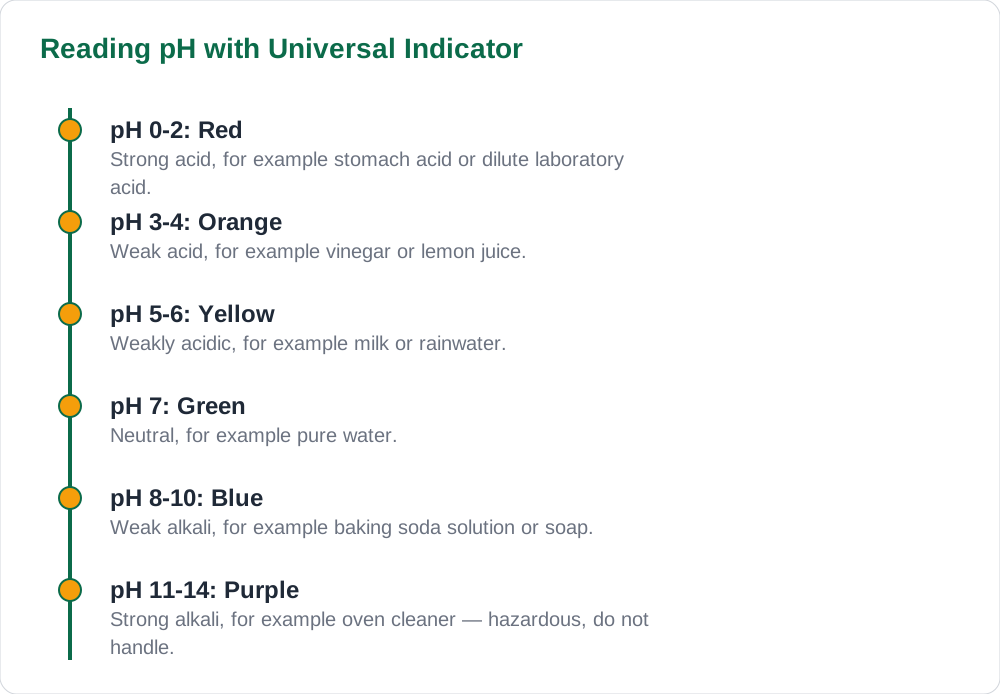
Indicators are dyes that change colour depending on pH. Litmus is the simplest: blue litmus paper turns red in acid, and red litmus paper turns blue in alkali. Universal indicator is more informative because it shows a rainbow of colours across the whole pH range — red for strong acid, orange and yellow for weak acid, green for neutral, blue and purple for alkali. In school you may use universal indicator solution or pH paper to estimate the pH of household liquids such as lemon juice, soap solution, and tap water.
Natural indicators work the same way. Red cabbage juice turns red-pink in acid, purple when neutral, and green-yellow in alkali, and making it is a classic safe classroom activity: chop red cabbage, soak it in hot water, strain, and test drops of household liquids. Whatever indicator you use, always record the colour you observed and the pH it indicates, and never taste the liquids you are testing. For safe, structured write-ups of such experiments, see Lab Report Writing.
Neutralisation: Acid Plus Base
Neutralisation happens when an acid reacts with a base to produce a salt and water. The word equation is simple: acid + base -> salt + water. For example, hydrochloric acid plus sodium hydroxide gives sodium chloride (common salt) plus water. If the acid and base are mixed in the right amounts, the resulting solution is neutral, pH 7. This is why neutralisation is so useful: it cancels out acidity or alkalinity.
Everyday life is full of neutralisation. Antacid tablets neutralise excess stomach acid. Baking soda neutralises the acid in a bee sting or in sour milk spills. Gardeners add lime to neutralise acidic soil. In each case the same chemistry is at work: H+ from the acid and OH- from the base combine to make water, and the remaining ions form a salt. When you write about neutralisation in an exam, always give the word equation, name the salt formed, and explain the pH change.
Staying Safe with Acids and Alkalis
Household acids and alkalis are weak and dilute, but laboratory ones can be dangerous. Never taste any chemical, never add water to a concentrated acid, and always wear eye protection when your teacher demonstrates with strong acids or alkalis. If a chemical splashes on skin, rinse with plenty of running water and tell your teacher at once. Strong acids burn, strong alkalis feel slippery and can also burn, and both can damage eyes, so goggles matter even for short demonstrations.
At home, the safe way to explore pH is with food substances: lemon juice, vinegar, baking soda solution, and soapy water, tested with litmus paper or red cabbage indicator. Keep cleaning products in their original labelled bottles, never mix bleach with acids or with other cleaners, and store everything out of reach of younger children. Good chemistry is careful chemistry — and the habits you build with safe substances now are the same habits that keep you safe in a real laboratory later.
AI Help: Muse AI
Muse AI is Meta's personal AI assistant, and it can help with this topic by turning your household pH observations into a labelled table: list the substance, its indicator colour, and its estimated pH, then ask for a check of your classifications. Muse AI does not give official Sindh Textbook Board answers — always verify against your Sindh Textbook Board book and your teacher.
Join Muse with invite code LTGSWD — in the Muse app, go to Settings > Redeem token and enter the code.
Disclosure: LTGSWD is the author's Muse invite code.
5 key points you must know
- Acids produce H+ ions in water; alkalis produce OH- ions.
- pH 7 is neutral; below 7 is acidic, above 7 is alkaline.
- Each whole pH step is a tenfold change in acidity or alkalinity.
- Indicators reveal pH through colour changes; litmus and universal indicator are the standard pair.
- Neutralisation: acid + base -> salt + water.
Frequently asked questions
What is the difference between a base and an alkali?
A base is any substance that neutralises an acid. An alkali is a base that dissolves in water to give hydroxide ions. All alkalis are bases, but not all bases are alkalis — some bases, like copper oxide, do not dissolve in water.
Why is the pH scale logarithmic?
Each whole-number step on the pH scale represents a tenfold change in hydrogen ion concentration. So pH 3 is ten times more acidic than pH 4 and a hundred times more acidic than pH 5.
What colour does universal indicator turn in acid and alkali?
It turns red in strong acid, orange and yellow in weak acid, green at neutral pH 7, blue in weak alkali, and purple in strong alkali.
What is formed in neutralisation?
A salt and water. The H+ ions from the acid and OH- ions from the base combine to make water, and the remaining ions form the salt.
Is it safe to test household substances for pH?
Testing food substances like lemon juice, vinegar, and baking soda solution with litmus or cabbage indicator is safe. Never taste laboratory chemicals, never mix cleaning products, and always follow your teacher's safety instructions.
Solved notes — preview free
These guides work best with the solved exercises. Preview the solved notes free on this website — 119 solved notes for Classes 6–10 in Sindhi, Urdu, English and Arabic medium. Or browse the full solved notes catalogue for your class and medium. New solved notes are added regularly — check the catalogue for coming-soon books.