Atomic Structure Basics: Protons, Neutrons and Electrons
Everything around you — your desk, your school bag, the air you breathe — is made of tiny particles called atoms. Atomic structure basics in chemistry start with one simple idea: every atom has a small, heavy centre called the nucleus, and much lighter particles moving around it. Once you can picture this structure, many later topics in chemistry become far easier, because the behaviour of an atom depends on how its particles are arranged. In this guide we build that picture step by step, using language you can reuse in class and in exams. You will meet three subatomic particles — protons, neutrons and electrons — and learn how their numbers explain the identity of an element. You will also practise drawing shell diagrams, which are the standard way pupils show how electrons are arranged around the nucleus. By the end, you will be able to describe any simple atom in three numbers: its atomic number, its mass number, and its electron arrangement. Keep a pencil and paper beside you, because drawing each diagram yourself is what turns reading into real understanding.
What Is an Atom?
An atom is the smallest particle of an element that still behaves like that element. A piece of iron can be cut smaller and smaller, but once you reach a single iron atom, cutting further would break it into parts that are no longer iron. Atoms are extremely small — millions of them fit across the width of a single hair — yet everything in chemistry is explained by how atoms join together, rearrange, and exchange particles. For school chemistry, you do not need to memorise every detail of modern atomic theory. You need a clear working model: a nucleus in the middle, and electrons arranged in shells around it.
The word atom comes from an old Greek word meaning uncuttable, because early thinkers believed atoms could not be split. Scientists later discovered that atoms do have smaller parts, called subatomic particles, but the name stayed. For your level, the useful picture is the one used in most school textbooks: protons and neutrons packed together in the nucleus, and electrons in shells at different distances from it. If you can draw that picture and label it, you already understand the core of atomic structure.
Protons, Neutrons and Electrons at a Glance
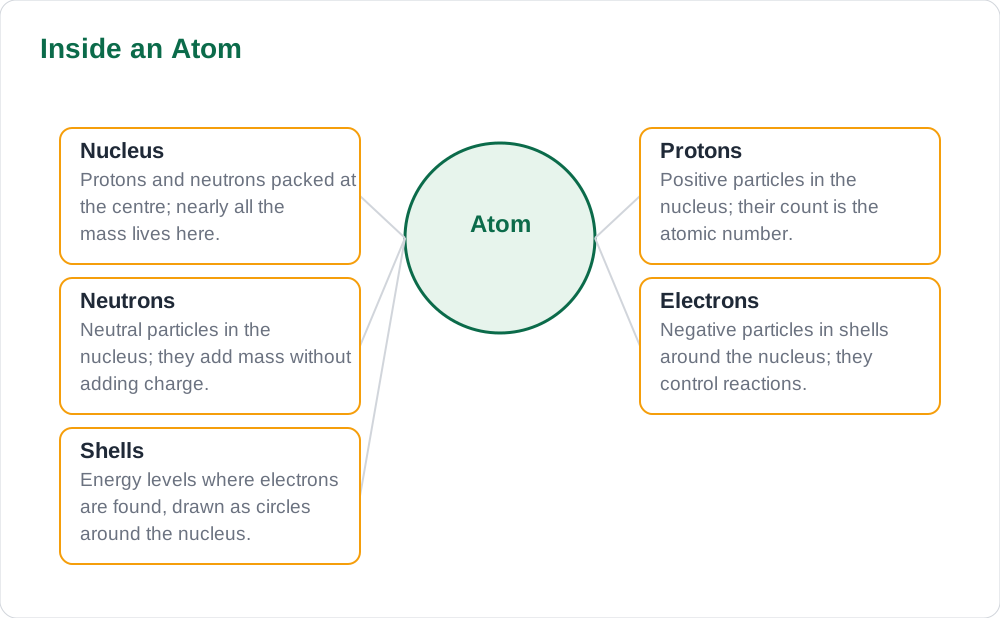
Protons carry a positive charge and sit in the nucleus. Neutrons carry no charge and also sit in the nucleus. Electrons carry a negative charge and move in shells around the nucleus. A normal atom has no overall charge because the number of protons equals the number of electrons, so the positive and negative charges balance. Protons and neutrons are much heavier than electrons; almost all the mass of an atom is in its nucleus, while electrons contribute almost nothing to the mass but almost everything to how the atom reacts.
Two numbers summarise any atom. The atomic number is the number of protons, and it decides which element the atom is: every carbon atom has six protons, every oxygen atom has eight. The mass number is the total number of protons plus neutrons. So if an atom has six protons and six neutrons, its mass number is twelve. The number of neutrons is therefore mass number minus atomic number. This simple subtraction appears in many exam questions, so practise it until it feels automatic.
- Proton: positive charge, in the nucleus, mass of 1 unit.
- Neutron: no charge, in the nucleus, mass of 1 unit.
- Electron: negative charge, in shells, mass almost zero.
- Atomic number = number of protons = number of electrons in a neutral atom.
- Mass number = protons + neutrons; neutrons = mass number - atomic number.
Shells: Where the Electrons Live
Electrons do not sit at random distances from the nucleus. They occupy shells, also called energy levels, which fill in order from the inside out. The first shell, closest to the nucleus, holds at most two electrons. The second shell holds at most eight, and the third shell also holds up to eight for the elements you meet in early chemistry. This 2, 8, 8 pattern is the key to drawing shell diagrams: you always fill the inner shells first, and you never put more electrons in a shell than its limit.
Consider oxygen, atomic number eight. It has eight protons and eight electrons. Two electrons fill the first shell and the remaining six go in the second shell, giving the arrangement 2,6. Sodium, atomic number eleven, has the arrangement 2,8,1: the first two shells are full and one electron sits alone in the third shell. That single outer electron explains why sodium is so reactive. When you draw shell diagrams, always write the atomic number first, then split it into shells using the 2, 8, 8 rule, and only then start drawing.
Drawing Shell Diagrams Step by Step
Start with a small dot or circle in the centre and label it with the element symbol, the number of protons, and the number of neutrons, for example C, 6p, 6n. Then draw one circle around it for the first shell and mark two dots on it if the atom has at least two electrons. Draw a second circle for the next shell and add dots up to eight. Keep going until all the electrons are placed. Spread the dots evenly around each circle so the diagram stays readable, and count the dots at the end to check that the total equals the atomic number.
Common mistakes are easy to avoid once you know them. Do not put more than two electrons in the first shell. Do not leave an inner shell half empty while filling an outer one. Do not forget to label the nucleus, because an unlabelled centre loses marks even when the electrons are right. Practise with the first ten elements — hydrogen to neon — and then try a few larger ones such as magnesium, 2,8,2, and chlorine, 2,8,7. Drawing each diagram yourself, rather than only looking at printed ones, builds the habit that examiners reward. For general exam technique, see How to Avoid Common Exam Mistakes and How to Get A+ in Sindh Board Exams.
Why Atomic Structure Matters in Chemistry
Atomic structure is not a topic to memorise and forget; it explains the rest of chemistry. The number of electrons in the outer shell — the valence electrons — decides how an atom bonds, whether it gains, loses, or shares electrons. Atoms with a full outer shell, like neon with 2,8, are stable and rarely react. Atoms with one or two outer electrons, like sodium and magnesium, tend to lose them. Atoms with six or seven outer electrons, like oxygen and chlorine, tend to gain or share electrons. This is why elements in the same group of the periodic table behave alike: they share the same number of outer electrons.
Atomic structure also explains ions. When an atom loses electrons it becomes a positively charged ion, and when it gains electrons it becomes a negatively charged ion, because the balance between protons and electrons is broken. Sodium loses its single outer electron to become Na+, while chlorine gains one electron to become Cl-. Keep this idea in mind as you move on to bonding, the periodic table, and chemical reactions — each of those topics is really atomic structure applied in a new way. You can explore the living world side of this in Cell Structure and Functions, and practise scientific writing in Lab Report Writing.
AI Help: Muse AI
Muse AI is Meta's personal AI assistant, and it can help with this topic by quizzing you on shell diagrams: ask it for an element, draw the diagram yourself, then check your shell counts against its explanation. Muse AI does not give official Sindh Textbook Board answers — always verify against your Sindh Textbook Board book and your teacher.
Join Muse with invite code LTGSWD — in the Muse app, go to Settings > Redeem token and enter the code.
Disclosure: LTGSWD is the author's Muse invite code.
5 key points you must know
- An atom has a nucleus of protons and neutrons, with electrons in shells around it.
- Atomic number = number of protons; mass number = protons + neutrons.
- Shells fill inside-out with a 2, 8, 8 pattern for early chemistry.
- Outer-shell electrons decide how an atom bonds and reacts.
- Draw shell diagrams yourself: label the nucleus and count every dot.
Frequently asked questions
What is the difference between atomic number and mass number?
The atomic number is the number of protons in an atom and identifies the element. The mass number is protons plus neutrons. Subtract the atomic number from the mass number to find the number of neutrons.
How many electrons fit in the first shell?
The first shell holds at most two electrons. The second and third shells each hold up to eight for the elements studied in early chemistry. Always fill inner shells before outer ones.
Why does a neutral atom have no charge?
A neutral atom has equal numbers of protons (positive) and electrons (negative), so the charges cancel out. Losing or gaining electrons creates a charged particle called an ion.
What are valence electrons?
Valence electrons are the electrons in the outermost shell. They control how an atom bonds. Atoms with a full outer shell are stable; others gain, lose, or share electrons to reach stability.
What should a shell diagram include?
A labelled nucleus showing protons and neutrons, circles for each shell, and dots for electrons adding up to the atomic number. Always count the dots at the end to check your work.
Solved notes — preview free
These guides work best with the solved exercises. Preview the solved notes free on this website — 119 solved notes for Classes 6–10 in Sindhi, Urdu, English and Arabic medium. Or browse the full solved notes catalogue for your class and medium. New solved notes are added regularly — check the catalogue for coming-soon books.