Types of Chemical Reactions with Everyday Examples
A chemical reaction happens when substances change into new substances with different properties. Rusting, burning, cooking, and the fizz of an antacid tablet are all chemical reactions, but they do not all work the same way. Chemists sort reactions into types so that each new reaction you meet can be recognised, predicted, and explained. In this guide we cover the three types you will meet first: combination, decomposition, and displacement reactions. Each type has a simple pattern, a word equation you can write in seconds, and everyday examples you already know. We also show how to tell a chemical change from a physical change, because that distinction sits behind many exam questions. By the end you will be able to look at a reaction description, name its type, write its word equation, and explain what evidence shows that a chemical change happened. Keep your examples concrete — kitchen and lab examples are the ones examiners love, because they prove you understand the chemistry rather than just the definition.
Chemical Change vs Physical Change
A physical change alters appearance or state without making a new substance: melting ice, dissolving sugar, or tearing paper. The change can usually be reversed, and no new substance appears. A chemical change makes one or more new substances with different properties, and it is usually hard or impossible to reverse by simple means. Burning wood makes ash, smoke, and gases that cannot be turned back into wood. Cooking an egg changes its proteins permanently.
Five signs suggest a chemical reaction has taken place: a colour change, a gas being produced (bubbles or fizz), a temperature change without heating or cooling, a solid forming in a liquid (a precipitate), or a new smell. No single sign proves a reaction on its own — dissolving can also cause a temperature change — so look for the strongest evidence: a new substance with new properties. When you answer a question about this, always name the sign you observed and the new substance you think formed.
Combination Reactions: Building Up
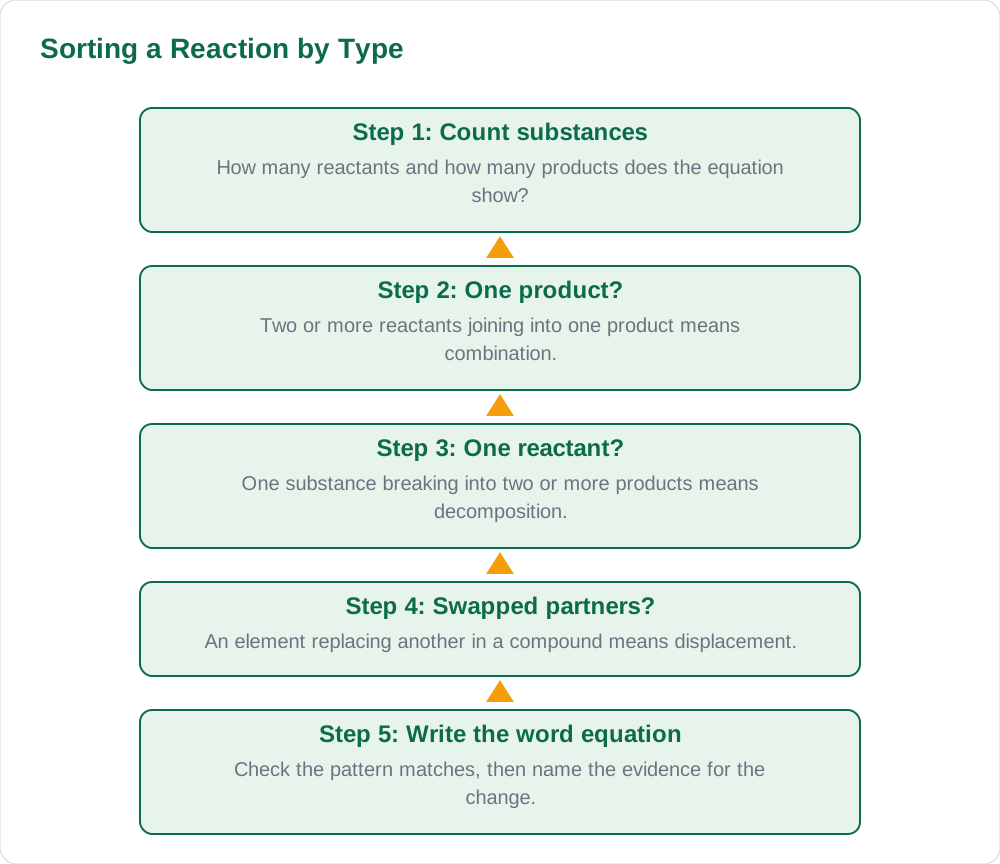
In a combination reaction, two or more substances join to form a single product. The pattern is A + B -> AB. A familiar example is the formation of water from hydrogen and oxygen. Another is magnesium burning in air: magnesium + oxygen -> magnesium oxide, seen as a bright white flame and a white powder product. The rusting of iron is also a combination reaction, though a slow one: iron + oxygen + water -> hydrated iron oxide, the flaky brown substance we call rust.
Combination reactions often release energy, especially heat. That is why burning is a combination reaction with oxygen: fuel + oxygen -> oxides + energy. In the kitchen, the browning of bread in a toaster involves combination reactions between sugars and proteins. When you write a combination word equation, check that the product is a single substance and that the reactants are the simpler substances that joined to make it.
Decomposition Reactions: Breaking Down
Decomposition is the opposite of combination: one substance breaks down into two or more simpler substances. The pattern is AB -> A + B. The breakdown can be caused by heat, light, or electricity. Heating calcium carbonate (limestone) produces calcium oxide and carbon dioxide, a reaction used in making cement. Heating copper carbonate gives copper oxide and carbon dioxide, with a clear colour change from green to black. Electrolysis — passing electricity through a compound — decomposes water into hydrogen and oxygen.
Your own body uses decomposition too: when you eat, enzymes break down large food molecules into simpler ones your body can absorb. In the kitchen, baking powder decomposes when heated, releasing carbon dioxide gas that makes cakes rise. Look for the signature pattern in exam questions: one reactant on the left, two or more products on the right, and a cause such as heat, light, or electricity mentioned in the question.
Displacement Reactions: Swapping Partners
In a displacement reaction, a more reactive element takes the place of a less reactive element in a compound. The pattern is A + BC -> AC + B. A classic classroom example is iron displacing copper from copper sulfate solution: iron + copper sulfate -> iron sulfate + copper. The blue colour of the solution fades and a reddish-brown coating of copper appears on the iron — two clear signs of a chemical change. Zinc displaces copper in the same way, and magnesium displaces hydrogen from acids.
Displacement only works in one direction: a less reactive element cannot displace a more reactive one. Copper will not displace zinc from zinc sulfate, because zinc is more reactive than copper. The reactivity series — a ranking of metals from most to least reactive — predicts which displacements are possible, and it is one of the most useful reference tools in school chemistry. If a question asks whether a displacement will happen, compare the two metals in the reactivity series before you answer.
Writing Word Equations for Each Type
Word equations are the simplest way to show a reaction: name the reactants on the left, an arrow, and the products on the right. For combination, practise: hydrogen + oxygen -> water; calcium + oxygen -> calcium oxide. For decomposition, practise: calcium carbonate -> calcium oxide + carbon dioxide; copper carbonate -> copper oxide + carbon dioxide. For displacement, practise: iron + copper sulfate -> iron sulfate + copper; magnesium + hydrochloric acid -> magnesium chloride + hydrogen.
Three habits make word equations reliable. First, use the correct names — say copper sulfate, not blue liquid. Second, include every product, including gases such as hydrogen or carbon dioxide. Third, check that your equation matches the reaction type you named: one product for combination, one reactant for decomposition, a swapped partner for displacement. Examiners often ask you to name the type and write the equation together, so practise both as a pair, not as separate skills. For careful exam habits, see How to Avoid Common Exam Mistakes and Lab Report Writing.
AI Help: Muse AI
Muse AI is Meta's personal AI assistant, and it can help with this topic by testing your sorting skill: describe a reaction in words and ask it to confirm whether it is combination, decomposition, or displacement, then check its reasoning against the patterns in this article. Muse AI does not give official Sindh Textbook Board answers — always verify against your Sindh Textbook Board book and your teacher.
Join Muse with invite code LTGSWD — in the Muse app, go to Settings > Redeem token and enter the code.
Disclosure: LTGSWD is the author's Muse invite code.
5 key points you must know
- Chemical changes make new substances; physical changes do not.
- Combination: two or more reactants join into one product.
- Decomposition: one substance breaks into two or more products.
- Displacement: a more reactive element replaces a less reactive one.
- Write the word equation and check it matches the reaction type.
Frequently asked questions
What is the pattern of a combination reaction?
Two or more substances join to form one product: A + B -> AB. Example: magnesium + oxygen -> magnesium oxide.
What is the pattern of a decomposition reaction?
One substance breaks into two or more simpler substances: AB -> A + B. The breakdown is usually caused by heat, light, or electricity.
What is the pattern of a displacement reaction?
A more reactive element replaces a less reactive element in a compound: A + BC -> AC + B. Example: iron + copper sulfate -> iron sulfate + copper.
Can copper displace zinc from zinc sulfate?
No, because zinc is more reactive than copper. Displacement only works when the free element is more reactive than the one it replaces, so check the reactivity series.
How do I know a chemical reaction happened?
Look for a colour change, gas production, temperature change, a precipitate forming, or a new smell — and check that a new substance with new properties has appeared.
Solved notes — preview free
These guides work best with the solved exercises. Preview the solved notes free on this website — 119 solved notes for Classes 6–10 in Sindhi, Urdu, English and Arabic medium. Or browse the full solved notes catalogue for your class and medium. New solved notes are added regularly — check the catalogue for coming-soon books.