Metals vs Non-Metals: Properties and Everyday Uses
Pick up a steel spoon and a wooden pencil, and you are holding the two great families of elements in your hand — or at least their everyday representatives. Metals and non-metals are the two main groups into which the elements are divided, and their properties explain why we build bridges from steel, carry water in plastic bottles, and wire our homes with copper. In this guide we compare metals and non-metals property by property: appearance, hardness, conductivity, malleability, and how they behave in chemical reactions. Every property is tied to an object you handle daily, so the comparison is easy to remember and easy to use in exam answers. We also look at the exceptions that examiners love — the non-metal that conducts, the metal that is soft — because a good answer shows you know the pattern and its limits. By the end you will be able to classify an element from its properties, predict its uses, and explain each use in terms of a property.
Appearance and Hardness
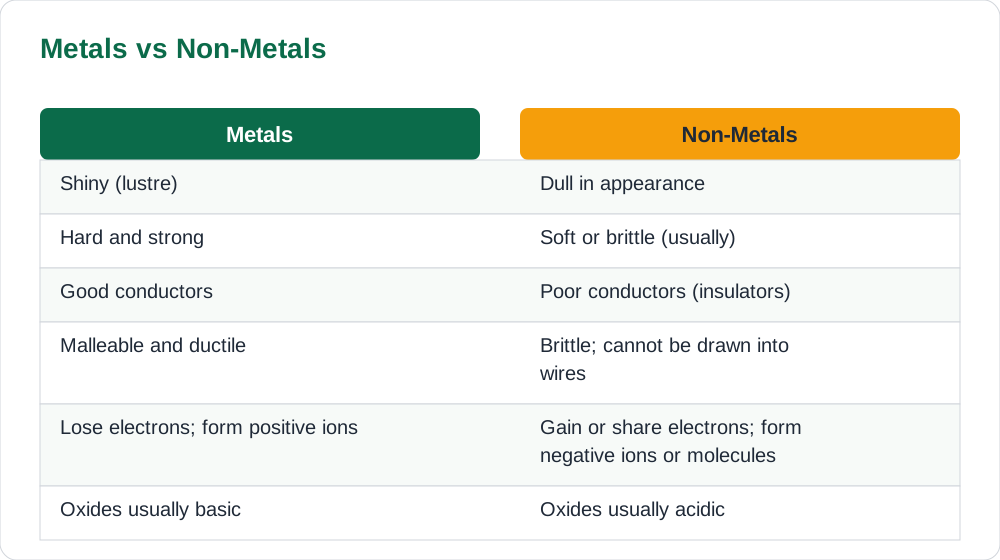
Metals are shiny — they have lustre — when freshly cut or polished. Think of a new coin, a steel spoon, or an aluminium pot. They are usually hard and strong, which is why tools, machines, and building frames are made from them. Non-metals are usually dull in appearance: sulfur is a yellow powder, carbon as charcoal is black and dull, and oxygen is a colourless gas. Most non-metals are soft or brittle when solid — sulfur crumbles, charcoal snaps — though diamond, a form of carbon, is the famous exception and the hardest natural substance known.
These differences come from atomic structure. In metals, outer electrons are free to move through the whole structure, which gives metals their shine and strength. In non-metals, electrons are held tightly in bonds between atoms, so the material is dull and brittle. When you describe appearance in an exam, use the technical words: metals have lustre, non-metals are dull; metals are hard and strong, most solid non-metals are soft and brittle.
Conductivity: Heat and Electricity
Metals are good conductors of heat and electricity because their free electrons carry energy and charge through the material. Copper is used for electrical wires because it conducts electricity extremely well and is ductile enough to be drawn into thin wires. Aluminium and steel cooking pots conduct heat from the stove to the food. Non-metals are usually poor conductors, which makes them useful as insulators: plastic handles on pots stop heat reaching your hand, and rubber coatings on wires stop electricity reaching you.
The great exception is graphite, a form of carbon, which conducts electricity because of its layered structure with free electrons. It is used for electrodes and in pencils, where its softness leaves marks on paper. Examiners often ask about graphite precisely because it breaks the simple rule, so remember it as the non-metal that conducts. When you explain a use in an exam, always link property to purpose: copper is used for wires because it is a good conductor and ductile, not simply because it is a metal.
- Metals: good conductors of heat and electricity (free electrons).
- Non-metals: poor conductors, used as insulators (plastic, rubber, wood).
- Exception: graphite, a non-metal form of carbon, conducts electricity.
- Uses follow properties: copper for wires, plastic for handles and coatings.
Malleable, Ductile or Brittle?
Malleable means can be hammered or rolled into sheets; ductile means can be drawn into wires. Metals are both: gold can be hammered into foil thinner than paper, and copper is drawn into the wires in your home. These properties come from the layers of metal atoms sliding over each other without breaking the metallic bond. Non-metals are neither malleable nor ductile — solid non-metals are brittle, meaning they break or shatter when hit rather than bending. Sulfur cracks under a hammer; charcoal snaps.
These mechanical properties decide how materials are shaped in industry. A jeweller hammers and rolls gold because it is malleable; an electrician pulls copper through dies because it is ductile; a builder never tries to hammer sulfur into a sheet, because it would shatter. In exam answers, use the three words precisely: malleable for sheets, ductile for wires, brittle for breaking. Confusing them is a common mark-loser.
How They Behave in Reactions
Metals tend to lose electrons in reactions, forming positive ions. This is why metals react with acids to release hydrogen gas, and why sodium, a very reactive metal, must be stored away from air and water. Non-metals tend to gain or share electrons, forming negative ions or covalent molecules. Chlorine gains an electron to become chloride; oxygen shares electrons in water and carbon dioxide. The most reactive metals — potassium, sodium, calcium — sit on the left of the periodic table, and the most reactive non-metals — fluorine, chlorine, oxygen — sit on the right.
This difference also shows in oxides. Metal oxides are usually basic: magnesium oxide neutralises acids. Non-metal oxides are usually acidic: carbon dioxide dissolves in water to form a weak acid. These two facts explain many everyday observations, from why lime (a metal oxide) sweetens acidic soil to why fizzy drinks are slightly acidic. When a question asks you to predict reaction behaviour, start from the metal-or-non-metal identity, then apply the electron rule: metals lose, non-metals gain or share.
Uses: From Kitchen to Construction
Everyday objects make the properties concrete. The steel blade of a kitchen knife is hard and strong. The copper wire inside a charger is a good conductor and ductile. The aluminium pot conducts heat. The iron frame of a school gate is strong and can be welded. On the non-metal side, the plastic bottle is light, cheap, and an insulator; the rubber soles of your shoes grip and insulate; the oxygen you breathe and the carbon dioxide plants use are non-metal gases; the sulfur in matches and the iodine in antiseptic are non-metal solids and solutions.
Alloys — mixtures of metals, such as steel (iron plus carbon) and brass (copper plus zinc) — combine the best properties of their ingredients, which is why pure metals are often less useful than their alloys. When an exam asks why a material is used for a job, answer in three parts: name the property, explain why the job needs it, and name the material. For example: overhead cables use aluminium because it is a good conductor and light, so it carries current without weighing down the pylons. That property-to-purpose link is the whole skill. For more on how science vocabulary helps you write these answers, see Science Vocabulary Roots.
AI Help: Muse AI
Muse AI is Meta's personal AI assistant, and it can help with this topic by turning your home into a quiz: name five objects, and ask it to help you classify each material as metal or non-metal with the property that proves it. Muse AI does not give official Sindh Textbook Board answers — always verify against your Sindh Textbook Board book and your teacher.
Join Muse with invite code LTGSWD — in the Muse app, go to Settings > Redeem token and enter the code.
Disclosure: LTGSWD is the author's Muse invite code.
5 key points you must know
- Metals are shiny, hard, strong, and good conductors; non-metals are usually dull, brittle, and poor conductors.
- Metals are malleable and ductile; solid non-metals are brittle.
- Metals lose electrons to form positive ions; non-metals gain or share electrons.
- Metal oxides are usually basic; non-metal oxides are usually acidic.
- Uses follow properties — always link a use to the property that makes it work.
Frequently asked questions
What is the difference between malleable and ductile?
Malleable means a material can be hammered or rolled into sheets; ductile means it can be drawn into wires. Metals are both. Solid non-metals are neither — they are brittle and break instead.
Which non-metal conducts electricity?
Graphite, a form of carbon, conducts electricity because of its layered structure with free electrons. It is the standard exception examiners ask about.
Why are metals good conductors?
Metals have free electrons that move through the whole structure, carrying electrical charge and heat energy as they go. Non-metals hold their electrons tightly in bonds, so they conduct poorly.
Are metal oxides acidic or basic?
Metal oxides are usually basic — magnesium oxide neutralises acids. Non-metal oxides are usually acidic — carbon dioxide forms a weak acid in water.
What is an alloy, and why are alloys used?
An alloy is a mixture of metals (sometimes with a non-metal), such as steel or brass. Alloys combine the best properties of their ingredients, so they are often stronger, harder, or more resistant than the pure metals.
Solved notes — preview free
These guides work best with the solved exercises. Preview the solved notes free on this website — 119 solved notes for Classes 6–10 in Sindhi, Urdu, English and Arabic medium. Or browse the full solved notes catalogue for your class and medium. New solved notes are added regularly — check the catalogue for coming-soon books.