Pre-Medical or Pre-Engineering in Class 11: How to Decide
Class 11 is the first time many pupils must choose a direction that genuinely shapes their future. The choice between pre-medical and pre-engineering is one of the biggest decisions of school life, and it often comes with pressure from family, friends, and teachers. Both groups are respected, both lead to real careers, and both demand hard work. The right choice is not the one that sounds most impressive — it is the one that fits your interests, your strengths, and the kind of work you want to do. This article compares the two groups by subjects, skills, workload, and future options, and offers a calm framework for deciding. It does not tell you which group to pick, and it does not promise any career outcome. The decision is yours, and it should be made with honest information, not with pressure.
What Each Group Actually Studies
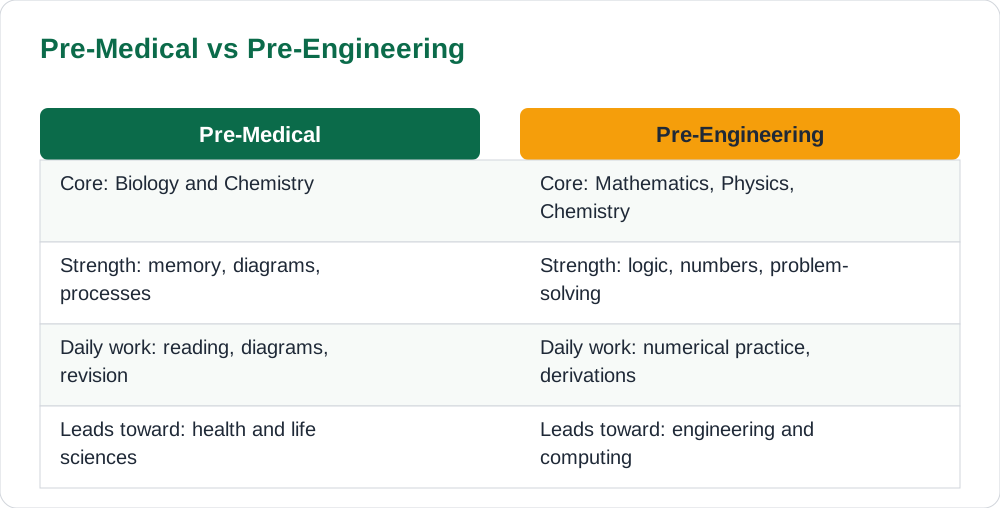
Both groups share several subjects. Pupils in both study Urdu, English, Islamic Studies or Ethics, and Pakistan Studies, along with Mathematics in pre-engineering and a different combination in pre-medical. The defining difference is in the science core: pre-medical centres on Biology and Chemistry, while pre-engineering centres on Mathematics, Physics, and Chemistry.
That difference shapes daily life. A pre-medical pupil spends a great deal of time on living systems — cells, organs, plants, and the human body — and on memorising and understanding biological processes. A pre-engineering pupil spends more time on problem-solving: applying formulas, working through numerical problems, and building mathematical models of physical situations. Neither is easier; they are hard in different ways.
Pre-Medical: Who It Suits
Pre-medical suits pupils who are curious about life, health, and the human body, and who enjoy careful, detailed study. It rewards patience, strong memory, and the ability to connect concepts across chapters — for example, linking cell structure to organ function to whole-body systems. Pupils who enjoy reading, making diagrams, and explaining processes in words often feel at home here.
It also suits pupils who can see themselves working with people in caring roles. The classic destinations are medicine, dentistry, pharmacy, nursing, physiotherapy, and allied health fields, along with biological and agricultural sciences. These paths are long and demanding, and they reward pupils who are motivated by helping others rather than by prestige alone.
Pre-Engineering: Who It Suits
Pre-engineering suits pupils who enjoy mathematics, puzzles, and understanding how things work. It rewards logical thinking, comfort with numbers, and persistence through multi-step problems. Pupils who like building, fixing, designing, or taking things apart often find the group's way of thinking natural.
The classic destinations include civil, mechanical, electrical, and computer engineering, along with architecture, computing, and applied sciences. These paths reward pupils who enjoy turning ideas into working things — bridges, machines, circuits, software, and systems. Like medicine, engineering is a long road that rewards genuine interest more than fashion.
Workload and Study Style: An Honest Comparison
Both groups are heavy. Pre-medical carries a large volume of content to learn and retain, with diagrams, terminology, and processes that must be accurate. Pre-engineering carries a large volume of practice, with numerical problems that require daily drilling to stay sharp. A pupil who dislikes memorisation will struggle in pre-medical; a pupil who dislikes daily numerical practice will struggle in pre-engineering.
The honest question is not which group is harder, but which kind of hard work you can sustain for two years. Think about the subjects where you currently do well without being forced, and about the homework you actually enjoy. That pattern is a better guide than anyone's opinion about which group is better.
A Decision Framework: Four Honest Questions
Instead of asking which group is better, ask four personal questions. First, which subjects do I enjoy most, when nobody is watching? Second, where do my marks and my teachers' feedback point — not one test, but the pattern across Class 9 and 10? Third, what kind of work do I want to do every day — working with people and living systems, or working with machines, structures, and code? Fourth, am I choosing this, or am I being pushed toward it?
Discuss your answers with a teacher who knows your work, and with your parents, honestly. A teacher can tell you whether your interest in a subject is matched by the skills it requires. Your parents can tell you about practical matters such as costs and distance. But the final decision should be one you can own, because you are the one who will do the studying. Strong study habits matter in either group — see how to get an A-plus in Sindh board exams.
- Which science subjects do I genuinely enjoy?
- What does my pattern of marks and teacher feedback show?
- What kind of daily work do I want — people and living systems, or machines and code?
- Am I choosing this freely, or under pressure?
Common Myths to Ignore
Several myths surround this choice. One is that pre-medical is for toppers and pre-engineering is for the rest — false; both groups contain strong and weak pupils, and both demand excellence. Another is that one group guarantees a better future — false; both lead to respected careers, and both can lead to disappointment if chosen without interest. A third is that you can easily switch later without cost — switching is sometimes possible, but it usually means lost time and catching up on a year's syllabus, so it should not be the plan.
The most useful advice is simple: choose the group whose daily work you can sustain, and then commit to it fully. Two years of steady work in the right group beats two years of regret in the wrong one. If you want a wider view of stream choice, see our guide on stream choice for Classes 11 and 12, and browse the books pages for your new subjects.
AI Help: Muse AI
Muse AI is Meta's personal AI assistant. If you are choosing between pre-medical and pre-engineering, you can ask Muse AI to explain what each group's subjects involve, or to help you list your own strengths and interests before you discuss the choice with a teacher. Muse AI does not give official Sindh Textbook Board answers — always verify against your Sindh Textbook Board book and your teacher.
Join Muse with invite code LTGSWD — in the Muse app, go to Settings > Redeem token and enter the code.
Disclosure: LTGSWD is the author's Muse invite code.
5 key points you must know
- Pre-medical centres on Biology and Chemistry; pre-engineering centres on Mathematics, Physics, and Chemistry.
- Choose by interest and strengths, not by prestige or pressure.
- Pre-medical rewards memory, diagrams, and understanding living systems.
- Pre-engineering rewards logic, numerical practice, and problem-solving.
- Discuss the choice honestly with a teacher and your parents before deciding.
Frequently asked questions
Which is harder: pre-medical or pre-engineering?
Both are demanding in different ways. Pre-medical carries a large volume of content, diagrams, and terminology to retain. Pre-engineering carries a large volume of numerical practice. The better question is which kind of hard work you can sustain for two years.
Can I switch groups after Class 11?
Switching is sometimes possible, but it usually means lost time and catching up on a year's syllabus in the new group's subjects. It should not be the plan. Choose carefully at the start, with honest advice from a teacher.
Does pre-medical only lead to becoming a doctor?
No. Pre-medical can lead to dentistry, pharmacy, nursing, physiotherapy, allied health fields, and biological and agricultural sciences, among others. Medicine is one destination, not the only one.
Does pre-engineering only lead to engineering?
No. Pre-engineering can lead to various engineering fields, architecture, computing, and applied sciences. The group's mathematics and physics foundation is useful across many technical careers.
What if my parents want one group and I want the other?
Have an honest conversation, ideally with a teacher present who knows your work. Share your interests, your marks pattern, and the kind of daily work each group involves. A decision made together, with facts, is easier to sustain than one made under pressure.
Solved notes — preview free
These guides work best with the solved exercises. Preview the solved notes free on this website — 119 solved notes for Classes 6–10 in Sindhi, Urdu, English and Arabic medium. Or browse the full solved notes catalogue for your class and medium. New solved notes are added regularly — check the catalogue for coming-soon books.