A Simple Daily Reading Routine for Class 1 and 2 Sindh Textbook Board Pupils
A class 1 2 reading routine Sindh Textbook Board pupils can actually enjoy does not need long homework or extra books. Fifteen calm minutes a day, built around the child's own reader, does more for reading than an hour of forced practice once a week. The routine below works for Sindhi, Urdu, and English readers alike, because it follows the same simple pattern: an adult reads, the child talks, and then the child reads a little. Parents who keep this routine steady for a few weeks usually see the biggest change of all — the child starts to pick up the book without being told.
Why Short and Daily Beats Long and Rare
Young children learn to read through repetition, not through marathon sessions. A six-year-old can concentrate hard for about ten to fifteen minutes, and after that the effort turns into tears or daydreaming. Short daily practice fits inside that attention window, so every minute counts. It also builds a habit: reading becomes something that happens after lunch or before dinner, like washing hands, rather than a punishment that appears when marks drop.
Daily practice also gives the child many small wins. Each day they recognise one new word, or read one line without help, and that small success makes the next day easier. A long weekly session, by contrast, usually ends with the child forgetting most of it before the next session begins. If you only have ten minutes, use ten minutes well — the routine below shows how.
The 15-Minute Reading Routine, Step by Step
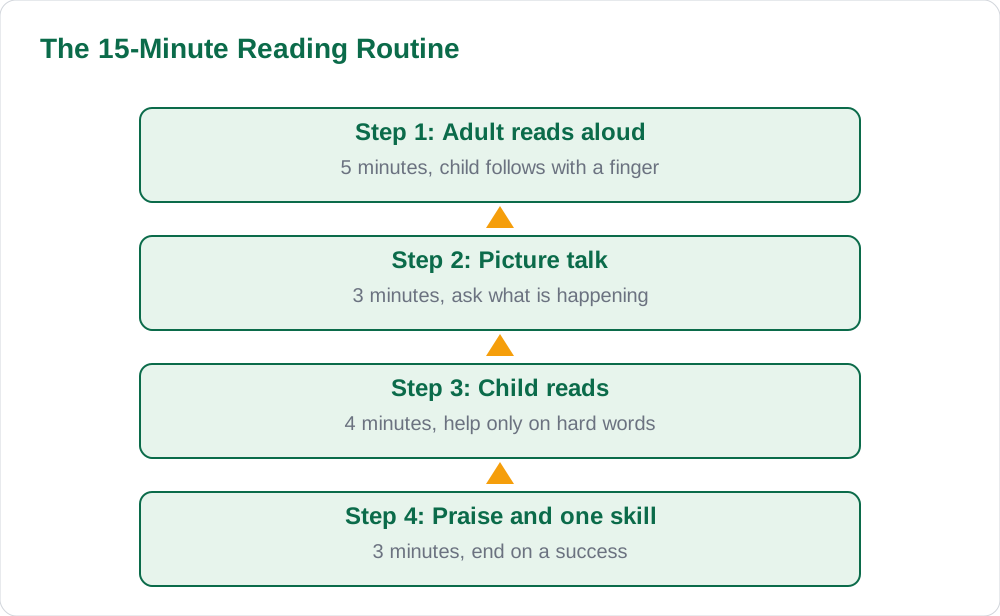
Keep the same four steps every day so the child knows what is coming. A predictable routine removes the fear of the unknown, and the child can relax into the reading instead of worrying about what will be asked next. The exact minutes are a guide, not a rule — if the child is enjoying the story, let the story run a little longer.
- Minutes 1 to 5: the adult reads aloud while the child follows the words with a finger.
- Minutes 6 to 8: talk about the pictures — what is happening, what might happen next.
- Minutes 9 to 12: the child reads a short part, with gentle help on hard words.
- Minutes 13 to 15: praise one thing the child did well, and practise one small skill.
Read Aloud First, Then Read Together
Always begin by reading to the child, even if the child can already read some words. Hearing a fluent reader shows the child how the story should sound — where to pause, where the voice rises, and how sentences flow. Point to each word as you read so the child begins to match the spoken word to the printed word. This is the single most useful thing a parent can do for a beginning reader.
When it is the child's turn, let them read a short passage they have just heard. Familiar text is easier, so the child experiences success instead of struggle. When they get stuck, wait three seconds, then give the first sound of the word rather than the whole word. If the word is still too hard, say it yourself and move on — the goal is to keep the story moving, not to turn every page into a test.
- Point to the words while you read aloud, so the child connects print and sound.
- Let the child re-read a passage they have just heard — familiar text builds confidence.
- Wait three seconds before helping, then give the first sound, not the whole word.
Talk About the Pictures Before the Words
In early Sindh Textbook Board readers, the pictures carry half the meaning. Before the child reads a page, spend a minute looking at the picture together. Ask simple questions: Who is in the picture? What are they doing? What do you think will happen next? These questions teach the child that reading is about understanding, not just saying words aloud. A child who predicts what comes next is already practising comprehension, long before any written exercise asks for it.
Picture talk also gives children words for things they see every day — a hen, a clay pot, a mango tree, a school bag. When those words appear in the text, the child already knows what they mean. This is especially helpful for children learning in a second or third language, because the picture gives them the meaning without translation. For more ideas on making study time effective, see our guide on how to make notes from Sindh Textbook Board books.
One Small Skill a Day
End each session with one tiny skill, and only one. On Monday it might be the sound of a new letter. On Tuesday it might be spotting all the words that start with that letter on the page. On Wednesday it might be reading three familiar words quickly. One skill a day feels easy, and over a month it adds up to thirty skills — far more than a child learns from a single crowded worksheet.
Keep a small notebook where you write the date and the one skill practised. This record helps you see progress, and it shows the child's teacher exactly what has been covered at home. It also prevents the common mistake of drilling the same easy words while the hard ones are never touched. If you want a wider look at the books your child is using, browse the Sindh Textbook Board books collection and the solved notes for older classes.
- Choose one skill per day: a letter sound, a sight word, or a short pattern.
- Write the date and the skill in a small notebook to track progress.
- Return to a hard skill after two days rather than drilling it until the child cries.
AI Help: Muse AI
Muse AI is Meta's personal AI assistant. It can explain concepts simply, summarise a lesson, or make practice questions for your child's level.
For this reading routine, you can ask Muse AI to suggest five easy picture-talk questions for a story your child is reading, or to make a short list of simple words to practise this week.
Join Muse with invite code LTGSWD — in the Muse app, go to Settings > Redeem token and enter the code.
Disclosure: LTGSWD is the author's Muse invite code.
Muse AI does not give official Sindh Textbook Board answers — always verify against your Sindh Textbook Board book and your teacher.
5 key points you must know
- Fifteen calm minutes every day beats one long weekly session for young readers.
- Read aloud first, then let the child re-read familiar text for confidence.
- Picture talk builds comprehension before any written exercise.
- Practise one small skill per day and record it in a notebook.
- End every session with praise so the child wants to return tomorrow.
Frequently asked questions
How long should a Class 1 or 2 pupil read each day?
About fifteen minutes is enough. Young children concentrate best in short bursts, and a daily fifteen-minute routine builds habit and confidence far better than long occasional sessions.
What if my child cannot read a word at all?
Wait three seconds, give the first sound, and if it is still too hard, say the word yourself and keep going. The goal is to keep the story moving and the child relaxed, not to turn every word into a test.
Should I correct every mistake my child makes while reading?
No. Correct only mistakes that change the meaning of the sentence. Small slips that do not change meaning can be ignored in the moment and revisited later, so the child keeps reading with confidence.
Which Sindh Textbook Board reader should we start with?
Start with the reader your child's school is currently using, so home practice matches classroom lessons. You can check the Sindh Textbook Board books collection to see which readers belong to your child's class.
What if my child hates reading time?
Shorten the session to five minutes, choose a funnier or more colourful page, and let the child choose the book. Praise effort, not perfection, and never use reading as a punishment — the habit grows when reading time feels safe.
Solved notes — preview free
These guides work best with the solved exercises. Preview the solved notes free on this website — 119 solved notes for Classes 6–10 in Sindhi, Urdu, English and Arabic medium. Or browse the full solved notes catalogue for your class and medium. New solved notes are added regularly — check the catalogue for coming-soon books.