How Young Learners Build Neat Urdu and Sindhi Letter Formation

Urdu Sindhi letter formation class 3 4 pupils practise every day is a skill that pays off in every subject, because neat writing makes answers easier to read and easier to mark. Many children in Class 3 and 4 know what they want to write, but their letters lean the wrong way, sit on the wrong line, or join up in ways that confuse the reader. The good news is that letter formation is a motor skill, and motor skills improve with short, correct practice — not with long pages of copying done the wrong way. This guide shows a simple method: teach the stroke order, practise on lines, and drill a little every day.
Why Stroke Order Matters More Than Speed
Every Urdu and Sindhi letter has a natural stroke order — the order and direction in which the pen moves. When a child follows that order, the letter forms itself: the curve lands in the right place, the dot sits above or below the right part, and joined letters connect cleanly. When a child invents their own order, the letter may look right once, but it will wobble under speed, and joined writing in later classes becomes a tangle.
Stroke order also matters because Urdu and Sindhi letters change shape depending on position — a letter looks different at the start, middle, and end of a word. A child who has practised the correct strokes can produce each shape without stopping to think. The practical rule is simple: slow and correct first, speed later. A child who writes ten letters correctly learns more than a child who rushes through a hundred the wrong way.
Teach One Letter Family at a Time
Urdu and Sindhi letters fall into families of similar shapes, and teaching by family is far more efficient than marching through the alphabet in order. For example, the letters that share the basic curved bowl shape can be taught together, so the child learns one stroke pattern and then adds the dots that make each letter different. This turns a list of dozens of letters into a handful of shapes with variations.
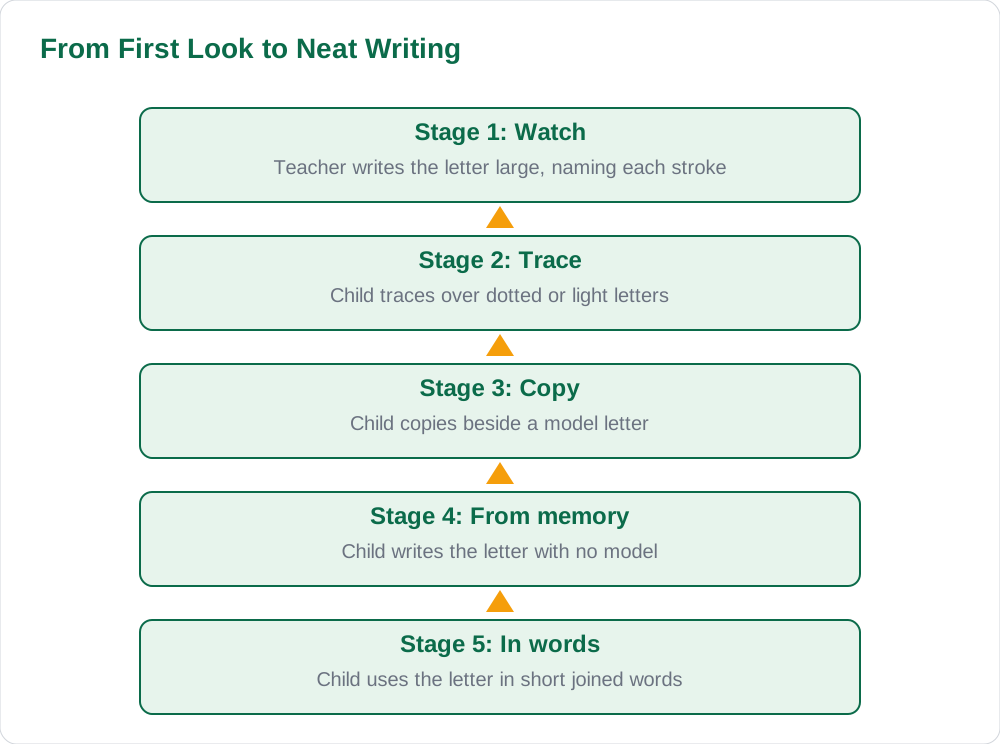
Within each family, teach the isolated form first, then the joined forms. Show the child the letter large — on a board, on a big sheet of paper, or traced in the air — and say the stroke directions out loud: start here, curve down, lift, dot. Then let the child trace it, then copy it, then write it from memory. Only when one family is steady should you move to the next. For guidance on avoiding common errors, see how to avoid common exam mistakes.
- Group letters by shape family, not by alphabet order.
- Teach isolated form first, then start, middle, and end joined forms.
- Say stroke directions aloud while demonstrating each letter large.
Lined Practice: The Line Is the Teacher
Urdu and Sindhi sit on a line, and the line is what keeps writing neat. Letters hang from the line or sit on it in fixed ways, and dots and marks have their own places. Practising on plain paper removes this guide, so children drift upward or downward across the page. Lined paper — or a notebook with a ruled line drawn across — gives the child a constant reference, and neatness improves almost immediately.
Use four-line practice for beginners: a top line, the main line the letters sit on, and guide lines for the parts that go below. Draw the lines in pencil so the child can see the letter's home. As the child improves, move to single-line paper, then to the ordinary notebook lines used in school. A short daily drill of five minutes on lines is worth more than a full page of unguided copying.
Short Daily Drills That Actually Work
The best drill is short, focused, and daily. Ten minutes is plenty. A useful pattern is: two minutes of warm-up tracing, five minutes of focused writing on one letter family, and three minutes of writing that family inside real words. End with the child circling their own neatest letter on the page — this trains the eye to recognise good formation, which is the first step to producing it.
Rotate the drill across the week so every family gets attention: one family on Monday and Thursday, another on Tuesday and Friday, and short words on Wednesday. Keep old drill pages in a folder so the child can flip back and see their own improvement. Nothing motivates a Class 3 pupil like seeing last month's wobbly letters next to this month's steady ones. If handwriting is a wider concern, our guide on how to improve handwriting for board exams has more techniques that also work for younger pupils.
- Warm up with two minutes of tracing before writing from memory.
- Drill one letter family per session, then use it inside real words.
- Let the child circle their neatest letter — self-checking builds an eye for good form.
Common Problems and Gentle Fixes
Dots in the wrong place are the most common problem in Urdu and Sindhi writing, because a single dot changes one letter into another. Teach dots as part of the letter, not as an afterthought: the child writes the body and the dot together, in one motion of attention. A useful trick is to have the child say the dot count aloud while writing — one dot, two dots — until the habit is automatic.
Reversed shapes and letters that float above the line are the next most common issues. Both are fixed by the same medicine: back to large, slow, correct strokes on lined paper for a few days. Never punish messy writing; instead, ask the child to rewrite only the three messiest words on the page, neatly. Rewriting three words feels fair. Rewriting a whole page feels like punishment, and it teaches the child to hate writing. For a broader look at steady study habits, the blog has more study tips for primary and middle classes.
AI Help: Muse AI
Muse AI is Meta's personal AI assistant. It can explain concepts simply, summarise a lesson, or make practice questions for your child's level.
For letter formation, you can ask Muse AI to list Urdu and Sindhi letters grouped by shape family, so you can plan one family per drill session.
Join Muse with invite code LTGSWD — in the Muse app, go to Settings > Redeem token and enter the code.
Disclosure: LTGSWD is the author's Muse invite code.
Muse AI does not give official Sindh Textbook Board answers — always verify against your Sindh Textbook Board book and your teacher.
5 key points you must know
- Correct stroke order matters more than speed — slow and correct first.
- Teach letters by shape family, isolated form first, then joined forms.
- Always practise on lined paper so letters sit in their proper place.
- Ten minutes of focused daily drill beats a full page of rushed copying.
- Fix dots and reversed shapes with large, slow practice — never punishment.
Frequently asked questions
At what age should children learn joined Urdu and Sindhi writing?
Most children in Class 3 and 4 are ready for joined writing once their isolated letters are steady. Start with two-letter joins from one letter family, then build to short words — rushing into full joined sentences too early creates tangled habits.
How do I teach a left-handed child Urdu and Sindhi letter formation?
Use the same stroke order, but let the child tilt the paper slightly and keep the wrist straight rather than hooked. Sit on the child's left when demonstrating so the writing hand does not block their view of the letter.
My child writes fast but messily. Should I slow them down?
Yes, for practice sessions. Speed without control produces letters even the child cannot read back. Set a rule for drills: neat first, then faster. Speed will return naturally once the correct strokes are automatic.
Are dotted tracing worksheets useful?
They are useful as a warm-up for two or three minutes, but tracing alone does not teach independent writing. Always follow tracing with copying beside a model, then writing from memory in the same session.
How long before I see neater writing?
With ten minutes of correct daily practice, most Class 3 and 4 pupils show clear improvement within three to four weeks. Check progress by comparing drill pages from the first week with the current week, not by expecting perfection overnight.
Solved notes — preview free
These guides work best with the solved exercises. Preview the solved notes free on this website — 119 solved notes for Classes 6–10 in Sindhi, Urdu, English and Arabic medium. Or browse the full solved notes catalogue for your class and medium. New solved notes are added regularly — check the catalogue for coming-soon books.