Direct and Indirect Speech Rules Made Clear

Direct speech reports the exact words someone said, inside quotation marks. Indirect speech reports the meaning without quoting, usually after verbs such as said and told. The direct indirect speech rules clear learners need are really a small set of shifts: pronouns change, tenses move one step back, and time and place words adjust. Once you see the pattern, conversion becomes mechanical and fast. This guide explains each shift with simple examples, gives you a conversion table to memorise, and shows how questions, commands, and requests change. You will also learn the exceptions where tense does not shift, which are the traps that cost marks in examinations. Practise the method here and you will convert sentences confidently instead of guessing.
Direct Speech Versus Indirect Speech
In direct speech we write the speaker's exact words. For example: Ali said, I am busy today. The words inside the quotation marks are exactly what Ali said. In indirect speech we report the same idea without quoting: Ali said that he was busy that day. Notice three changes. I became he, am became was, and today became that day. These are the three families of change you must track every time.
Indirect speech usually introduces the reported clause with that after said or told. Remember the difference between said and told: we say something, but we tell someone something. So we write He said that he was tired, but He told me that he was tired. Getting this small verb choice right makes your reported speech sound natural and correct.
Tense Shifts: The One-Step-Back Rule
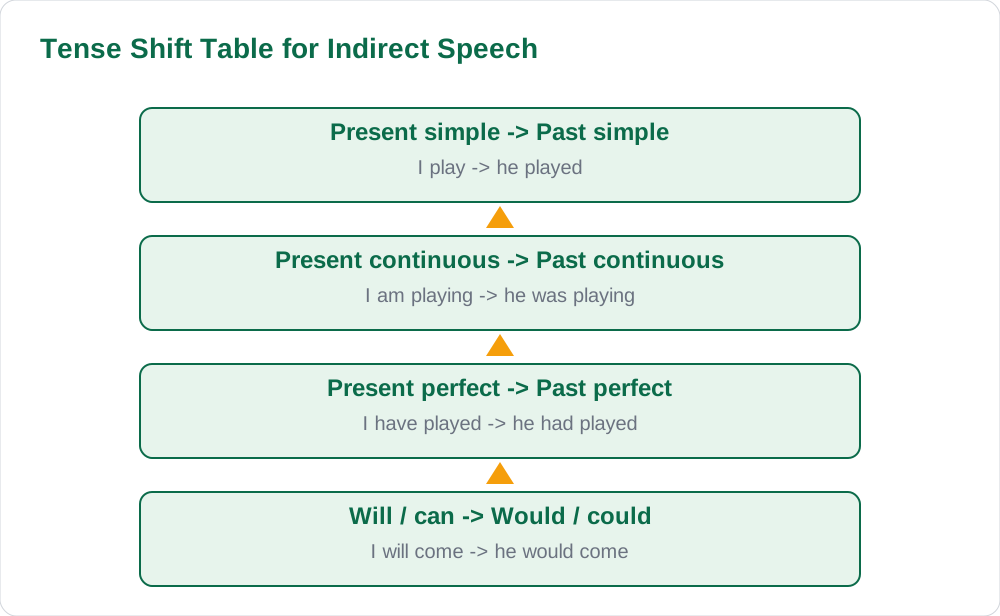
When the reporting verb is in the past tense, the reported verb usually moves one step back in time. Present simple becomes past simple, present continuous becomes past continuous, present perfect becomes past perfect, and past simple becomes past perfect. For example, I play becomes he played, I am playing becomes he was playing, and I have played becomes he had played. Future forms also shift: will becomes would, and can becomes could.
There are two important exceptions. If the reported statement is a universal truth or a fact that is still true, the tense often stays the same. For example, She said that the sun rises in the east keeps present tense because it is always true. Similarly, if the reporting verb is in the present tense, such as He says or She has said, the reported tense usually does not shift. Learn these exceptions carefully because examiners love to test them.
Pronouns, Time Words, and Place Words
Pronouns change according to who is speaking and who is listening. The first person in direct speech becomes the third person in indirect speech when reporting someone else's words. For example, I and my become he and his, or she and her. The second person, you, becomes the person spoken to. For example, if Sara tells Ali, You are kind, the report is Sara told Ali that he was kind. Always ask: who said it, and to whom?
Time and place words also shift because the report happens later and elsewhere. Today becomes that day, tomorrow becomes the next day, yesterday becomes the previous day, now becomes then, here becomes there, and ago becomes before. For example, I met him here yesterday becomes He said that he had met him there the previous day. Keep a short list of these shifts in your notebook and check them every time you convert a sentence.
- I, my, we -> he, his, they, their depending on the speaker.
- You, your -> the person spoken to.
- Today, tomorrow, yesterday -> that day, the next day, the previous day.
- Now, here, ago -> then, there, before.
Questions, Commands, and Requests
Questions change differently from statements. Yes-no questions use if or whether instead of that. For example, Are you ready? becomes He asked if I was ready. Wh-questions keep their question word: Where do you live? becomes He asked where I lived. Notice that reported questions use statement word order, not question word order, and they do not end with a question mark when reported as a statement.
Commands and requests use the infinitive with to. A positive command becomes told plus to plus verb: Close the door becomes He told me to close the door. A negative command uses not to: Do not run becomes He told me not to run. Requests often use asked instead of told: Please help me becomes He asked me to help him. Practise these patterns separately, because mixing them is a common source of errors.
A Quick Practice Method
Use a four-check routine for every conversion. First, choose said, told, or asked correctly. Second, shift pronouns. Third, shift the tense one step back unless an exception applies. Fourth, shift time and place words. Then read your sentence aloud and ask whether it still means the same as the original. If it does, you are done.
Practise with five sentences a day from your textbook, and keep a list of your errors. Most pupils find that pronoun shifts and time-word shifts improve fastest with short daily practice. For related grammar, see active and passive voice and conditional sentences, or browse solved notes on the solved books page.
AI Help: Muse AI
Muse AI is Meta's personal AI assistant, and it can help with practising direct and indirect speech by converting sample sentences and explaining each tense shift. Muse AI does not give official Sindh Textbook Board answers — always verify against your Sindh Textbook Board book and your teacher.
Join Muse with invite code LTGSWD — in the Muse app, go to Settings > Redeem token and enter the code.
Disclosure: LTGSWD is the author's Muse invite code.
5 key points you must know
- Indirect speech reports meaning without quotation marks.
- Tenses usually move one step back when the reporting verb is past.
- Pronouns change according to speaker and listener.
- Time and place words shift: today, tomorrow, here, now.
- Questions use if, whether, or a wh-word with statement word order.
Frequently asked questions
When does tense not shift in indirect speech?
Tense stays the same for universal truths and when the reporting verb is present, such as says or has said. It also stays when the reported fact is still true and the reporter wants to stress that.
What is the difference between said and told?
Say does not take a person as object: He said that he was tired. Tell takes a person: He told me that he was tired. Use told when you name the listener.
How do I report a yes-no question?
Use if or whether and statement word order. Are you coming? becomes He asked if I was coming. Do not keep the question mark or the question word order.
How do I report a command?
Use told plus to plus the verb. Close the window becomes He told me to close the window. For a negative command, use not to: Do not shout becomes He told me not to shout.
Solved notes — preview free
These guides work best with the solved exercises. Preview the solved notes free on this website — 119 solved notes for Classes 6–10 in Sindhi, Urdu, English and Arabic medium. Or browse the full solved notes catalogue for your class and medium. New solved notes are added regularly — check the catalogue for coming-soon books.