English-Medium Maths: The Language of Word Problems
Many pupils who are good at calculations still struggle with word problems. The difficulty is often not the maths, but the English. A problem that says Maria had twelve pencils and gave away four uses the same subtraction as twelve minus four, yet the words can hide the operation. Pupils need to learn the language of word problems: clue words for addition, subtraction, multiplication, and division, and the habit of restating the problem in their own words before solving. This guide explains the most common clue words, shows how to turn a word problem into a number sentence, and gives a checking routine that catches careless mistakes.
Why Word Problems Feel Harder Than Sums
A bare sum such as 24 divided by 6 tells the pupil exactly what to do. A word problem hides the same operation inside a story. The pupil must read the story, decide what is known, decide what is asked, choose the operation, and then calculate. That is four jobs at once, so it is normal for word problems to feel harder. Pupils who rush to calculate often pick the wrong operation. Pupils who slow down and restate the story usually choose correctly. The goal is not to read faster, but to read with a plan.
In English-medium maths classes in Sindh, pupils also meet words that have one meaning in daily life and a sharper meaning in maths. For example, difference in daily talk can mean any kind of change, but in maths it means the result of subtraction. Product in daily talk can mean something made in a factory, but in maths it means the result of multiplication. Teachers should point out these double meanings directly. Pupils can keep a maths word bank in their notebook with a plain English meaning and one example for each term. For more worked practice, pupils can check the solved notes and the books for their class.
- Word problems require reading, choosing, calculating, and checking, not just calculating.
- Many maths words have a daily meaning and a sharper maths meaning.
- Restating the problem in your own words is the most reliable first step.
Clue Words for Each Operation
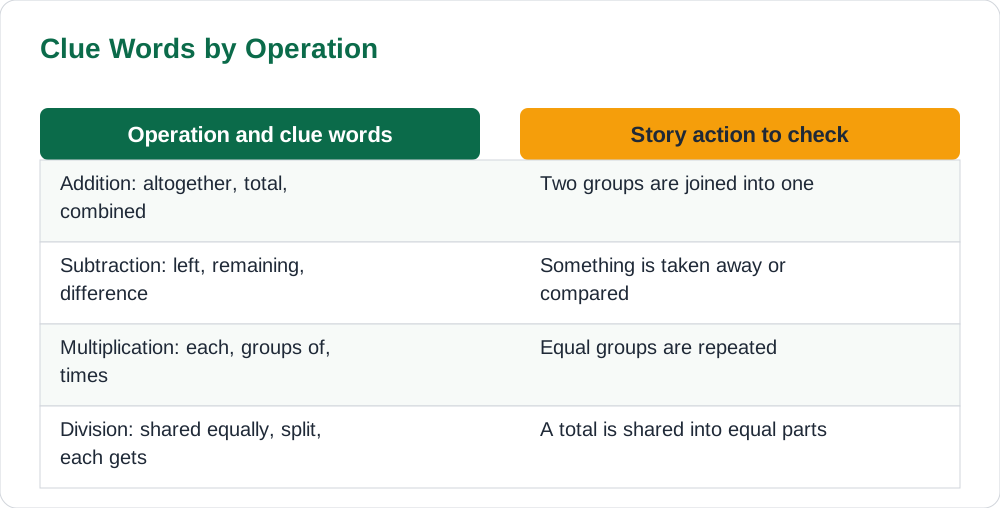
Clue words are not perfect rules, but they are useful signposts. Addition clue words include altogether, in all, total, sum, combined, and more than. Subtraction clue words include left, remaining, fewer than, difference, how many more, and gave away. Multiplication clue words include each, every, groups of, times, twice, and per. Division clue words include shared equally, split, each gets, average, per, and divided among. Pupils should learn these words in groups, with one example sentence for each group, rather than as a long mixed list.
Clue words work best when pupils also ask what the story is doing. If the story joins two groups, it is likely addition, even if no clue word appears. If the story takes away or compares, it is likely subtraction. If the story repeats equal groups, it is likely multiplication. If the story shares or splits into equal parts, it is likely division. Teachers can give pupils a set of word problems with the numbers covered and ask them to name the operation only. That exercise trains the reading skill without the pressure of calculating. Pupils can also practise with problems from the blog study guides and their own textbook exercises.
- Addition: altogether, in all, total, sum, combined, more than.
- Subtraction: left, remaining, fewer than, difference, gave away.
- Multiplication: each, every, groups of, times, twice, per.
- Division: shared equally, split, each gets, divided among.
Restate the Problem Before You Solve
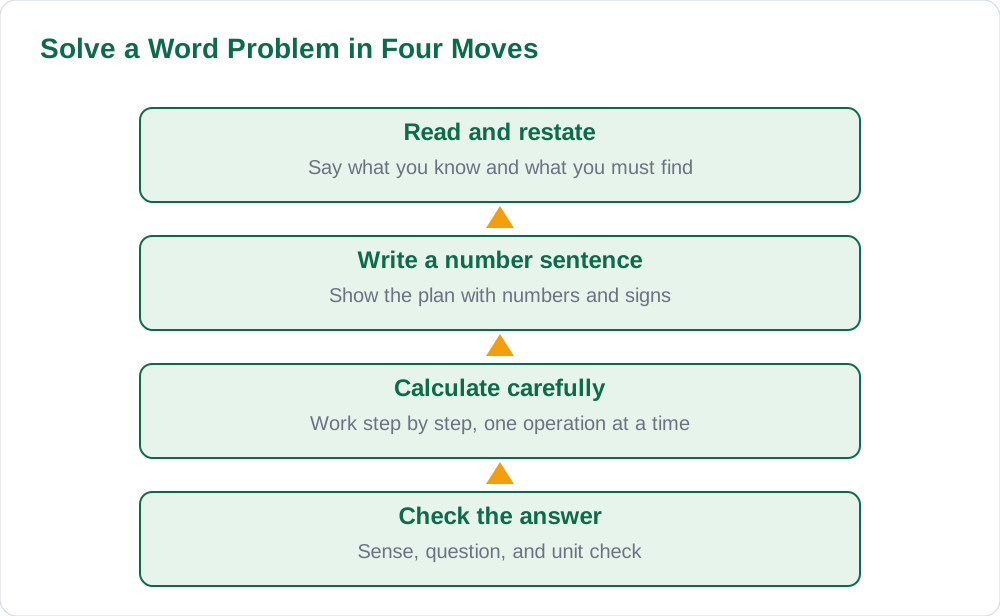
Restating means saying the problem in your own short words before you pick up the pencil to calculate. For example, if the problem says A shopkeeper had 5 boxes with 12 pencils in each box and sold 18 pencils, how many pencils are left, the restatement might be: start with 5 groups of 12, take away 18, find what is left. That restatement makes the two steps visible: first multiply, then subtract. Pupils who restate rarely miss a second step, while pupils who rush often solve only the first step and stop.
A good restatement has three parts: what I know, what I must find, and what I will do first. Pupils can write it as three short lines or say it quietly to themselves. Teachers can model this by thinking aloud in class: I know there are 5 boxes, each has 12 pencils, so I have 5 times 12. I need the number left after selling 18, so I will subtract 18. This thinking aloud shows pupils that even confident solvers pause to plan. With practice, the restatement becomes quick and automatic, and pupils carry it into exams without being told to do it.
- Say what you know in one short sentence.
- Say what you must find in one short sentence.
- Say what you will do first before calculating.
From Words to a Number Sentence
Once the restatement is clear, the next step is to write a number sentence. A number sentence uses numbers and operation signs to show the plan. For the pencil example, the number sentence is 5 times 12 minus 18 equals an unknown number. Pupils should write the number sentence before calculating, because it makes the plan visible and easy to check. If the number sentence is wrong, the teacher can see where the thinking went wrong. If the pupil only writes an answer, nobody can see the plan.
Pupils should also label the answer with the correct unit, such as pencils, rupees, or kilometres. A bare number without a unit is incomplete in a word problem. After calculating, the pupil should read the original question again and check that the answer matches what was asked. If the question asks how many are left, the answer should be the number left, not the number sold. If the question asks for a total cost, the answer should be in rupees, not in items. This final check takes ten seconds and prevents many lost marks. More worked examples appear in the solved notes and the books for each class.
A Checking Routine That Catches Mistakes
A strong checking routine has three questions. First, does the answer make sense? If a pupil starts with 60 pencils and sells 18, the answer must be less than 60 and close to 42. An answer of 420 or 2 would be a signal to recalculate. Second, did I answer the question asked? Pupils should underline the question sentence and compare it with the answer. Third, is the unit correct? If the problem asks for rupees, the answer should not be in kilograms. Pupils who ask these three questions routinely catch most careless errors before handing in their work.
Teachers can make checking a habit by giving pupils two minutes at the end of each practice set for checking only. During those two minutes, pupils may not start a new problem; they must reread questions, check number sentences, and check units. Parents can support the habit by asking the pupil to explain one solved problem aloud, including the restatement and the check. Explaining aloud forces the pupil to slow down and notice gaps. Over time, pupils begin to check automatically, and their word problem scores improve even when the maths itself has not changed.
- Does the answer make sense compared with the starting numbers?
- Did I answer the exact question that was asked?
- Is the unit correct and written with the answer?
AI Help: Muse AI
Muse AI is Meta's personal AI assistant that can help pupils restate a maths word problem in simpler English and explain which operation fits the story.
Join Muse with invite code LTGSWD — in the Muse app, go to Settings > Redeem token and enter the code.
Disclosure: LTGSWD is the author's Muse invite code.
Muse AI does not give official STBB answers — always verify against your Sindh Textbook Board book and your teacher.
5 key points you must know
- Word problems test reading and choosing the operation, not just calculation.
- Clue words point to the operation, but the story action confirms it.
- Restate the problem in your own words before calculating.
- Write a number sentence to make the plan visible and checkable.
- Always check sense, question, and unit before finishing.
Frequently asked questions
What if a word problem has no clear clue word?
Focus on the story action. Joining means addition, taking away or comparing means subtraction, repeating equal groups means multiplication, and sharing equally means division. Restate the story in your own words to make the action clear.
Should pupils underline clue words in exams?
Yes, if time allows. Underlining the question sentence and circling clue words helps pupils stay focused on what is asked and avoids solving the wrong part of the problem.
How can a pupil handle a two-step word problem?
Restate the problem as two steps, write a number sentence for each step, and solve one step at a time. Check after the first step before moving to the second.
Why do pupils lose marks even with the right calculation?
Common reasons are answering the wrong question, missing the unit, or stopping after the first step. The checking routine of sense, question, and unit catches these errors.
Solved notes — preview free
These guides work best with the solved exercises. Preview the solved notes free on this website — 119 solved notes for Classes 6–10 in Sindhi, Urdu, English and Arabic medium. Or browse the full solved notes catalogue for your class and medium. New solved notes are added regularly — check the catalogue for coming-soon books.