The Last Ten Minutes: A Checklist Before You Hand In

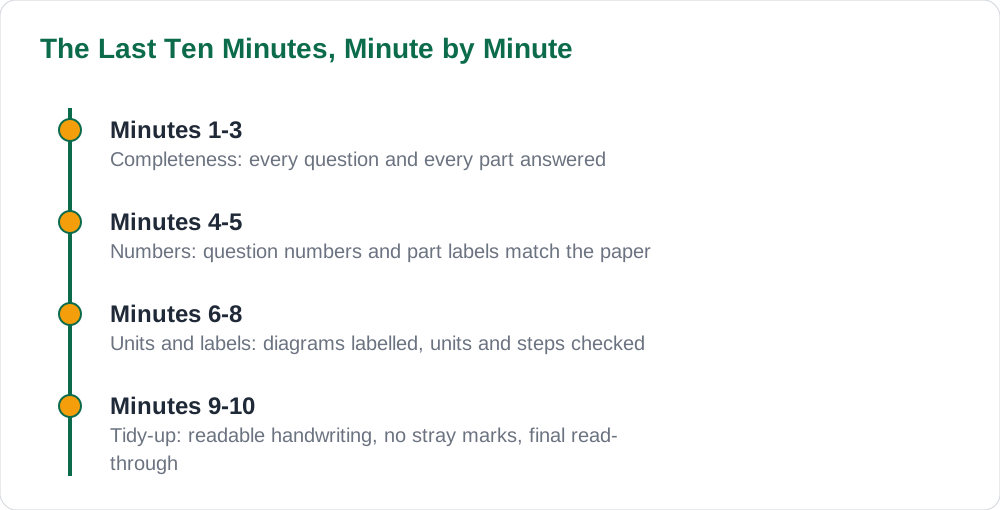
Pupils treat the end of an exam in two ways: they either rush out the moment they finish writing, or they sit staring at the paper unsure what to do. Both waste the most valuable minutes of the paper. The last ten minutes are when small, cheap fixes rescue real marks: a missed question part, a missing unit, a wrong question number, an unlabelled diagram. These are not hard fixes — they are checking fixes. This guide gives you a simple last-ten-minutes checklist that works for every subject. Reserve the final ten minutes in your time plan, then work through the checks in order: completeness, numbering, units and labels, and a final tidy-up. Ten minutes of checking regularly earns more marks than ten minutes of extra writing.
Reserve the Last Ten Minutes in Advance
Checking only happens if you plan for it. When you divide your exam time at the start, set aside the last ten minutes for checking and treat them as protected — not as spare writing time. That means finishing your last answer about ten minutes before the end. Pupils who plan this way finish calmer, because the final minutes feel like a safety net rather than a countdown.
If you are running behind, still protect at least five minutes for checking. A five-minute check that catches one missed question part is worth more than five extra minutes spent polishing an answer that is already good. The checklist below is written for ten minutes, but it compresses easily: do the completeness check first, then numbering, then units and labels.
Check 1: Completeness — Every Question, Every Part
First, compare your answer sheet with the question paper, question by question. Is every question you were supposed to answer actually answered? Did you answer every part — (a), (b), (c) — of each question? Missed parts are the single most common avoidable loss in exams, and they are invisible until you check against the question paper.
If you find a missed part, answer it now in short form. A concise bullet attempt earns marks; a blank earns none. If you find a whole missed question, write a structured short attempt — definition, point, example — rather than a long essay you have no time for. Even a few minutes of attempt beats a blank. Use your attempt-every-question habit here: no blank should survive the final check.
Check 2: Question Numbers and Order
Second, check that every answer carries the correct question number and that the number matches the question you actually answered. Pupils who answer out of order sometimes write the wrong number, and an answer under the wrong number can be marked against the wrong question. Read each number slowly against the question paper.
Also check that multi-part answers are labelled (a), (b), (c) to match the question. If you added a late point in a gap, make sure it is labelled with the question it belongs to. These small numbering fixes take seconds and prevent large losses.
Check 3: Units, Labels and Steps
Third, check the technical details. In mathematics and science, does every numerical answer carry its unit? Are diagrams labelled, with each label pointing to the right part? Did you write the steps in order, or did you skip from the formula to the answer? Missing units and labels are classic last-minute losses, and they are the easiest to fix.
In written subjects, check that names, terms, and quotations are spelled as you intended, and that any list you promised is complete — if you wrote There are three reasons and listed two, add the third or adjust the sentence. In language papers, scan for the errors you personally make most often, such as verb endings or punctuation, and fix them where you spot them.
Check 4: A Final Read-Through for Sense
Fourth, read through your answers quickly, asking one question of each: does this answer what was asked? This is where you catch answers that drifted off topic, or where a sentence says the opposite of what you meant. Fix short slips neatly with a single line through the wrong word and the correction beside it. Do not rewrite whole answers in the final minutes — a rewrite rarely finishes, and a half-rewritten answer scores worse than the original.
Resist the urge to change answers you are merely unsure about. First instincts are often right, and changing a correct answer to a wrong one is a painful way to lose marks. Only change an answer when you can point to a real error — a wrong unit, a misread question, a calculation slip — not just a vague doubt.
- Fix real errors you can point to: wrong units, misread questions, calculation slips.
- Do not change answers on vague doubt alone — first instincts are often right.
- Never start a full rewrite in the final minutes; a half-finished rewrite scores worse.
Handing In: The Last Thirty Seconds
In the last thirty seconds, do three things. Make sure your name, roll number, and any required details are on the answer sheet. Count your answers against the questions once more. Then put your pen down and hand in calmly. A tidy, complete, checked paper is the best finish you can give your hard work, and it is a habit shared by top scorers in Sindh board exams.
Practise this checklist on every mock paper at home, with a timer, until it feels automatic. On exam day it should feel like a routine, not a new idea. For more on the habits that feed into a strong finish, see how to manage time during exams and checking with estimation.
AI Help: Muse AI
Muse AI is Meta's personal AI assistant, and it can help you rehearse this checklist: ask it to turn the four checks into a pocket card you can memorise, then practise running the checklist on a timed mock paper at home. Muse AI does not give official Sindh Textbook Board answers — always verify against your Sindh Textbook Board book and your teacher.
Join Muse with invite code LTGSWD — in the Muse app, go to Settings > Redeem token and enter the code.
Disclosure: LTGSWD is the author's Muse invite code.
5 key points you must know
- Reserve the last ten minutes for checking in your exam time plan.
- Check completeness first: every question and every part answered.
- Check question numbers and part labels against the question paper.
- Check units, diagram labels, and steps in mathematics and science.
- Change answers only for real errors, never on vague doubt alone.
Frequently asked questions
What if I finish early with more than ten minutes left?
Use the extra time to strengthen weak answers first, then run the checklist. Start checking early rather than sitting idle — extra checking time is a gift.
Should I check as I go or only at the end?
Both. A quick check after each answer catches slips early, and the final ten-minute check catches the misses — unanswered parts and wrong numbers — that per-answer checks cannot.
What is the most common thing pupils find in the final check?
A missed question part, most often part (b) or (c) of a multi-part question. That is why the completeness check comes first.
Is it risky to add a late answer in a gap?
No, if it is clearly labelled with the right question number. A labelled late point earns marks; an unlabelled one may be missed.
What if I spot a big mistake in the final minutes?
Fix it in the smallest neat way possible — a corrected figure, a short added paragraph, a relabelled diagram. Never start a full rewrite with minutes left.
Solved notes — preview free
These guides work best with the solved exercises. Preview the solved notes free on this website — 119 solved notes for Classes 6–10 in Sindhi, Urdu, English and Arabic medium. Or browse the full solved notes catalogue for your class and medium. New solved notes are added regularly — check the catalogue for coming-soon books.