How to Solve English Textbook Exercises from Comprehension
English textbook exercises are won or lost in the passage. Pupils who answer from general knowledge, or from a half-remembered reading, write answers that sound plausible but miss what the text actually says. The rule for English exercises is simple: return to the passage for evidence before writing a single sentence. Find the sentence or lines that answer the question, understand what they say, and then build the answer on that evidence. This article shows how to do that for every common English exercise type, from comprehension questions to vocabulary and grammar.
The Golden Rule: Evidence Before Opinion
Every English exercise answer should be traceable to the passage. Before writing, the pupil finds the part of the text that answers the question and underlines or notes it. This evidence-first habit prevents the most common English error: writing what the pupil thinks about the topic instead of what the passage says about it. Examiners mark answers against the text, so an answer that reflects the passage earns credit while an answer that reflects general opinion often does not, even when the opinion is sensible.
Evidence also gives the answer its structure. The pupil can see which points the passage makes, in what order, and with what examples, and then mirror that order in the answer. This makes answers complete, because nothing the passage says is left out, and focused, because nothing outside the passage creeps in. Pupils who practise evidence-first answering soon find that English exercises take less time, not more, because the search for evidence replaces the struggle of inventing an answer from nothing.
How to Find Evidence Quickly
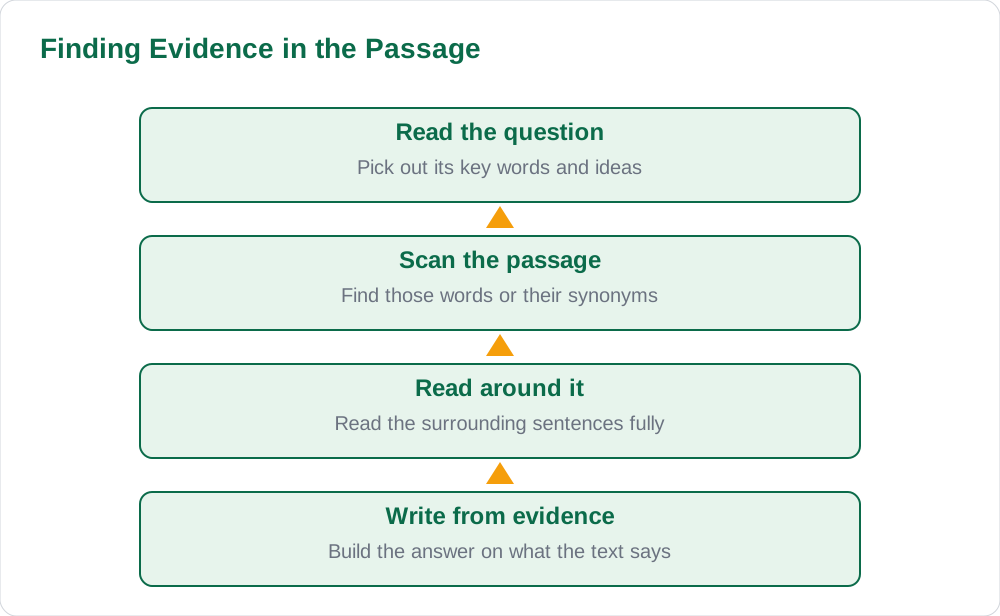
Finding evidence starts with the question's key words. The pupil picks out the names, terms, or ideas the question mentions, then scans the passage for those words or their synonyms. Headings, first sentences of paragraphs, and repeated words are good signposts, since textbook passages usually place important ideas in prominent positions. Once a likely spot is found, the pupil reads the surrounding sentences carefully, because the full answer often spans two or three sentences rather than sitting in one.
If the key words do not appear, the pupil should think of synonyms or related ideas and scan again. Comprehension questions often rephrase the passage, so the question's wording and the passage's wording may differ while the meaning matches. Reading the question and the passage side by side, asking what part of the passage talks about this idea, usually locates the evidence within a minute or two. Rushing past this search and writing from memory is a false economy that costs marks.
Turning Evidence into an Answer
Evidence becomes an answer when the pupil rewrites it in their own words, keeping the passage's facts and order but not its sentences. The first sentence should answer the question directly, so the examiner sees the point immediately. The following sentences give the supporting details from the passage, in the order the passage gives them. A short closing line can restate the point where the question asks for an explanation. This shape is simple, but it is exactly what examiners look for: a direct answer, supported by the text, expressed clearly.
Pupils must resist two temptations here. The first is copying the passage word for word, which shows no understanding and cannot be repeated in an exam. The second is adding outside knowledge that the passage does not contain, which dilutes the answer and can contradict the text. The discipline is to stay inside the evidence while using one's own sentences. With practice, this balance becomes natural, and English answers become both original and accurate.
Vocabulary, Grammar, and Inference Questions
Vocabulary questions are answered from context: the pupil finds the word in its sentence, reads the surrounding sentences, and works out the meaning the passage gives it. An example sentence of the pupil's own then proves the meaning fits. Grammar questions are answered from the rule and the example: state the rule briefly, then apply it to the sentence given, showing the working rather than only the result. Both types reward the same evidence-first habit as comprehension questions.
Inference questions, which ask what can be understood though not directly stated, still need evidence. The pupil finds the details that point toward the inference and names them in the answer, then states the inference they support. An inference with no supporting detail is a guess, and guesses earn little credit. Even here, the rule holds: return to the passage, gather the clues, and only then write. Pupils who do this write inference answers that examiners can follow and credit.
- Vocabulary: find the word in context, work out its passage meaning, prove with an example.
- Grammar: state the rule briefly, then show it applied to the given sentence.
- Inference: name the passage details first, then state what they imply.
- All types: no answer without evidence from the text.
Checking English Answers Before Submission
The final check for an English answer has three parts. First, does the answer match the question, including any second part. Second, does every claim in the answer have support in the passage, or has outside knowledge crept in. Third, is the English itself correct: spelling, punctuation, capital letters, and complete sentences. A quick read aloud catches many errors in the third check, because awkward sentences sound wrong even when they look acceptable on the page.
Once checked, the answer should be written neatly as a fair copy and filed with the subject's notes by chapter. English fair copies deserve extra attention to handwriting and spacing, since readability is part of the impression an answer makes. Pupils who build this checking habit find that their English marks rise steadily, because most lost marks in English come from avoidable slips rather than from lack of knowledge. The general checking routine is covered in How to Check Your Answers Against the Textbook, and the drafting stages are in A Drafting Workflow for Solved Notes: From Rough Answer to Fair Copy. Explore the solved notes collection for more study methods.
AI Help: Muse AI
Muse AI is Meta's personal AI assistant, and it can help with English comprehension in a useful way. A pupil can ask Muse to explain a difficult passage sentence in simpler English, which makes finding and using evidence much easier.
Join Muse with invite code LTGSWD — in the Muse app, go to Settings > Redeem token and enter the code.
Disclosure: LTGSWD is the author's Muse invite code.
Muse AI does not give official STBB answers — always verify against your Sindh Textbook Board book and your teacher.
5 key points you must know
- Return to the passage for evidence before writing any English answer.
- Find evidence using the question's key words and their synonyms.
- Rewrite evidence in your own words; never copy the passage.
- Support inferences with named passage details, never guesses.
- Check question, evidence, and language before fair-copying.
Frequently asked questions
What if I cannot find the evidence for a question?
Re-read the question for its key ideas, then scan the passage for synonyms of those ideas rather than the exact words. Comprehension questions often rephrase the passage. If the evidence still cannot be found, ask your teacher instead of writing an answer from general knowledge.
Is it acceptable to quote a short phrase from the passage?
Yes, a short quoted phrase that supports your point is fine, but the answer as a whole should be in your own words. Long copied passages show no understanding and cannot be reproduced in exams, so keep quotations brief and purposeful.
How do I answer an inference question?
Gather the passage details that point toward the answer, name them in your response, and then state the inference they support. An inference answer needs its evidence visible, so the examiner can follow your reasoning from clue to conclusion.
Should English answers be long?
They should be as long as the question requires: a short question needs a few sentences, while an explanation needs a paragraph with passage support. Length alone earns nothing; completeness and evidence earn the marks.
Solved notes — preview free
These guides work best with the solved exercises. Preview the solved notes free on this website — 119 solved notes for Classes 6–10 in Sindhi, Urdu, English and Arabic medium. Or browse the full solved notes catalogue for your class and medium. New solved notes are added regularly — check the catalogue for coming-soon books.