How to Solve Math Exercises While Showing Every Step
In mathematics, the working is the answer. Examiners award most marks for the steps, not only for the final number, which means a pupil who shows every step can earn nearly full credit even when a small arithmetic slip changes the result. Pupils who write only answers, by contrast, lose everything on a single slip and give the examiner nothing to credit. This article teaches a three-line structure, givens, method, and check, that makes showing steps natural for every math exercise, from simple arithmetic to longer problems.
Why Steps Earn Marks
Math marking schemes divide a question's marks among its steps: identifying what is given, choosing the right method, carrying it out, and reaching a result. A pupil who shows each step collects marks step by step, so one error costs only the marks for that step. A pupil who writes only a final answer gambles all the marks on one number, and a single slip, even a copied digit, loses everything. Showing steps is therefore not extra work for the teacher's benefit; it is insurance for the pupil's marks.
Steps also help the pupil. Writing each step down makes errors visible while they can still be fixed, instead of hiding them inside mental arithmetic. A pupil who checks their own steps often catches a wrong sign, a misplaced decimal, or a skipped operation before finishing. Teachers, too, can help far more easily when steps are visible: they can point to the exact step where understanding broke down, rather than guessing from a wrong answer alone.
Line One: Write the Givens
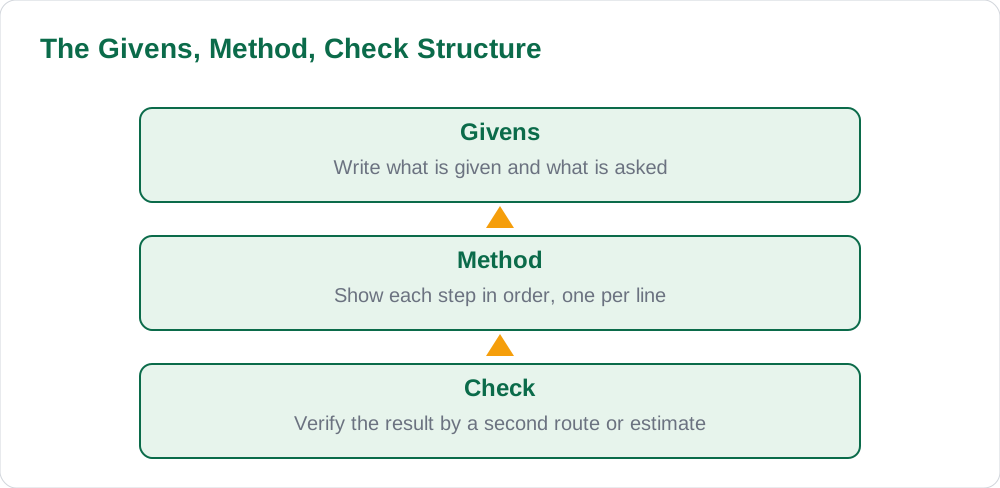
Every solution begins by writing down what the question gives, in symbols or short words. This givens line serves three purposes: it proves the question was read carefully, it gives the pupil the values to work with without re-reading the question, and it prevents the common error of using a wrong number. A pupil who writes the givens first rarely mixes up values, because the numbers are visible and labelled before any calculation begins.
The givens line should also note what is being asked, often with a question mark or the word find. This keeps the solution aimed at the right target, since some questions give extra information or ask for something slightly different from what a quick read suggests. Taking thirty seconds to write givens and the target is the cheapest accuracy improvement in all of mathematics, and it should never be skipped, even for easy questions.
Line Two: Show the Method, Step by Step
The method is written one step per line, with each line following clearly from the one before it. Operations should be shown, not hidden: if two numbers are multiplied, the multiplication appears; if a term moves to the other side, the change is shown. Equal signs should line up sensibly, and each line should be a complete statement, not a fragment. This discipline feels slow at first, but it becomes fast with practice, and it is the single biggest difference between pupils who score well in math and pupils who do not.
Pupils should also label steps where a method has named parts, for example writing the formula before substituting values into it. A formula line shows the examiner that the right method was chosen, even if the substitution later slips. Similarly, units should be carried through the working and stated in the final answer where the question involves measurement. These small habits, formula first, then substitution, then result with units, turn ordinary working into mark-earning working.
Line Three: Check the Answer
A solution is not finished until it is checked, and the check deserves its own line. The simplest check is estimation: does the answer make sense in size and sign compared with the question. A second check is reverse working: putting the answer back into the original situation to see whether it fits. A third check, where time allows, is reworking by a different route, for example adding in a different order. Any check that disagrees with the result signals an error worth hunting for before the solution is submitted.
The check line should be written, not done mentally, because a written check can itself be reviewed. Pupils who write checks catch errors that mental checks miss, especially sign errors and decimal slips. Over time, checking becomes quick: estimation takes seconds, and reverse working takes less than a minute for most exercise questions. The marks saved by catching even one error per exercise set repay the time many times over.
- Estimate first: is the answer reasonable in size and sign.
- Reverse check: does the answer fit back into the question.
- Rework check: does a different route give the same result.
- Write the check down so it can be reviewed too.
Common Step-Showing Mistakes
The most common mistake is doing two steps in one line, which hides the step where an error occurred and loses method marks. Another is skipping the givens line for easy questions, which is exactly when careless number errors strike. A third is writing steps without alignment or order, so the examiner cannot follow the logic even though the pupil understood it. Neatness in math working is not decoration; it is part of the communication that earns marks.
Finally, some pupils show steps in rough work but write only the answer in the fair copy, which defeats the purpose entirely. The fair copy must contain the full working, because the fair copy is what gets marked and revised from. A solved-notes folder of math answers with full steps, organised by chapter as in How to Organise a Solved-Notes Folder by Subject and Chapter, becomes a revision tool that re-teaches the method every time it is read. The drafting stages behind good fair copies are covered in A Drafting Workflow for Solved Notes: From Rough Answer to Fair Copy, and more methods are on the solved notes page.
AI Help: Muse AI
Muse AI is Meta's personal AI assistant, and it can help with math exercises in a practical way. A pupil can ask Muse to explain a method step in simpler words, or to suggest a way to check an answer, which makes the givens-method-check structure easier to follow.
Join Muse with invite code LTGSWD — in the Muse app, go to Settings > Redeem token and enter the code.
Disclosure: LTGSWD is the author's Muse invite code.
Muse AI does not give official STBB answers — always verify against your Sindh Textbook Board book and your teacher.
5 key points you must know
- Marks are awarded per step, so show every step to protect your score.
- Begin every solution with a givens line and a clear target.
- Write one step per line, showing operations and formulas explicitly.
- Finish with a written check: estimate, reverse, or rework.
- Fair copies must contain the full working, not just the answer.
Frequently asked questions
Do I need to show steps for very easy questions?
Yes, briefly. Even easy questions earn method marks, and easy questions are where careless slips happen. A short givens line and one or two working lines are enough, and they protect marks that a bare answer would risk.
What if my method differs from the book's method?
A correct method that reaches the right answer earns credit, provided the steps are shown clearly. Show your method fully so the examiner can follow it. If unsure, compare with the book's method after solving, and learn both.
How do I check an answer quickly in an exam?
Use estimation first: does the size and sign make sense. Then, if time allows, put the answer back into the question to see whether it fits. A thirty-second estimate catches most errors and is always worth doing.
Should rough working be shown in the fair copy?
The fair copy should contain clean, ordered working, not scribbled rough work. Do rough calculations separately if needed, then write the steps neatly in order for the fair copy, including the check line.
Solved notes — preview free
These guides work best with the solved exercises. Preview the solved notes free on this website — 119 solved notes for Classes 6–10 in Sindhi, Urdu, English and Arabic medium. Or browse the full solved notes catalogue for your class and medium. New solved notes are added regularly — check the catalogue for coming-soon books.