How to Solve Sindhi Textbook Exercises with a Method
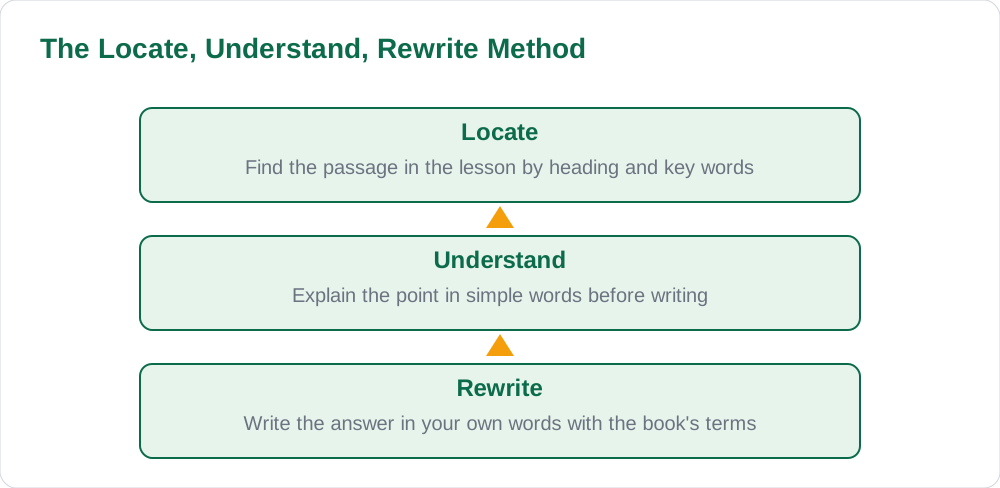
Sindhi exercises become much easier when a pupil follows a method instead of guessing. The method has three moves: locate the answer in the lesson, understand it properly, and rewrite it in the pupil's own words. Pupils who skip the first two moves often write answers that sound confident but miss the lesson's point, while pupils who copy the lesson word for word learn nothing for the exam. The locate-understand-rewrite method avoids both traps. It works for every Sindhi exercise type, from word meanings to lesson questions, and it turns exercise time into real learning time.
Locate: Find the Answer in the Lesson
Locating means opening the Sindhi textbook and finding the exact passage the exercise question comes from. The pupil reads the question first, notes what it asks, and then searches the lesson by headings and key words until the relevant paragraph or verse is found. This search is itself valuable study, because it teaches the pupil how the lesson is organised and where each idea lives. A pupil who can locate answers quickly can also revise quickly, since revision becomes a matter of returning to known places in the book.
Locating also protects accuracy. Sindhi lessons often contain several related ideas, and a question usually targets one specific one. Without locating, a pupil may answer with a neighbouring idea that is true but not the answer, which earns little credit. Reading the located passage slowly, and noting its key words exactly as the book gives them, gives the answer a solid foundation. If the passage cannot be found after a careful search, the pupil should ask the teacher rather than inventing an answer, because a guessed answer can be revised into memory as if it were true.
Understand: Make Sure You Grasp the Point
Understanding is the step between finding and writing, and it is the step that most often gets skipped. After locating the passage, the pupil should be able to say what it means in simple words, either aloud or in rough notes, before writing the answer. If that simple explanation will not come, the passage needs another slow read, perhaps with attention to one sentence at a time. This check saves the pupil from writing sentences that copy the book's words without grasping them, which is the most common weakness in Sindhi exercise answers.
A good test of understanding is the example test: can the pupil give a short example that fits the point, or connect it to something in the lesson. If yes, understanding is real. If no, more reading is needed. Pupils should not rush this stage, because a few minutes of genuine understanding produce an answer that is both correct and memorable, while a copied answer is forgotten within days. Understanding also makes the rewrite stage easy, since the pupil now has something of their own to say.
Rewrite: Write It in Your Own Words
Rewriting means expressing the located and understood point in the pupil's own sentences, while keeping the lesson's key terms. The pupil writes from their understanding, not from the open book, though the book stays nearby for checking key words. A rewritten answer should read naturally, as if the pupil were explaining the point to a classmate. If a sentence feels stiff or copied, it probably is, and it should be rephrased until it sounds like the pupil's own voice. This is not about changing the meaning; it is about owning it.
Rewriting also forces decisions about length and order. The pupil decides which points the question needs, puts them in a logical order, and writes them as connected sentences rather than a list of fragments. The first sentence should answer the question directly, and the following sentences should support it. A rewritten answer built this way is far easier to remember in exams than a copied paragraph, because the pupil created its structure and therefore understands it.
Handling Sindhi Word Meanings and Grammar
For word-meaning questions, the method works the same way: locate the word in its sentence, understand the meaning the context gives it, and rewrite the meaning in simple words, adding a short example sentence of the pupil's own. The example sentence is the best proof that the meaning is right, because a wrong meaning produces a sentence that sounds odd. For grammar questions, the pupil should locate the rule in the lesson, understand how it applies to the given example, and then state the rule briefly before applying it, so the answer shows reasoning rather than only a result.
For questions about a lesson story or poem, the pupil should locate the relevant event or verse, understand what happens or what it means, and rewrite the explanation in prose, staying faithful to the text. Adding details the lesson does not contain, however interesting, weakens the answer. The discipline is always the same: the book supplies the facts, the pupil supplies the expression. Pupils who keep this boundary produce Sindhi answers that are both original and accurate.
- Word meanings: locate in context, give the lesson's meaning, prove with an example sentence.
- Grammar: state the rule briefly, then apply it to the example given.
- Stories: rewrite the event faithfully, without adding invented details.
- Poetry: explain the verse in simple prose, line by line where needed.
Checking, Fair Copy, and Revision
After rewriting, the pupil checks the answer against the book and the question. The content check asks whether every part of the question is answered and whether the key terms match the lesson. The language check looks at spelling of lesson vocabulary and at sentence completeness. Sindhi spelling deserves care, because small changes in letters can change a word, so key words should be compared with the book. A final read aloud catches tangled sentences that silent reading misses, and the corrected draft is then written as a neat fair copy.
The fair copy goes into the subject's solved-notes folder, organised by chapter so it can be found during revision. A folder of rewritten answers is one of the best revision tools a pupil can own, because every answer in it was understood before it was written. Pupils who follow this method find that revision feels like remembering their own explanations rather than re-memorising the book. The folder system is described in How to Organise a Solved-Notes Folder by Subject and Chapter, and the drafting stages match A Drafting Workflow for Solved Notes: From Rough Answer to Fair Copy. Find your class books on the books page.
AI Help: Muse AI
Muse AI is Meta's personal AI assistant, and it can help with Sindhi exercises in a practical way. A pupil can ask Muse to explain a difficult Sindhi word or passage in simpler words, which makes the understand stage of this method much easier.
Join Muse with invite code LTGSWD — in the Muse app, go to Settings > Redeem token and enter the code.
Disclosure: LTGSWD is the author's Muse invite code.
Muse AI does not give official STBB answers — always verify against your Sindh Textbook Board book and your teacher.
5 key points you must know
- Locate every answer in the lesson passage before writing anything.
- Test understanding by explaining the point in simple words first.
- Rewrite in your own sentences, keeping the lesson's key terms.
- Prove word meanings with an example sentence of your own.
- Check content and spelling against the book before fair-copying.
Frequently asked questions
What if I understand the passage but cannot rewrite it?
Say it aloud first, as if explaining to a younger pupil, then write down what you said. Spoken explanations are usually simpler and clearer than first written attempts. If speech also stalls, re-read the passage one sentence at a time until each sentence makes sense.
Is copying ever acceptable for Sindhi answers?
Copying key terms is fine, but copying whole sentences is not: it teaches nothing and fails in exams. The goal is to keep the book's vocabulary inside sentences you built yourself. Use solved notes to check your rewritten answer, not to replace it.
How do I handle a word with several meanings?
Use the meaning the sentence context gives it. Read the sentence around the word carefully; the surrounding words almost always point to one meaning. Your example sentence should fit that same context.
Should I write Sindhi answers in rough first?
Yes, for answers longer than two sentences. A rough draft lets you test your understanding and order your points before committing to a fair copy, which is exactly what the locate-understand-rewrite method is designed to support.
Solved notes — preview free
These guides work best with the solved exercises. Preview the solved notes free on this website — 119 solved notes for Classes 6–10 in Sindhi, Urdu, English and Arabic medium. Or browse the full solved notes catalogue for your class and medium. New solved notes are added regularly — check the catalogue for coming-soon books.