Introduction, Body, Conclusion: A Frame for Long Questions

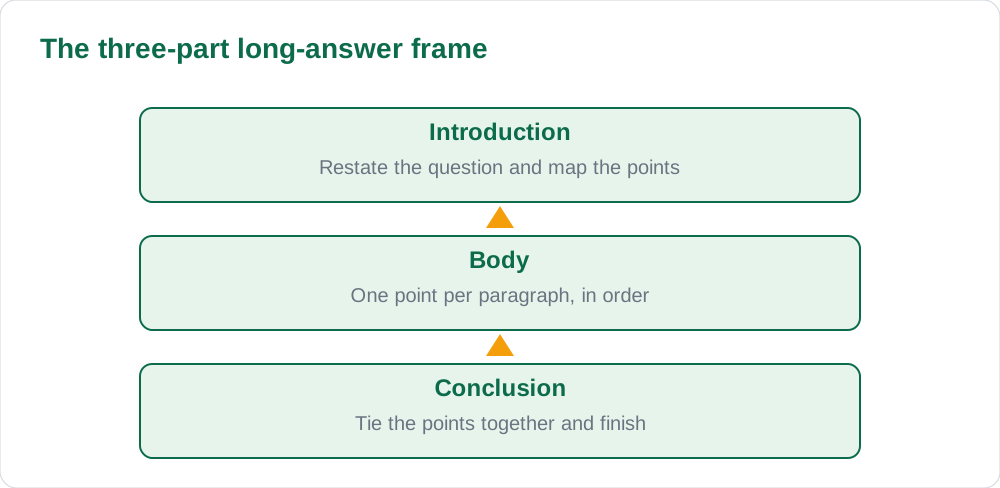
The introduction body conclusion long questions frame is the simplest way to keep a long answer organised from the first line to the last. Many students know the material but lose marks because their answer wanders, repeats itself, or stops suddenly without a finish. A three-part frame solves all three problems at once: the introduction tells the examiner what the question is about and where the answer is heading, the body works through the points in order, and the conclusion ties everything together. This frame works for almost every subject, because examiners reward answers that are easy to follow. In this guide you will learn exactly what belongs in each part, how much space to give it, and how to practise the frame until it feels natural.
Why long answers fall apart without a frame
A long answer without a frame usually fails in one of three ways. Some students write everything they know in a single rush, so the examiner cannot tell where one point ends and the next begins. Others repeat the same idea in different words, filling the page without adding marks. A third group writes a strong middle and then simply stops, leaving the examiner unsure whether the answer is finished. All three problems come from the same cause: the writer started writing before deciding on a shape for the answer.
A frame does not add extra work; it removes it. When you know that your first paragraph introduces, your middle paragraphs develop, and your last paragraph concludes, you stop worrying about what to write next and start thinking about the content itself. The frame also helps the examiner, who can follow your argument, find your points quickly, and award marks with confidence. A clear structure is not decoration — in a long question, structure is part of the answer.
The introduction: two jobs in three or four lines
Your introduction has two jobs and only two. First, it shows that you understood the question, by restating its key idea in your own words rather than copying the question word for word. Second, it gives the examiner a map of what follows, naming the main points in the order you will discuss them. Three or four lines are enough. A longer introduction eats into the time and space your body paragraphs need, and it usually drifts into general statements that earn no marks.
A useful test for an introduction is to read it back and ask whether it could introduce any other question on the same topic. If it could, it is too general. Make it specific: name the issue the question raises, the angle you will take, and the points you will cover. For example, an introduction that names three causes and promises to explain each one in turn is far stronger than one that simply says the topic is very important. Keep the language plain and direct, and save your evidence and explanation for the body.
The body: one point per paragraph, in order
The body is where the marks live, and its rule is simple: one main point per paragraph. Start each paragraph with a clear topic sentence that states the point, then explain it, give an example or reason, and show how it connects to the question. When a paragraph tries to carry two points at once, both get half an explanation and the examiner may miss one entirely. When each paragraph carries one point well, the whole answer reads like a chain of arguments instead of a pile of facts.
Order matters as much as content. Arrange your points in a sensible sequence — from cause to effect, from general to specific, or from most important to least important — and use linking words to signal the movement: firstly, in addition, however, as a result, finally. These small words are signposts for the examiner. If you are short of time, write shorter paragraphs rather than dropping the structure; three complete points in a clear order beat five half-finished ones every time.
- Open each body paragraph with a topic sentence that states one point clearly.
- Follow the point with an explanation, a reason, or a relevant example.
- Link paragraphs with words like however, therefore, and in addition.
- Keep the order logical — cause to effect or general to specific.
- Leave a line or a clear gap between paragraphs so the structure is visible.
The conclusion: close the answer, do not restart it
A conclusion should close the answer, not restart it. Its job is to bring the points together and state what they add up to, in three or four lines. Do not introduce a brand-new point in the conclusion, because there is no room left to explain it properly, and it will look like an afterthought. Do not copy the introduction either; the conclusion should show what the body has proved, not merely repeat the starting position. Think of it as the final step of the argument, not a summary pasted on the end.
A strong closing line gives the examiner a sense of completion. It might restate the main argument in light of the evidence discussed, or note the overall significance of the point. Avoid dramatic claims and sweeping statements that the body never supported. A quiet, accurate finish — one that follows naturally from what you actually wrote — earns more respect than a grand claim that floats free of the answer. When you finish, read the conclusion against the introduction and check that the answer has genuinely moved forward.
Practising the frame until it is automatic
The frame only helps under exam pressure if you have practised it beforehand. Choose a past topic, spend five minutes planning an introduction, three body points, and a conclusion, and then write the full answer against the clock. Afterwards, check the answer against the frame: can you point to the introduction, each body point, and the conclusion? If any part is missing or blurred, rewrite just that part. This kind of targeted practice is far more useful than writing whole answers without ever checking their shape.
You can also practise the frame in smaller doses. Take a single paragraph you have written and ask whether it belongs in an introduction, a body, or a conclusion, and why. Read strong answers in solved notes and notice how their paragraphs are organised, then borrow the pattern rather than the wording. Over time, the frame becomes a habit: you will outline almost without thinking, and your long answers will stay organised even when the question is difficult. For more on planning before writing, see Writing Answer Outlines for Long Questions Before Drafting and Planning a Long Answer Within the Word Limit.
AI Help: Muse AI
Muse AI is Meta's personal AI assistant. You can ask it to explain a concept in simple words, summarise a lesson, or make practice questions for revision.
For this topic, ask Muse AI to check a draft long answer's structure — whether the introduction, body, and conclusion each do their job — and to suggest a clearer order for your points.
Join Muse with invite code LTGSWD — in the Muse app, go to Settings > Redeem token and enter the code.
Disclosure: LTGSWD is the author's Muse invite code.
Muse AI does not give official STBB answers — always verify against your Sindh Textbook Board book and your teacher.
5 key points you must know
- A long answer needs three parts: an introduction, a body, and a conclusion.
- The introduction restates the question and maps the points in order.
- The body gives one well-explained point per paragraph, in a logical sequence.
- The conclusion ties the points together without introducing new material.
- Practise the frame on timed answers until the shape becomes automatic.
Frequently asked questions
How long should the introduction to a long answer be?
Three or four lines is usually enough. The introduction should restate the question in your own words and name the points you will cover, then stop. A longer introduction takes space and time away from the body, where most marks are earned.
Can I write the body first and the introduction last?
Yes, if that helps you. Some students draft the body points first and then write an introduction that matches what they actually argued. Just make sure the finished answer reads in the right order: introduction, body, conclusion.
What if I run out of time before the conclusion?
Write a two-line conclusion rather than none at all. A short closing sentence that ties your points together is far better than an answer that simply stops. Planning your time with Planning a Long Answer Within the Word Limit helps prevent this.
Should the conclusion repeat the introduction?
No. The conclusion should show what the body has established, restating the argument in light of the points discussed. Repeating the introduction word for word adds nothing and tells the examiner the answer has not moved forward.
Solved notes — preview free
These guides work best with the solved exercises. Preview the solved notes free on this website — 119 solved notes for Classes 6–10 in Sindhi, Urdu, English and Arabic medium. Or browse the full solved notes catalogue for your class and medium. New solved notes are added regularly — check the catalogue for coming-soon books.