Percentages in Daily Life: Shop Receipts, Discounts, Profit and Loss

Percent of what? That is the question pupils should ask every time they meet a percentage, because a percentage is never a number on its own — it is always a fraction of some whole. When the whole is invisible, percentages feel like guesswork. When the whole is a shop receipt, a discount tag, or a shopkeeper's cost price, percentages become concrete, checkable and even interesting. This article teaches percentages through the places pupils already meet them: market stalls, sale signs, pocket money, and the profit and loss of a small shop. The examples are clearly illustrative, and every method here transfers directly to textbook problems, because the mathematics is the same — only the packaging is friendlier.
Percent Means Per Hundred — And the Whole Matters
Percent means per hundred, so 25 percent is 25 out of every 100. The crucial habit is to ask: 25 percent of what? Twenty-five percent of 200 rupees is 50 rupees, but 25 percent of 2,000 rupees is 500 rupees. Same percentage, very different answer, because the whole is different. Pupils who always name the whole before calculating avoid the most common percentage error, which is applying a percentage to the wrong quantity. A simple sentence frame helps: find the whole, then find the percentage of that whole.
The fraction connection makes percentages easier too. Twenty-five percent is one quarter, fifty percent is one half, and ten percent is one tenth. A pupil who sees 25 percent of 400 as one quarter of 400 gets 100 without any formal method. Teachers should build fluency with the friendly percentages — 50, 25, 10, 20, 75 — before introducing awkward ones like 17 percent, because the friendly ones teach the idea and the awkward ones only need a calculator method. The solved notes on this site use the same friendly-first approach, and the books page lists the official texts to check against.
- Always name the whole first: percent of WHAT?
- Friendly percentages: 50% is a half, 25% is a quarter, 10% is a tenth.
- 10% is the key building block: find 10%, then build 20%, 30% or 5% from it.
- A percentage bigger than 100% means more than the whole — for example, 150% of 200 is 300.
Discounts: What a Sale Sign Really Means
A sale sign saying 20 percent off is a percentage problem pupils meet constantly, and it is an ideal teaching example. Take a shirt priced at 1,500 rupees with 20 percent off, as an illustrative example. Twenty percent of 1,500 is 300, so the discount is 300 rupees and the sale price is 1,200 rupees. There are two routes to the same answer: subtract the discount, or compute 80 percent of the price directly, since paying 80 percent is the same as taking 20 percent off. Pupils who can do it both ways have a built-in check: if the two routes disagree, something went wrong.
Discount problems also teach pupils to be careful readers. A shop offering an extra 10 percent off an already discounted price does not mean 30 percent off the original, because the second discount applies to the reduced price, not the original. Take a 1,000-rupee item reduced by 20 percent to 800, then reduced by another 10 percent: the second discount is 10 percent of 800, which is 80, giving a final price of 720 — not 700. Pupils who catch this subtlety have understood something many adults miss, and the shop receipt is the perfect place to verify it.
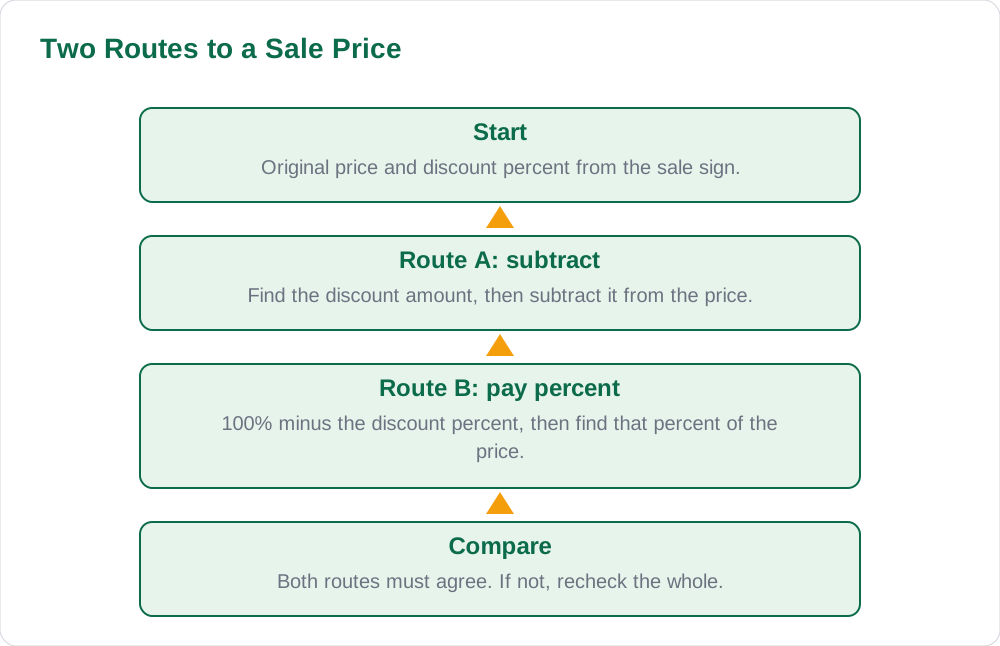
Profit and Loss: Cost Price, Selling Price and Margin
Profit and loss problems confuse pupils when the vocabulary is unclear, so the definitions come first. Cost price is what the seller paid. Selling price is what the buyer pays. If the selling price is higher, the difference is profit; if it is lower, the difference is loss. The percentage is always calculated on the cost price, unless the question says otherwise — this is the rule pupils most often forget. A shopkeeper who buys a toy for 400 rupees and sells it for 500 makes a profit of 100, and the profit percent is 100 divided by 400, times 100, which is 25 percent. The whole is the cost price, and naming it first makes the method obvious.
Loss works the same way. A shopkeeper who buys a phone cover for 600 rupees and sells it for 540 has lost 60 rupees, and the loss percent is 60 divided by 600, times 100, which is 10 percent. Pupils should practise both directions: given cost and selling price, find the percent; and given cost price and profit percent, find the selling price. The second direction needs one extra step — find the profit amount, then add it to the cost — and pupils who write the steps in order rarely go wrong. Real shop receipts and market visits make these problems feel honest rather than artificial.
- Profit = selling price minus cost price; loss = cost price minus selling price.
- Profit and loss percent are always calculated on the COST price.
- To find a selling price: profit amount first, then add it to the cost price.
- Check: a profit means the selling price is above the cost price.
Percentages Everywhere: Marks, Savings and Bills
Once pupils can handle discounts and profit, the same methods unlock percentages everywhere. Exam marks are a natural example: 36 marks out of 50 is 36 divided by 50, times 100, which is 72 percent. Savings work the same way: saving 200 rupees out of 1,000 rupees of pocket money over time is 20 percent. Bills and charges give a third context: a bill with a 5 percent service charge on 2,000 rupees adds 100 rupees. In every case the method is identical — divide by the whole, multiply by 100 — and pupils who recognise the pattern stop seeing each new context as a new topic.
Teachers can turn the classroom into a percentage laboratory with real receipts. Ask pupils to bring a shop receipt (with personal details removed) and find the percentages hidden in it: what percent of the total was the biggest item, what would the total be with a 10 percent discount, what profit percent would the shop make at a guessed cost? The receipt makes the whole visible and the answers checkable. Pupils who have argued about a real receipt's numbers understand percentages in a way that worksheet drills alone rarely achieve, and the discussion teaches estimation alongside calculation.
The 10 Percent Building Block and Quick Estimation
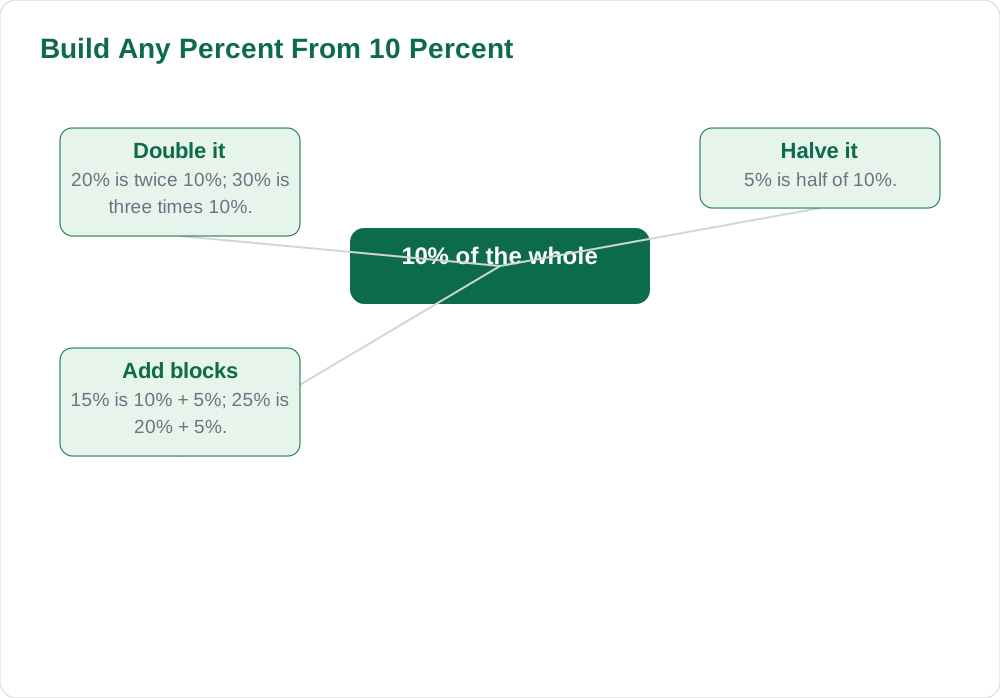
The fastest mental percentage method is the 10 percent building block. Ten percent of any number is the number with one zero removed, or the decimal point moved one place: 10 percent of 350 is 35. From there, 20 percent is double 10 percent (70), 5 percent is half of 10 percent (17.5), and 15 percent is 10 percent plus 5 percent (52.5). This single trick handles most everyday percentages without a calculator, and it gives pupils a way to estimate before calculating exactly. A pupil who can estimate 15 percent of 350 as about 50 will immediately notice if a calculator answer of 525 has a decimal slip.
Estimation also protects pupils in exams. Before computing 37 percent of 840, a pupil can estimate: 40 percent of 840 is 336, so the answer should be a little less, around 310. The exact answer is 310.8, so the estimate confirms it. Pupils who estimate first catch decimal-point errors, wrong-whole errors and calculator slips that otherwise cost marks. The habit takes five seconds and pays for itself many times over. For more exam-day checking habits, see the guide to checking maths answers in exams, and browse further guides on the blog.
AI Help: Muse AI
Muse AI is Meta's personal AI assistant, and it can help with this topic by working through a shop receipt or discount problem step by step, or by making extra profit-and-loss practice questions with different cost and selling prices.
Join Muse with invite code LTGSWD — in the Muse app, go to Settings > Redeem token and enter the code.
Disclosure: LTGSWD is the author's Muse invite code.
Muse AI does not give official STBB answers — always verify against your Sindh Textbook Board book and your teacher.
5 key points you must know
- A percentage is always a fraction of a named whole — name the whole first.
- 50% is a half, 25% is a quarter, 10% is a tenth; build other percents from 10%.
- Sale price can be found two ways: subtract the discount, or pay 100% minus the discount.
- Profit and loss percent are always calculated on the cost price.
- Estimate before calculating: a rough answer catches decimal slips and wrong-whole errors.
Frequently asked questions
What is the difference between profit and profit percent?
Profit is an amount in rupees: selling price minus cost price. Profit percent compares that profit with the cost price: profit divided by cost price, times 100. A profit of 100 rupees on a 400-rupee cost is 25%, but the same 100-rupee profit on a 1,000-rupee cost is only 10%. The percent tells you how big the profit is relative to the investment.
Is profit percent calculated on cost price or selling price?
On the cost price, unless the question explicitly says otherwise. This is the standard convention in textbook problems and in shopkeeping. Always check the question wording: if it says profit is a percent of the selling price, then the whole changes, and so does the answer.
Why is 20% off plus 10% off not 30% off?
Because the second discount applies to the already reduced price, not the original. A 1,000-rupee item reduced by 20% costs 800; a further 10% off takes 10% of 800, which is 80, giving 720. The total reduction is 280, or 28%, not 30%. Each percentage applies to a different whole.
How do I find a percentage of a number quickly?
Find 10% first by moving the decimal point one place left. Then build what you need: 20% is double 10%, 5% is half of 10%, 15% is 10% plus 5%. For a percentage like 37%, estimate with 40% first, then calculate exactly and compare with your estimate.
How do I turn marks into a percentage?
Divide the marks obtained by the total marks, then multiply by 100. For 36 out of 50: 36 divided by 50 is 0.72, times 100 is 72%. The same method works for any part-to-whole comparison, including savings, shares and survey results.
Solved notes — preview free
These guides work best with the solved exercises. Preview the solved notes free on this website — 119 solved notes for Classes 6–10 in Sindhi, Urdu, English and Arabic medium. Or browse the full solved notes catalogue for your class and medium. New solved notes are added regularly — check the catalogue for coming-soon books.