Questions Worth Asking at a Parent-Teacher Meeting

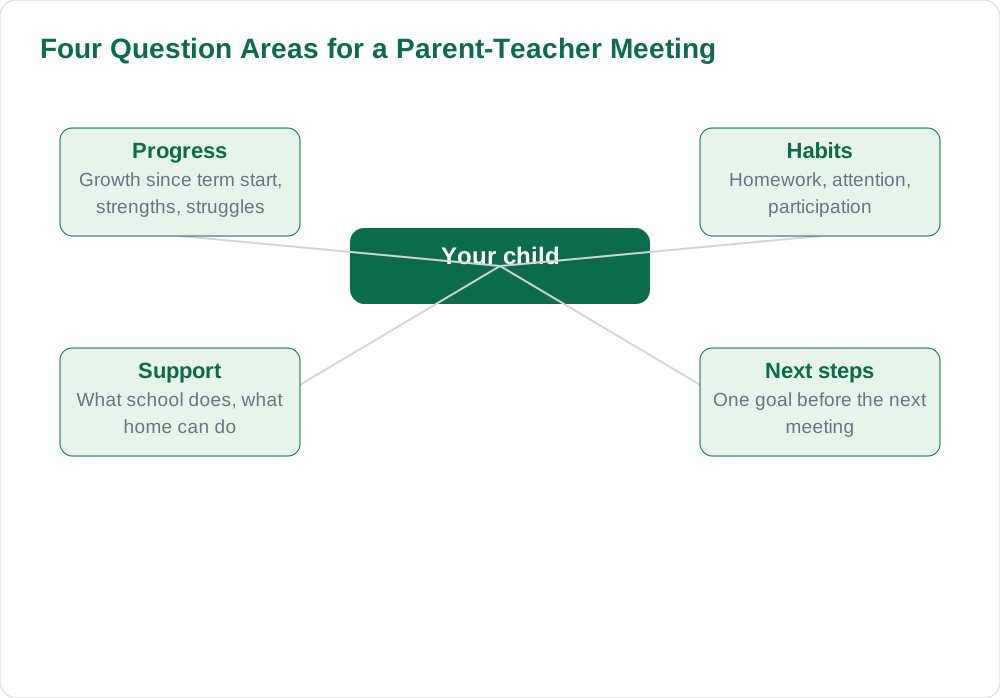
A parent-teacher meeting is often short, sometimes only ten minutes, yet parents leave many meetings knowing little more than a grade. The difference between a useful meeting and a wasted one is usually the questions asked, because teachers answer what parents ask, and vague questions receive vague answers. This article gives parents focused questions worth asking at a parent-teacher meeting, covering progress, habits, and next steps, so a brief conversation becomes a clear plan for helping your child. You will learn how to prepare before the meeting, which questions reveal the most, and how to follow up afterwards. Going in with three or four good questions shows the teacher you are a partner in your child's learning, and it gives you information you can actually use at home.
Prepare Before You Arrive: Notes Beat Memory
Preparation turns a rushed meeting into a focused conversation, so spend ten minutes beforehand noting what you want to learn. Look at your child's recent work, homework, and report card, and write down two or three observations or worries, such as maths homework takes very long, or reading seems to have slowed. Also ask your child beforehand what they enjoy, what they find hard, and whether anything at school worries them, since a child's own view often reveals issues adults miss. Bring the short list on paper, because in a busy meeting it is easy to forget your questions and leave with only a general impression.
Prepare your attitude as well as your questions, by remembering that the teacher and you share the same goal: your child's progress. Arrive on time, listen fully before responding, and avoid starting with blame, even if you are worried, because a defensive teacher shares less. If you need an interpreter or extra time, mention it when booking, and if both parents can attend, agree beforehand who will ask which question so nothing is repeated. A prepared, respectful parent gets more honest information in ten minutes than an unprepared parent gets in thirty. The solved notes help parents understand the subjects their child studies.
Ask About Progress, Not Just Marks
Marks alone say little about learning, so ask questions that reveal progress over time and understanding behind the grade. Useful questions include: how is my child progressing compared with the start of term, in which topics is my child strongest, and where does my child struggle most. Ask for examples, such as can you show me a piece of work that shows my child's level, because a concrete example tells you far more than a number. Also ask how your child participates in class, whether they ask questions, and how they handle difficult tasks, since effort and participation shape future results as much as current marks.
Listen for the story behind the marks: a child whose marks are steady but who avoids hard questions may need confidence support, while a child whose marks dropped may be struggling with one topic rather than the whole subject. Ask whether the teacher sees any pattern, such as careless errors, weak basics, or difficulty understanding questions, and what the school is already doing about it. These questions turn a meeting from a report delivery into a diagnosis, giving you a clear picture of where your child stands and why. The book collection shows the books behind each subject you discuss.
Ask About Habits: Homework, Attention, and Friends
A child's habits often explain their results better than their ability, so ask about daily behaviour at school. Good questions include: does my child complete homework on time, how long should homework take, does my child pay attention in class, and how does my child get along with classmates. Ask whether your child works independently or waits for help, and whether they join group work willingly, because these habits decide how much they learn from every lesson. Teachers observe habits daily, and their answers can point to simple home changes, such as a fixed homework time or a quieter study corner.
Also ask about behaviour in a balanced way, covering strengths as well as concerns, so you hear the full picture rather than only problems. A question such as what does my child do well in your class often reveals talents parents never see at home, and builds a warmer conversation. If the teacher raises a concern, ask for a specific example and for the teacher's suggestion, rather than reacting immediately, so you can discuss it calmly with your child later. Habits can be changed, and a meeting that identifies one habit to improve is more valuable than one that only lists grades. More family study tips appear on the blog.
Ask What You Can Do at Home, Specifically
The most useful meeting question is often the simplest: what one thing can I do at home to help my child most. Vague advice such as practise more helps nobody, so press gently for specifics: which topic should we practise, for how long each day, and using what kind of activity. Ask whether reading together, times-table practice, or reviewing class notes would help most, and whether the teacher can suggest material at the right level. A specific home task gives you a clear job and lets you report back at the next meeting on whether it worked.
Also ask what the school will do, so support is shared rather than left entirely to parents. Questions such as will my child get extra help in class, or how will you check whether this improves, create accountability on both sides. Agree one small goal before the next meeting, such as finishing homework without reminders for two weeks, or reading daily, and write it down together. A meeting that ends with one shared goal and a date to review it is a meeting that changes something, while a meeting that ends with general encouragement changes nothing. The [home page](/) offers an overview of resources for parents and pupils.
After the Meeting: Share, Follow Up, and Stay in Touch
What happens after the meeting matters as much as the meeting itself, so share the outcome with your child the same day in a positive way. Tell them what the teacher praised, explain the one goal you agreed on, and involve them in planning how to reach it, so the meeting feels like teamwork rather than a secret report. Avoid repeating criticisms harshly, and avoid promising rewards or punishments you will not keep; instead, focus on the next step and on your belief that your child can improve. Children who hear that home and school work together try harder, because they know both sides care.
Follow up on the agreed goal after a few weeks, by checking homework habits or reading practice, and contact the teacher if the plan is not working rather than waiting months for the next meeting. A short, polite message asking for an update shows commitment without demanding constant attention, and most teachers welcome it. Keep your meeting notes in one place, so each meeting builds on the last and you can track progress across the year. Parent-teacher meetings work best as part of an ongoing conversation, not a once-a-year event, and your follow-up keeps that conversation alive. For questions, visit the contact page.
AI Help: Muse AI
Muse AI is Meta's personal AI assistant, and it can help parents prepare for a meeting by turning worries into clear questions, or by suggesting follow-up activities for a goal agreed with the teacher. Ask it to draft five short questions about progress and homework, then pick the ones that fit your child.
Join Muse with invite code LTGSWD — in the Muse app, go to Settings > Redeem token and enter the code.
Disclosure: LTGSWD is the author's Muse invite code.
Muse AI does not give official STBB answers — always verify against your Sindh Textbook Board book and your teacher.
5 key points you must know
- Prepare a short written list of questions and observations before the meeting.
- Ask about progress and understanding, not just marks or grades.
- Ask about homework, attention, and classroom habits that shape results.
- Press for one specific thing to practise at home, with time and material.
- Agree one shared goal, share it positively with your child, and follow up.
Frequently asked questions
How many questions should I ask in a short meeting?
Three or four focused questions are enough for ten minutes. Choose one about progress, one about habits, and one about what to do at home, so you leave with a clear plan.
What if the teacher only talks about marks?
Ask for examples and patterns: which topics are strongest, where does my child struggle, and what does participation look like. Concrete examples reveal far more than a grade.
Should I bring my child to the meeting?
Follow the school's practice, but many meetings work better with parents alone so concerns can be discussed openly. Share the positive outcome and agreed goal with your child afterwards.
What if I disagree with the teacher?
Listen fully first, ask for specific examples, and discuss calmly. If disagreement remains, agree a trial plan and a review date, and speak to the school through proper channels if needed.
Solved notes — preview free
These guides work best with the solved exercises. Preview the solved notes free on this website — 119 solved notes for Classes 6–10 in Sindhi, Urdu, English and Arabic medium. Or browse the full solved notes catalogue for your class and medium. New solved notes are added regularly — check the catalogue for coming-soon books.