Simple Machines: Levers, Pulleys and Inclined Planes

A seesaw, a well pulley, and a ramp are all machines, even though they have no engine and no electricity. A machine is any device that makes work easier, usually by changing the size or the direction of a force. Simple machines do this with a few moving parts: levers, pulleys, inclined planes, wheels and axles, wedges, and screws. You use them every day, often without noticing, and this article shows you where to find them. You will learn the three classes of lever with examples from your own body and school, how a pulley can lift a heavy bucket with a small pull, and why a long, gentle ramp is easier to climb than a steep step. You will also meet the idea of mechanical advantage: the number that tells you how many times a machine multiplies your force. By the end, a walk around your school will look different, because you will see a machine in the door handle, the scissors, the flagpole, and the stairs. Machine examples from daily life also appear in [force and motion in daily life](/blog/science-force-motion-daily-examples.html).
What a Machine Does
A machine does not create energy. It changes how a force is applied so that the same work becomes easier. A machine can do three useful things: it can multiply a force, so a small effort lifts a heavy load; it can change the direction of a force, so pulling down lifts something up; or it can increase the speed or distance of movement, so a small movement of your hand produces a large movement of the load. A pulley on a well does the first two: it lets you pull down, which is easier than lifting up, and it can reduce the effort needed.
The price of a machine's help is distance. When a machine multiplies your force, you must apply that smaller force over a longer distance, so the total work stays the same, apart from a little lost to friction. That is the trade-off behind every simple machine: less force, more distance. The mechanical advantage of a machine is the load divided by the effort: MA = load / effort. If a machine lets a 100 N effort lift a 400 N load, its mechanical advantage is 4. Efficiency tells you how much of the work you put in comes out as useful work; friction always wastes some as heat, so real machines are never 100 percent efficient.
Levers: Three Classes Around You
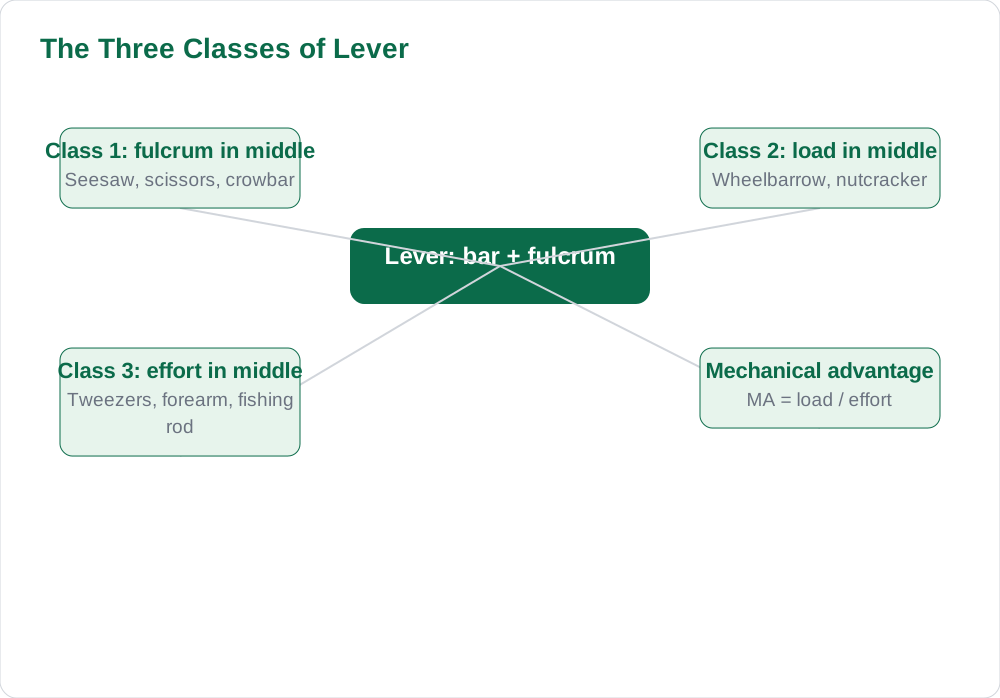
A lever is a bar that turns around a fixed point called the fulcrum. The effort is the force you apply, and the load is the weight you move. The order of fulcrum, load, and effort decides the class of lever. In a first-class lever, the fulcrum sits between the effort and the load, like a seesaw or a pair of scissors. In a second-class lever, the load sits between the fulcrum and the effort, like a wheelbarrow or a nutcracker. In a third-class lever, the effort sits between the fulcrum and the load, like a pair of tweezers or your forearm lifting a book.
Each class has its own job. First-class levers can multiply force or change direction, depending on where the fulcrum sits. Second-class levers always multiply force, which is why a wheelbarrow makes a heavy load feel light. Third-class levers never multiply force; they multiply movement and speed, which is why your arm can flick a ball quickly even though the muscle works close to the elbow. To identify a lever, find the fulcrum first, then the load, then the effort, and read the order. A bottle opener, a fishing rod, a door, and a stapler are all levers, and naming their class is a favourite exam question.
Pulleys: Lifting by Pulling Down
A pulley is a wheel with a groove that a rope runs over. A single fixed pulley does not multiply your force, but it changes the direction of the force: you pull down on the rope, and the load rises. Pulling down is easier than lifting up because you can use your own weight to help. A flagpole uses a fixed pulley for exactly this reason: the flag rises while the person pulls downward.
A movable pulley, one that moves up with the load, does multiply force. The load is supported by two parts of the rope, so each part carries half the weight, and the effort needed is about half the load. A block and tackle combines fixed and movable pulleys, and with more rope parts supporting the load, the effort falls further. Well pulleys, cranes, and the ropes that lift theatre curtains all use pulleys. The trade-off is the same as for every machine: to lift the load one metre with a two-part pulley, you must pull two metres of rope. Less force, more rope.
Inclined Planes, Wedges and Screws
An inclined plane is a sloping surface, a ramp. Pushing a heavy box up a long, gentle ramp needs less force than lifting it straight up, because the weight is spread over a longer distance. The longer the ramp, the smaller the effort, but the longer the distance you push. School ramps for wheelchairs, loading ramps for trucks, and the sloping path up a hill are all inclined planes. Stairs are a series of short inclined planes.
A wedge is two inclined planes joined back to back. An axe, a knife, a chisel, and a nail all work as wedges: a small force on the wide end drives the thin edge into the material with a large splitting force. A screw is an inclined plane wrapped around a cylinder: turning the screw converts a small turning force into a large forward force, which is why a screw holds wood together so firmly. The thread of a screw is literally a ramp wound in a spiral, and the closer the threads, the greater the advantage, but the more turns are needed.
Wheels, Axles and Machines at School
A wheel and axle is a wheel fixed to a smaller cylinder. Turning the big wheel with a small force turns the small axle with a larger force, or turning the axle fast spins the wheel faster. A door handle is a wheel and axle: you turn the wide handle easily, and the small spindle inside turns the latch. A screwdriver is the same idea, and so is a bicycle wheel with its hub, and a steering wheel with its column.
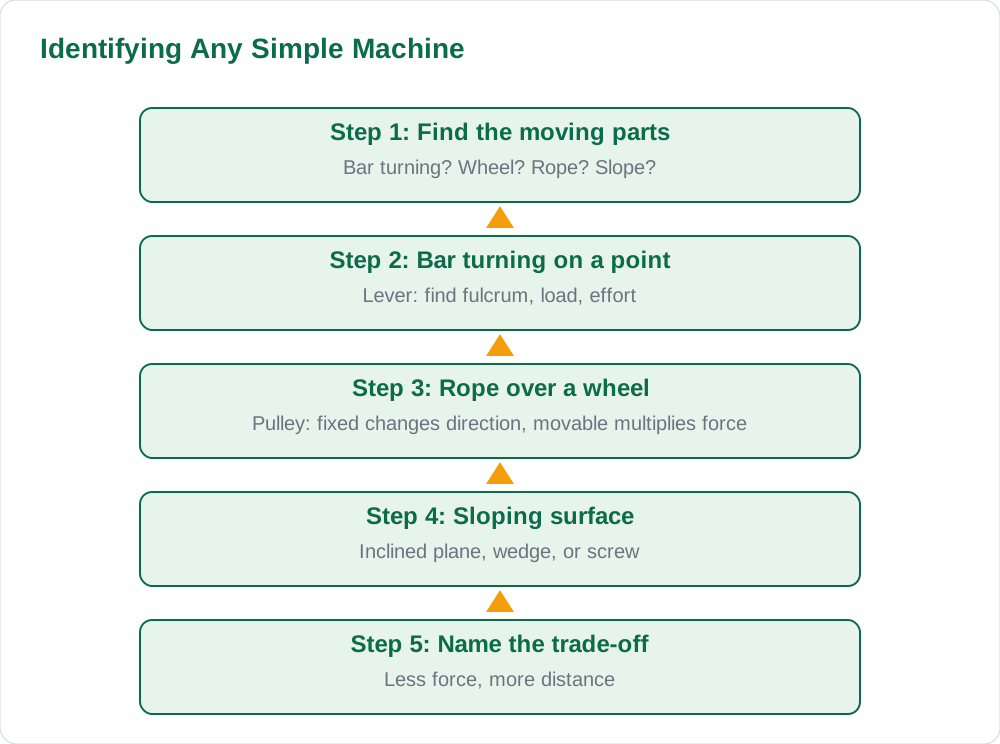
Now walk around your school and spot the machines. The flagpole has a fixed pulley. The seesaw is a first-class lever. The door handle is a wheel and axle. The ramp at the entrance is an inclined plane. The scissors in the classroom are two first-class levers joined together. The screw holding a desk together is an inclined plane in a spiral. At home, a bottle opener is a second-class lever, tweezers are third-class, and the pulley over a well lifts water by pulling down. Finding machines in your own surroundings is the best revision for this topic, because each one you name from memory is one you will recognise in an exam question. Class material and solved notes are listed on the solved notes page. More material is on the books page and the blog index.
AI Help: Muse AI
Muse AI is Meta's personal AI assistant, and it can help with this topic by naming the simple machine in any object you describe, from a door handle to a fishing rod, and telling you its lever class. You can ask it to compare a fixed and a movable pulley using a well bucket you know. Muse AI does not give official Sindh Textbook Board answers — always verify against your Sindh Textbook Board book and your teacher.
Join Muse with invite code LTGSWD — in the Muse app, go to Settings > Redeem token and enter the code.
Disclosure: LTGSWD is the author's Muse invite code.
5 key points you must know
- A machine changes a force's size or direction; it does not create energy.
- Mechanical advantage is load divided by effort: MA = load / effort.
- Lever classes depend on the order of fulcrum, load, and effort.
- A fixed pulley changes direction; a movable pulley multiplies force.
- An inclined plane, wedge, and screw all trade less force for more distance.
Frequently asked questions
Do machines save work?
No. A machine makes work easier by letting a smaller force act over a longer distance, but the total work stays the same, apart from a little lost to friction. Machines change how force is applied; they do not create energy.
What class of lever is a wheelbarrow?
Second class. The wheel is the fulcrum, the load in the bucket sits between the fulcrum and the effort, and the handles are where you apply effort. Second-class levers always multiply force, which is why a wheelbarrow makes a heavy load feel light.
Why is pulling down on a well pulley easier than lifting up?
A fixed pulley changes the direction of the force, so you pull down instead of lifting up. Pulling down lets you use your own weight to help, and it is a more comfortable direction for your arms.
Why is a long ramp easier than a short steep one?
A longer ramp spreads the same height over a longer distance, so the effort needed at any moment is smaller. You push for a longer distance, but with less force, which is the usual machine trade-off.
Is a screw really a simple machine?
Yes. A screw is an inclined plane wrapped around a cylinder. Turning the screw converts a small turning force into a large forward force, which is why screws hold wood together so firmly.
Solved notes — preview free
These guides work best with the solved exercises. Preview the solved notes free on this website — 119 solved notes for Classes 6–10 in Sindhi, Urdu, English and Arabic medium. Or browse the full solved notes catalogue for your class and medium. New solved notes are added regularly — check the catalogue for coming-soon books.