Building Everyday English Vocabulary in Primary Classes
Primary English vocabulary daily words are best learned in small, steady doses — ten words a week, used in real sentences, beat fifty words memorised for a test and forgotten the next day. Young learners remember words they can see, touch, and use. A word like window means something when the child points to the classroom window and says it. A word learned only from a list stays a list. This guide gives a simple ten-word-a-week routine built on classroom objects, daily actions, and picture labels, so vocabulary grows week by week and stays learned.
Why Ten Words a Week Is the Right Dose
A small weekly set works because it respects how memory works. Ten words can be met every day, used in sentences, spotted in the classroom, and revised at the end of the week. Fifty words can only be crammed, and crammed words vanish within days. Teachers who have tried both approaches find the same result: the class that learns ten words a week deeply knows hundreds of words by the end of the year, while the class that chases long lists still struggles with basic words.
Ten words a week also leaves room for depth. For each word, the child learns what it means, how it sounds, how it is spelled, and one sentence that uses it. That is real vocabulary. A child who knows ten words deeply can use them in speaking and writing; a child who half-knows fifty words can use none of them. For advice on avoiding common study errors, see how to avoid common exam mistakes.
Choose Words From the Child's Own World
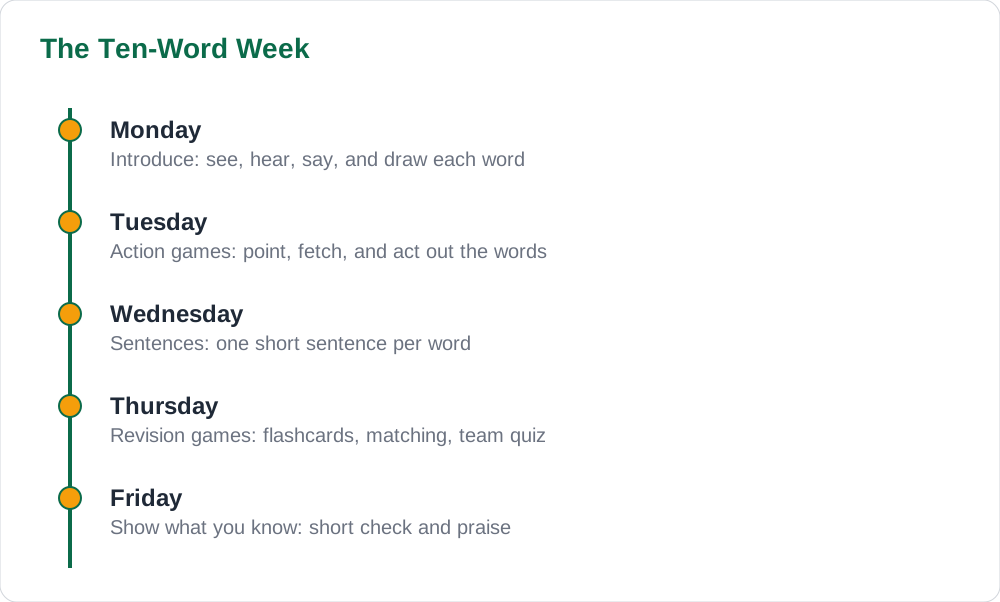
The best vocabulary words come from what the child already sees and does. Classroom objects are the natural first set: desk, chair, board, door, window, book, bag, pencil, ruler, eraser. Body parts and clothes come next: hand, foot, eye, shirt, shoe, cap. Then daily actions: open, close, sit, stand, read, write, wash, eat, run, sleep. Every word in these sets can be pointed to, acted out, or drawn — and that is what makes them stick.
Avoid abstract words at this stage. Words like honest or beautiful mean little to a seven-year-old without a story or example attached. Concrete words first, abstract words later, once the child has a strong base. Choose words that appear in the child's English reader too, so classroom lessons and vocabulary work reinforce each other instead of pulling in different directions.
- Week 1 set: classroom objects — desk, chair, board, door, window, book, bag, pencil, ruler, eraser.
- Week 2 set: body and clothes — hand, foot, eye, ear, shirt, shoe, cap, hair, nose, mouth.
- Week 3 set: daily actions — open, close, sit, stand, read, write, wash, eat, run, sleep.
The Ten-Word Week: A Daily Routine
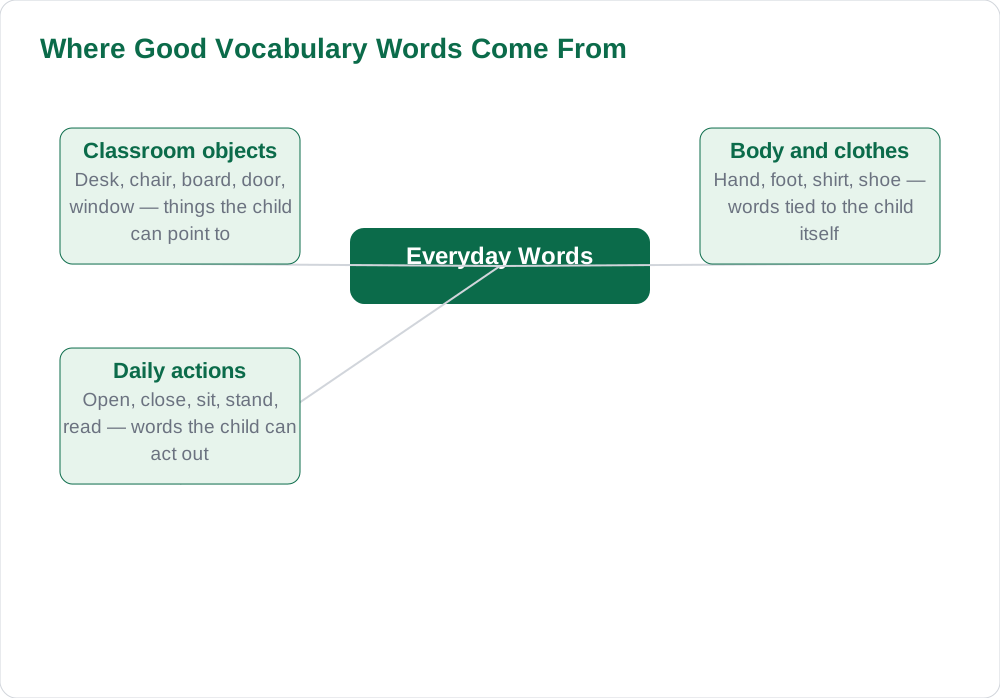
Monday is introduction day. Show each word with a picture or the real object, say it clearly, and have the class repeat it. Write the word on the board, and let children copy it into their vocabulary notebooks with a small drawing beside it. Tuesday is action day: play quick games where children point to, fetch, or act out the words. Wednesday is sentence day: each child makes one short sentence with one word — I open the door, She reads a book. Thursday is a revision game: flashcards, matching, or a quick team quiz. Friday is the show-what-you-know day: a five-minute oral or written check, with praise for every word remembered.
The same routine works at home in ten minutes a day. A parent can label five objects in the house with English word cards, and ask the child to read the label each time they pass it. The fridge, the door, the mirror, the table, the window — five labels, seen twenty times a day, teach themselves. For more on steady study habits, see how to make notes from Sindh Textbook Board books.
Picture Labels Make Words Stick
A vocabulary notebook with a small drawing beside each word is worth more than a neat list. When the child draws a window beside the word window, the meaning is stored as an image as well as a word, and two memories are stronger than one. Picture labels on classroom objects do the same job: a card reading door on the classroom door means the child reads the word every time they walk through it. Teachers can make a set of such labels once and reuse them all year.
Labels also help children who are shy about speaking. A child who will not answer aloud can still point to the right label, and that pointing is real vocabulary knowledge. Over time, pointing turns into saying, and saying turns into writing. Never force a child to speak a new word before they are ready — let the label do the teaching until confidence grows.
Using New Words in Speaking and Writing
A word is only truly learned when the child uses it. Build tiny speaking habits into the day: greet the class in English, ask for a pencil in English, say one sentence about the weather in English. Each habit uses two or three vocabulary words in a real situation. In writing, ask for one sentence per word rather than long paragraphs — ten correct short sentences teach more than one long paragraph full of copied phrases.
Celebrate use, not just correctness. When a child tries a new word in a sentence, praise the attempt first and fix the grammar gently afterwards. Children who are afraid of mistakes stop speaking, and silent children learn no vocabulary at all. A classroom where trying is praised is a classroom where words grow. You can find more study strategies on the blog.
AI Help: Muse AI
Muse AI is Meta's personal AI assistant. It can explain concepts simply, summarise a lesson, or make practice questions for your child's level.
For vocabulary, you can ask Muse AI to make a ten-word set for a theme like classroom objects or daily actions, with a simple example sentence for each word.
Join Muse with invite code LTGSWD — in the Muse app, go to Settings > Redeem token and enter the code.
Disclosure: LTGSWD is the author's Muse invite code.
Muse AI does not give official Sindh Textbook Board answers — always verify against your Sindh Textbook Board book and your teacher.
5 key points you must know
- Ten new words a week, learned deeply, beats fifty words crammed and forgotten.
- Choose concrete words from the child's world: objects, body, clothes, daily actions.
- Meet the same ten words five ways: introduce, act, use in sentences, revise, check.
- Picture labels and drawings store vocabulary as images as well as words.
- Praise every attempt to use a new word — fear of mistakes stops speaking.
Frequently asked questions
How many English words should a primary pupil learn each week?
Ten words a week is a good target. It allows each word to be met daily, used in sentences, and revised at the end of the week, which is what makes vocabulary stick.
Should children memorise the spelling of every new word?
Spelling matters, but it should not come before meaning and speaking. First the child should know what the word means and be able to say it, then spelling practice — copying, then writing from memory — will fix it in memory.
What if my child forgets last week's words?
That is normal. Bring two or three old words back into each new week's games. Words need several meetings across several weeks before they are truly remembered.
Are picture dictionaries useful for primary classes?
Yes. A picture dictionary matches words to images, which is exactly how young children learn vocabulary best. Use it for independent looking-up, and let the child find and copy words that interest them.
Should vocabulary be taught in English only, or with Urdu and Sindhi translation?
A quick home-language meaning at first is fine and helps understanding, but most practice should be in English — pointing, acting, and using the word in English sentences — so the child learns to think in the word, not just translate it.
Solved notes — preview free
These guides work best with the solved exercises. Preview the solved notes free on this website — 119 solved notes for Classes 6–10 in Sindhi, Urdu, English and Arabic medium. Or browse the full solved notes catalogue for your class and medium. New solved notes are added regularly — check the catalogue for coming-soon books.