Learning Multiplication Tables Through Play in Classes 1 to 4
Multiplication tables play primary classes can use every day turns a dreaded chore into something children actually ask for. Most children can chant a table without understanding it — and then freeze when a word problem asks them to use it. Play fixes this because games force children to use multiplication: to count, to group, to predict, and to check. This guide shows how counting games, skip-counting songs, and everyday objects teach tables with real understanding, so the tables stay learned long after the chanting stops.
Why Understanding Beats Chanting Alone
Chanting teaches sound, not sense. A child who chants the table of four may still not know that four groups of three make twelve, or that four times three is the same as three times four. When a word problem asks how many wheels four tricycles have, the chant does not help — but the picture of four groups of three does. Play builds that picture, because every game move is a group being made, counted, or combined.
Understanding also makes tables easier to remember. A child who knows that the table of four is just double the table of two can rebuild any forgotten fact in seconds. A child who only chanted has nothing to rebuild with — a forgotten line is simply gone. So chanting has a place, but it should come after the child understands what multiplication means, not before.
Start With Groups, Not Symbols
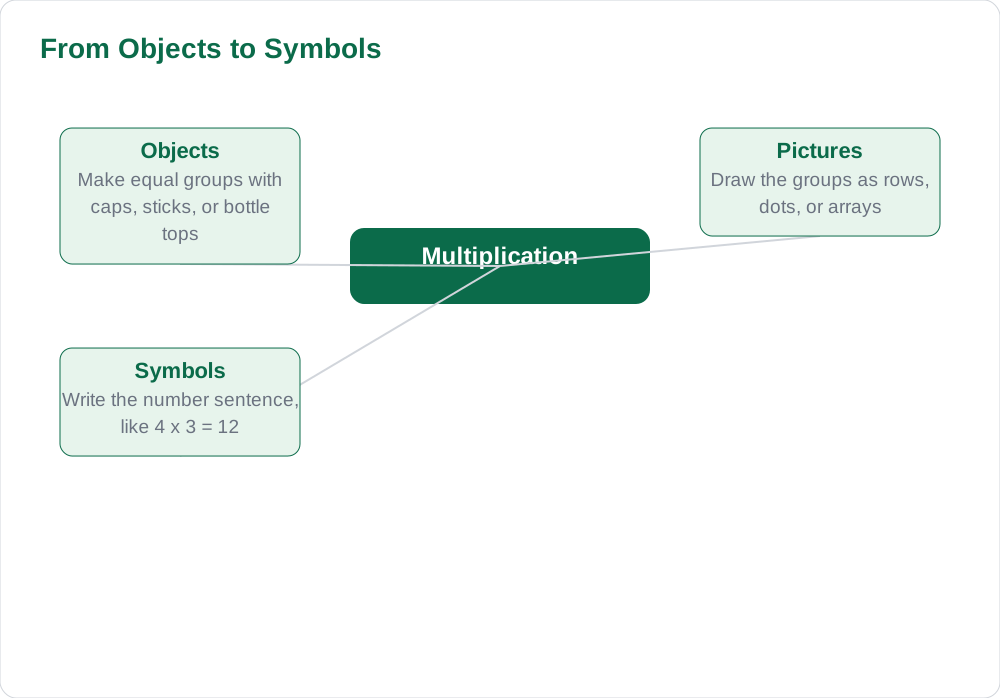
Before any table appears, let children make groups with real objects: buttons, bottle caps, pebbles, or sticks. Ask for three groups of two caps, then count them together. Ask for four groups of two. The child sees that multiplication is fast counting of equal groups. Only after this picture is clear should you write 3 x 2 = 6 on the board, and then point back to the groups the child just made.
Everyday objects work just as well at home. Egg trays hold six eggs in two rows of three. A packet of biscuits holds rows. A classroom has rows of desks. Each of these is a multiplication fact waiting to be noticed. Ask the child to find groups in the room — how many legs do three chairs have, how many wheels do two bicycles have — and the tables begin to feel like a description of the world, not a punishment from the textbook.
Counting Games That Teach Tables
Skip-counting is the bridge between adding and multiplying, and games make it stick. In a circle-counting game, children count by twos, threes, or fives around the class, and anyone who misses the pattern sits down — the game is short, lively, and full of repetition. In a clapping game, children clap on every multiple of three while counting normally, which trains the ear to hear the pattern of the table. In a dice game, two dice decide the groups and the size of each group, and the child must build the answer with counters before writing it down.
Board games work too. A simple homemade track where each square tells the player to solve a table fact turns revision into a race. The key rule for every game: the child must show the answer with groups or fingers, not just shout a memorised number. Showing the answer is what turns a game into learning. For more on solving problems with understanding, see how to solve math word problems.
- Circle counting: count by twos, threes, or fives around the class.
- Clapping game: clap on every multiple of the table being practised.
- Dice groups: roll two dice, build the groups with counters, then write the fact.
- Track game: move forward only after showing the answer with groups.
Skip-Counting Songs and Rhythms
Songs work because rhythm carries memory. A skip-counting song for the table of five, sung to a familiar tune, can stay in a child's head for years. The trick is to pair the song with movement: children step, clap, or hop on each multiple, so the body learns the pattern along with the voice. A child who has hopped to 5, 10, 15, 20 has felt the table as a pattern of jumps, not just a list of words.
Keep songs short — one table per song, and no more than a minute long. Sing the table of two on Monday, the table of five on Tuesday, and mix them on Friday. Avoid singing tables backwards and forwards at full speed before the child can say each fact with its groups. A song is a memory aid for a fact the child already understands, not a replacement for understanding.
A Weekly Plan for Tables Through Play
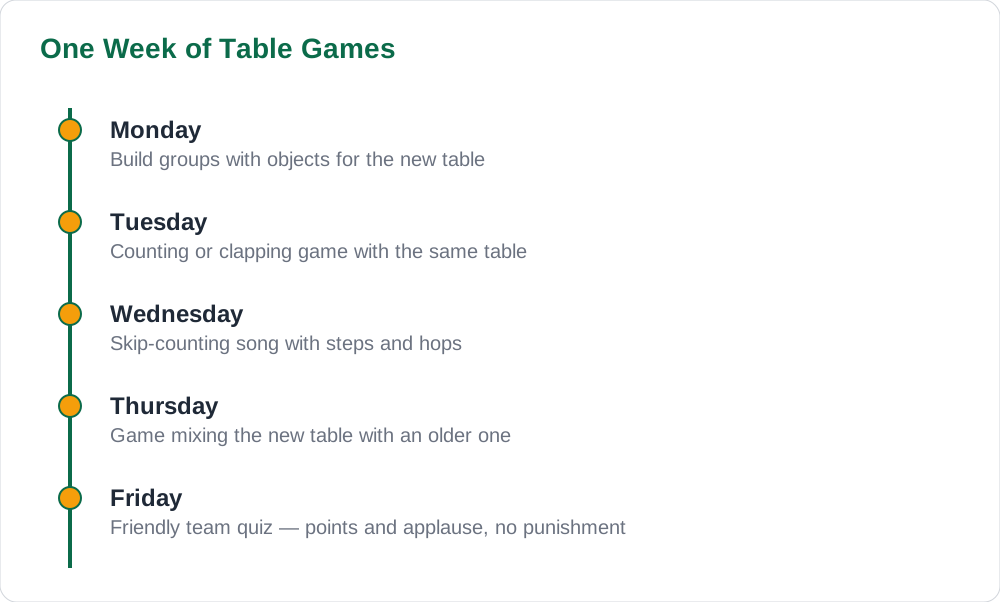
A steady weekly plan beats random practice. Monday is for building groups with objects for the new table. Tuesday is for a counting game using that table. Wednesday is for the song and movement. Thursday mixes the new table with one older table in a game, so old facts stay fresh. Friday is a friendly quiz game — teams, points, and applause, but no punishment for wrong answers. A wrong answer is simply a chance to rebuild the groups and try again.
Parents can follow the same pattern at home in ten minutes a day: one game, one round, then stop while it is still fun. Short and playful beats long and tearful, every time. Keep a small chart on the wall showing which tables the child has mastered through play — the visible progress is its own reward. For wider study routines, the blog has more tips for primary classes, and the books collection shows the readers your child uses.
AI Help: Muse AI
Muse AI is Meta's personal AI assistant. It can explain concepts simply, summarise a lesson, or make practice questions for your child's level.
For tables, you can ask Muse AI to invent a short counting game for a specific table, or to make ten quick table questions that use everyday objects like chairs, eggs, or wheels.
Join Muse with invite code LTGSWD — in the Muse app, go to Settings > Redeem token and enter the code.
Disclosure: LTGSWD is the author's Muse invite code.
Muse AI does not give official Sindh Textbook Board answers — always verify against your Sindh Textbook Board book and your teacher.
5 key points you must know
- Teach multiplication as equal groups with real objects before writing symbols.
- Games force children to use tables — counting, grouping, predicting, checking.
- Skip-counting songs with movement make table patterns stick in memory.
- A weekly plan (groups, game, song, mix, quiz) keeps old tables fresh.
- Wrong answers are chances to rebuild the groups, never a reason for punishment.
Frequently asked questions
Which table should a Class 1 or 2 child learn first?
Start with the tables of two, five, and ten, because they have the clearest skip-counting patterns. The table of one and the table of zero come naturally once children understand what multiplication means.
My child can chant the table but cannot solve word problems. Why?
Chanting stores sound, not meaning. Go back to building groups with objects for each fact, then connect the group picture to the word problem. Once the child sees the groups inside the problem, the chant becomes useful.
How much table practice is enough each day?
Ten to fifteen minutes of playful practice is plenty for primary classes. One game or one song, done daily, beats a long weekend cramming session.
Should children use their fingers for multiplication?
Yes, at first. Fingers are a legitimate counting tool, and children naturally drop them once the facts are secure. Banning fingers too early removes the child's main way of checking an answer.
What if two children in the same class learn at different speeds?
Let the faster child play the game with a harder table or with mixed tables, while the other child practises one table with objects. Games with different roles let both children play together without either feeling left behind.
Solved notes — preview free
These guides work best with the solved exercises. Preview the solved notes free on this website — 119 solved notes for Classes 6–10 in Sindhi, Urdu, English and Arabic medium. Or browse the full solved notes catalogue for your class and medium. New solved notes are added regularly — check the catalogue for coming-soon books.