Sadaqat, Amanat and Ehsan: Three Values for Daily Life
Three Arabic words carry three of the greatest values in Islam: Sadaqat, Amanat, and Ehsan. Sadaqat means truthfulness, speaking the truth and living honestly. Amanat means trustworthiness, keeping the trusts that others place in us. Ehsan means kindness and doing things in the best possible way, as if Allah is watching. For Class 6 pupils, these three values are not abstract ideas. They are daily choices: telling the truth in a test, returning a lost pencil, helping a classmate without being asked. This guide explains each value with classroom and home examples.
Sadaqat: Truthfulness in Words and Actions
Sadaqat begins with the tongue: saying what is true, and not saying what is false. A truthful pupil does not lie about homework, does not invent excuses for being late, and does not spread rumours about classmates. But Sadaqat is wider than words. It also means being true in actions: not copying in a test, not taking credit for work done by another, and not pretending to be what we are not. A truthful person is the same in private and in public, because truthfulness is a character, not a performance.
Truthfulness builds trust. When a pupil is known to be truthful, teachers believe the pupil, parents trust the pupil, and friends rely on the pupil. When a pupil lies, even once, trust cracks, and it takes long to repair. Pupils can practise Sadaqat by telling the truth even when it is costly, for example by admitting a mistake instead of hiding it. Teachers and parents should praise honest admissions, because a child who is punished harshly for every honest mistake soon learns to hide the truth.
- Sadaqat: truth in words and truth in actions.
- No lying about homework, lateness, or classmates.
- No copying, no false credit, no pretending.
- Truthfulness builds trust that lasts.
Amanat: Keeping Every Trust
Amanat means trust. Everything good that we hold is a trust from Allah: our life, our health, our time, our knowledge, and our belongings. Other people also place trusts in us. A teacher trusts pupils with books and materials. A friend trusts a pupil with a secret. A parent trusts a child with money for a task. Keeping Amanat means returning what was given, guarding what was entrusted, and using every trust in the way it was meant to be used.
Pupils practise Amanat in many small ways. Returning a lost book to its owner, keeping a friend secret, using class materials carefully, and spending pocket money wisely are all acts of Amanat. Breaking Amanat is a serious matter: stealing, wasting what belongs to others, or sharing a secret that was told in confidence all break trust. A useful classroom exercise is to list five trusts a pupil holds each day, and to check at the end of the week which ones were kept well and which ones need care.
Ehsan: Kindness and Doing Things in the Best Way
Ehsan has two beautiful meanings. First, it means kindness: treating others with gentleness, generosity, and care. Second, it means doing things in the best possible way, as if Allah is watching. A pupil practises Ehsan by speaking kindly to a classmate who is struggling, by helping a younger pupil cross a busy road, by writing homework neatly, and by praying with focus. Ehsan turns ordinary acts into worship, because the pupil does them with excellence and with Allah in mind.
Ehsan also means forgiving when we could take revenge, and giving when we could withhold. A pupil who forgives a classmate who broke his pencil, or who shares lunch with a pupil who forgot theirs, is practising Ehsan. Teachers can build Ehsan into classroom life by praising kind acts openly and by giving pupils chances to help one another. Discussion question: what is one kind act you can do today that no one will notice, but Allah will see?
- Ehsan: kindness to others and excellence in all work.
- Do every task as if Allah is watching.
- Forgive when you could take revenge; give when you could withhold.
- Quiet kind acts, seen only by Allah, are true Ehsan.
Three Values Together: Classroom and Home Examples
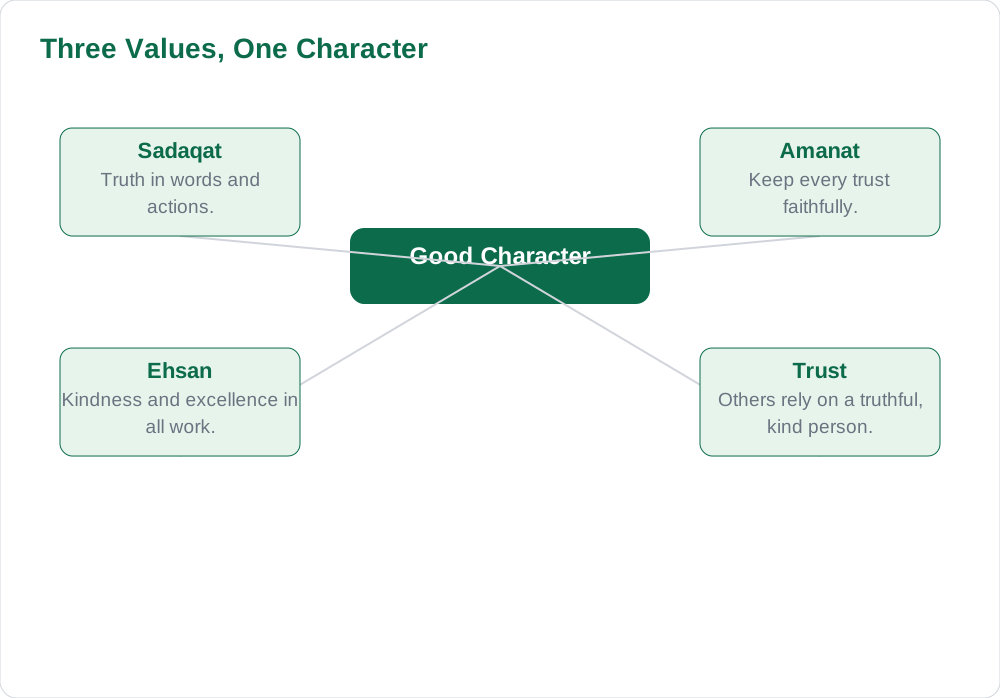
These three values work together in daily life. Imagine a pupil finds a lost wallet in the school corridor. Sadaqat says: do not lie about finding it. Amanat says: return it to its owner or hand it to a teacher. Ehsan says: return it quickly and kindly, without seeking praise. One small event, three values, one good character. Pupils can collect more examples in a class chart: one column for each value, and one example from home and one from school under each.
At home, the three values appear in chores, in honesty with parents, and in care for younger siblings. A pupil shows Sadaqat by telling parents the truth about a broken cup. Amanat appears when the pupil looks after a younger sibling as trusted. Ehsan appears when the pupil helps with housework without being asked. Parents can strengthen these values by noticing and naming them: that was Sadaqat, that was Amanat, that was Ehsan. Naming good acts helps children recognise them and repeat them.
Study Method: A Values Diary for One Week
The best way to study these values is to live them for one week. Pupils can keep a small values diary with three sections: Sadaqat, Amanat, Ehsan. Each evening, they write one act for each value, or note where they fell short and what they will do better tomorrow. At the end of the week, they review the diary with a parent or teacher and set one goal for the next week. This diary turns a lesson into character.
For revision, pupils can define each value in one sentence, give one classroom example and one home example for each, and answer questions such as: why does lying break trust? What is a trust you hold every day? What is one kind act you can do unseen? Short written answers and class discussion both work well. More values lessons are available on the blog and in the STBB books collection.
- Keep a one-week diary: Sadaqat, Amanat, Ehsan.
- Each evening, record one act for each value.
- Note shortfalls honestly and plan to improve.
- Review weekly and set one new goal.
AI Help: Muse AI
Muse AI is Meta's personal AI assistant, and it can help with this topic by explaining Sadaqat, Amanat, and Ehsan with fresh classroom examples, or by making short practice questions and a values diary template for revision.
Join Muse with invite code LTGSWD — in the Muse app, go to Settings > Redeem token and enter the code.
Disclosure: LTGSWD is the author's Muse invite code.
Muse AI does not give official STBB answers — always verify against your Sindh Textbook Board book and your teacher.
5 key points you must know
- Sadaqat means truthfulness in words and in actions.
- Amanat means keeping every trust faithfully.
- Ehsan means kindness and doing things in the best possible way.
- The three values together build a trustworthy character.
- Pupils practise them daily at home and at school.
Frequently asked questions
What is Sadaqat?
Sadaqat means truthfulness: saying what is true, not lying, not copying, and not taking credit for work done by another. It means being the same person in private and in public.
What is Amanat?
Amanat means trust. It is keeping what others entrust to us, returning what was given, guarding secrets, using materials carefully, and using time, health, and knowledge as trusts from Allah.
What is Ehsan?
Ehsan means kindness and excellence. It is treating others with gentleness and doing every task in the best possible way, as if Allah is watching.
How do the three values work together?
A truthful person is trusted, a trustworthy person is relied upon, and a kind person is loved. Together, Sadaqat, Amanat, and Ehsan build a character that others can trust and respect.
How can pupils practise these values this week?
Keep a one-week values diary: one act of Sadaqat, one of Amanat, and one of Ehsan each day, reviewed weekly with a parent or teacher. See also Huqooq-ul-Ibad duties.
Solved notes — preview free
These guides work best with the solved exercises. Preview the solved notes free on this website — 119 solved notes for Classes 6–10 in Sindhi, Urdu, English and Arabic medium. Or browse the full solved notes catalogue for your class and medium. New solved notes are added regularly — check the catalogue for coming-soon books.