Reading Longer Quran Passages in Senior Islamiat

Longer Quran passages can feel overwhelming at senior level because the passage is long, the language is dense, and the lesson seems to hide inside many verses. The solution is not to read faster or to memorise harder; it is to read in a structured way. This guide teaches a senior method for longer passages: break the passage into chunks, note key words for each chunk, and finish with a short summary line. Used regularly, this method turns a long passage into a set of small, understandable parts, and it gives you notes you can actually revise from.
Why Longer Passages Feel Difficult
A longer passage feels difficult for three separate reasons, and naming them helps you solve each one. First, length itself tires the reader, so attention fades before the end. Second, unfamiliar words slow you down, so you lose the thread of meaning while trying to understand a single term. Third, the passage may move between themes, such as guidance, warning, and encouragement, so a reader who expects one idea throughout feels lost. Senior pupils who recognise these three problems can deal with them one at a time instead of feeling generally confused.
The most important shift is to stop treating a long passage as something to finish in one breath. Treat it as a journey with resting points. Each chunk is a small unit of meaning that you can understand, note, and summarise before moving on. When you work this way, the passage stops being a wall of text and becomes a sequence of ideas, each with its own key words. That sequence is also what you will revise later, so the effort you spend chunking pays off twice.
The Chunking Method, Step by Step
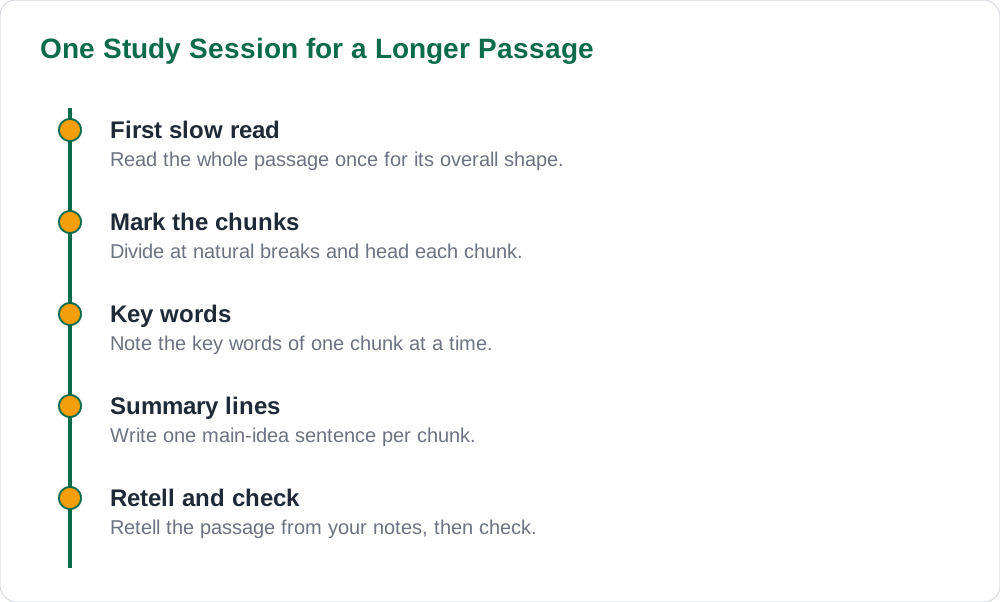
Start by reading the whole passage once slowly, without stopping to write anything, just to hear its overall shape. Then divide it into chunks at natural breaks, such as a change of theme, a new address to the reader, or a completed idea. Aim for chunks of roughly similar size, and mark each chunk with a short heading in your own words, such as 'guidance for the patient' or 'warning against arrogance'. These headings are your map; if you can list them from memory later, you have understood the passage's structure.
Next, work through one chunk at a time. Read it slowly, look up unfamiliar words from a reliable source or ask your teacher, and write two things: the key words of the chunk and one sentence stating its main idea. Do not copy long lines into your notes; your own short sentence is worth more than a copied paragraph because it proves understanding. When all chunks are done, read your chunk sentences in order. If they read like a sensible summary of the passage, your chunking has worked.
Key-Word Notes That Actually Help
Key-word notes fail when they become another long copy of the passage. A good key-word note for a chunk contains three to five words only: the central terms that carry the meaning. For example, a chunk about patience might yield the words patience, reward, and steadfastness. If you later see those three words, they should be enough to rebuild the chunk's main idea in your mind. Test your notes this way: cover the passage, look at the key words, and speak the main idea aloud. If you cannot, the key words are wrong, not your memory.
Keep your key-word notes in a single notebook or file, one passage per page, with chunk headings down the margin. This layout matters at revision time because you can cover the main-idea sentences and quiz yourself from headings and key words alone. Over a term, this notebook becomes a personal map of every long passage you have studied. Pupils who build such a notebook rarely need to re-read whole passages before exams; their chunk notes carry the meaning. For a companion reading method, see the Nazm and Ghazal reading method used for longer literary texts.
From Summary Lines to Exam Answers
Summary lines are not only for understanding; they are the raw material of exam answers. When a question asks about a passage's lesson, start from your chunk summary lines and select the ones that answer the question directly. A strong answer usually combines two or three chunk ideas: state the lesson, explain it briefly, and show how it applies to a believer's conduct. Because your summary lines are already in your own words, the answer will sound natural and organised instead of copied or jumbled.
Practise this conversion regularly. Take one passage you have chunked, invent a simple question about its lesson, and write a six-to-eight-line answer using only your summary lines. Then check the answer against the passage for accuracy. This exercise teaches the most valuable senior skill of all: moving from a text you have studied to an answer you can write under time pressure. Keep your answers short at first; accuracy and organisation matter more than length.
Mistakes That Undo Good Reading
The first mistake is reading only for completion, rushing to the end without chunking or noting anything. This feels fast but leaves nothing to revise, so the passage must be re-read from scratch later. The second mistake is writing notes that are longer than the passage itself, usually by copying instead of summarising. Notes should shrink the passage, not enlarge it. The third mistake is skipping unfamiliar words and guessing their meaning; a guessed word can quietly change a whole chunk's meaning, so always check words you do not know.
The final mistake is revising passages by re-reading them passively the night before an exam. Passive re-reading feels familiar, but familiarity is not understanding. Instead, revise by covering your summary lines and rebuilding each chunk's idea from its key words, then checking yourself. This active recall takes the same time as re-reading but produces far stronger memory. Begin this habit with your next passage, and find your class book through the books collection and the solved notes pages before you start.
AI Help: Muse AI
Muse AI is Meta's personal AI assistant. It can help with this topic by breaking a long passage into study chunks with you, or by turning your key-word notes into quick recall questions.
Join Muse with invite code LTGSWD — in the Muse app, go to Settings > Redeem token and enter the code.
Disclosure: LTGSWD is the author's Muse invite code.
Muse AI does not give official STBB answers — always verify against your Sindh Textbook Board book and your teacher.
5 key points you must know
- Read a long passage in chunks at natural breaks, not in one rushed pass.
- Give each chunk a short heading in your own words to map the passage's structure.
- Note only three to five key words per chunk, then write one main-idea sentence.
- Revise by rebuilding each chunk's idea from its key words, not by passive re-reading.
- Build exam answers from your summary lines, selecting only the chunks that answer the question.
Frequently asked questions
How large should each chunk be?
Let meaning decide, not length. A chunk ends where the theme changes or an idea completes, even if chunks end up different sizes. As a rough guide, a chunk you can summarise in one sentence is the right size.
What should I do with words I do not understand?
Never guess and move on. Check the word from a reliable source or ask your teacher, then write its meaning beside your key-word note. One misunderstood word can change a whole chunk's meaning.
How many key words should I note per chunk?
Three to five words that carry the chunk's meaning. If you need more, the chunk is probably too large and should be split. Test your notes by covering the passage and rebuilding the idea from the key words alone.
Can this method help in exams, not just in study?
Yes. Your summary lines become the building blocks of answers: select the chunks that answer the question, state the lesson, explain it briefly, and show its application. Practise writing six-to-eight-line answers from summary lines under time pressure.
Solved notes — preview free
These guides work best with the solved exercises. Preview the solved notes free on this website — 119 solved notes for Classes 6–10 in Sindhi, Urdu, English and Arabic medium. Or browse the full solved notes catalogue for your class and medium. New solved notes are added regularly — check the catalogue for coming-soon books.