Sindh Boards Join NADRA: What the New Digital Record System Means for Students
Sindh has become the first province in Pakistan to connect all of its educational boards with NADRA's secure digital system, under an agreement called the Academic Record Integration Project. For students, this is a big behind-the-scenes change: your academic records will be stored digitally, secured, and verifiable in a way that was not possible before. This article explains in plain language what the Sindh boards NADRA integration means, what changes for students, and what stays exactly the same.
What Was Announced
The Sindh government signed an agreement with NADRA under the Academic Record Integration Project to connect all educational boards in Sindh with NADRA's secure digital system. Sindh is the first province in Pakistan to sign such an agreement. The announcement was made by the Universities and Boards Minister, Ismail Rahoo, and NADRA officials confirmed that NADRA will provide the integration facility to all educational boards free of charge.
The core idea is simple. Right now, a board certificate is mainly a piece of paper. If someone wants to check whether it is real, the process can be slow and manual. Once board records are linked with NADRA's secure digital system, a student's educational record can be verified digitally. That makes the record harder to fake, easier to check, and safer for the student who earned it honestly. If you are preparing for board exams, your first job is still the same: study your Sindh Textbook Board books well and practise with solved notes so your result reflects real learning.
- All educational boards in Sindh are covered by the agreement.
- Sindh is the first province in Pakistan to sign such a pact.
- NADRA will provide the integration facility to boards free of charge.
- The project is called the Academic Record Integration Project.
What Changes for Students
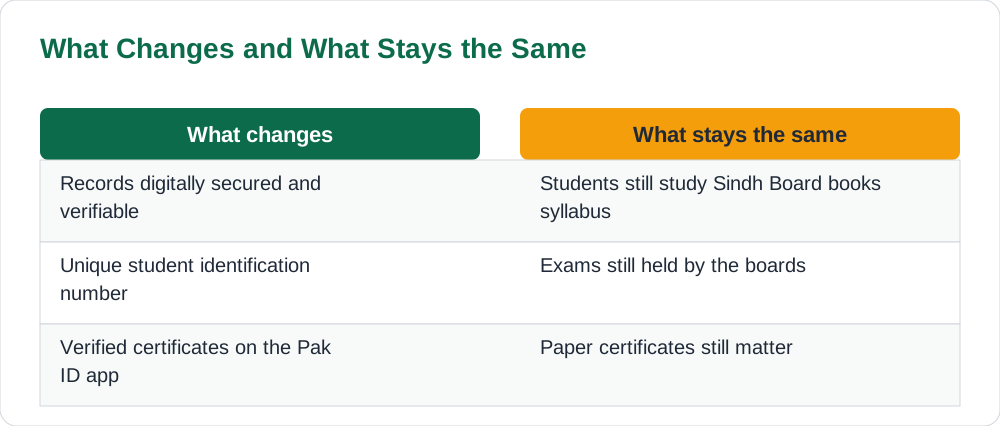
The most important change is verification. Students' educational records will be digitally secured and verifiable, which means that colleges, universities, and employers will eventually be able to confirm a certificate quickly and reliably. For an honest student, that is good news: your genuine result becomes harder for anyone else to copy or misuse, and easier for you to prove.
A second change is the plan for a unique identification number for every student. A mechanism will be developed to assign a unique identification number to each student for accurate identification and verification of academic records. In practice, this should reduce mix-ups between students with similar names and make record-keeping more accurate. A third change is access: verified academic certificates will be available through the Pak ID mobile app, so students will have a digital way to carry and show a verified certificate.
- Records become digitally secured and verifiable.
- Each student will get a unique identification number for accurate record matching.
- Verified certificates will be available through the Pak ID app.
- Verification of a genuine certificate should become faster and more reliable.
What Stays the Same
It is important not to over-read this announcement. The agreement changes how records are stored and verified. It does not change the syllabus, the exam pattern, or the way you prepare. You still study the same Sindh Textbook Board books, sit the same board exams, and earn your result through the same hard work. No announcement has changed exam dates or the paper pattern, so keep following your normal exam preparation plan and your teacher's guidance.
It also does not mean that your old certificates suddenly stop working. Existing certificates remain the record of the result you earned. The new system is about making future verification stronger and more convenient. If your school or board issues any new instructions about the unique student number or the Pak ID app, follow those official instructions and ignore rumours on social media.
- Your syllabus and exam pattern are unchanged.
- Your existing certificates remain valid records of your results.
- Study, revision, and exam preparation work exactly as before.
- Only follow official board or school instructions about new processes.
Why Sindh Signed This Agreement
The stated purpose of the pact is to prevent fake academic certificates and impersonation in examinations. Fake certificates harm everyone: they let an unqualified person claim a result they did not earn, and they make genuine certificates look less trustworthy. Impersonation — where someone else sits an exam pretending to be another student — is equally unfair to every student who prepares honestly.
A digital, verifiable record makes both kinds of fraud much harder. When a certificate can be checked against a secure digital record tied to a unique student number, a fake document is far easier to catch. That protects honest students most of all, because it protects the value of the result they worked for. For more on building results that hold up, read our guide on how to avoid common exam mistakes and our paper pattern guide for Classes 9 and 10.
What Students Should Do Now
For now, students do not need to do anything special. There is no new form to fill in and no new exam step announced as part of this pact. The sensible steps are practical ones: keep your own records safe, keep your roll number slips and result cards in a safe place, and make sure the name and details on your school and board records match your official identity documents. If a mismatch exists, raise it with your school early, because accurate records are exactly what a verification system depends on.
Second, be patient with the rollout. A project that connects every board in the province takes time, and details about the unique student number and the Pak ID certificate feature will come through official channels. Check your board's official announcements and your school's notices, and do not pay anyone who claims they can speed up or alter a digital record. Your best investment remains the same: steady study, good notes from your Sindh Textbook Board books, and honest exam preparation.
- Keep roll number slips, result cards, and certificates safe.
- Make sure your name and details match across school and board records.
- Wait for official instructions about the unique student number.
- Never pay anyone who claims to change or speed up a digital record.
AI Help: Muse AI
Muse AI is Meta's personal AI assistant. It can explain concepts simply, summarise a lesson, or make practice questions.
Muse AI can help you understand this NADRA integration in simpler words, for example by explaining what digital verification means or by summarising the key points of this article for quick revision.
Join Muse with invite code LTGSWD — in the Muse app, go to Settings > Redeem token and enter the code.
Disclosure: LTGSWD is the author's Muse invite code.
Muse AI does not give official Sindh Textbook Board answers — always verify against your Sindh Textbook Board book and your teacher.
5 key points you must know
- Sindh is the first province to link all its education boards with NADRA under the Academic Record Integration Project.
- Student records will be digitally secured and verifiable, making fake certificates harder to use.
- Every student will get a unique identification number for accurate record verification.
- Verified certificates will be available through the Pak ID mobile app.
- Syllabus, exams, and preparation stay the same — only record verification changes.
Frequently asked questions
What is the Sindh boards NADRA integration?
It is an agreement under the Academic Record Integration Project to connect all educational boards in Sindh with NADRA's secure digital system, so student records are digitally secured and verifiable.
Is Sindh the first province to do this?
Yes. Sindh is the first province in Pakistan to sign such an agreement with NADRA.
Will my old board certificate still work?
Yes. Existing certificates remain valid records of your results. The new system strengthens how records are verified; it does not cancel old certificates.
What is the unique student identification number?
A mechanism will be developed to assign a unique identification number to every student so academic records can be identified and verified accurately, reducing mix-ups between similar names.
Do students need to apply for anything now?
No new application step has been announced. Keep your records safe, make sure your details match your identity documents, and follow official board or school instructions as the rollout proceeds.
Solved notes — preview free
These guides work best with the solved exercises. Preview the solved notes free on this website — 119 solved notes for Classes 6–10 in Sindhi, Urdu, English and Arabic medium. Or browse the full solved notes catalogue for your class and medium. New solved notes are added regularly — check the catalogue for coming-soon books.