Hindu Religious Textbooks for Grades 3 to 5 in Sindh: What the New Decision Means
Sindh has decided to publish religious textbooks for Hindu students in government schools, for Grades 3 to 5, for the academic year 2026-27. Until now, minority-religion students were generally taught Ethics instead of their own faith's education. This article explains what the decision says, how the books will reach schools, and what it means for the pupils, parents, and schools affected.
What Was Decided
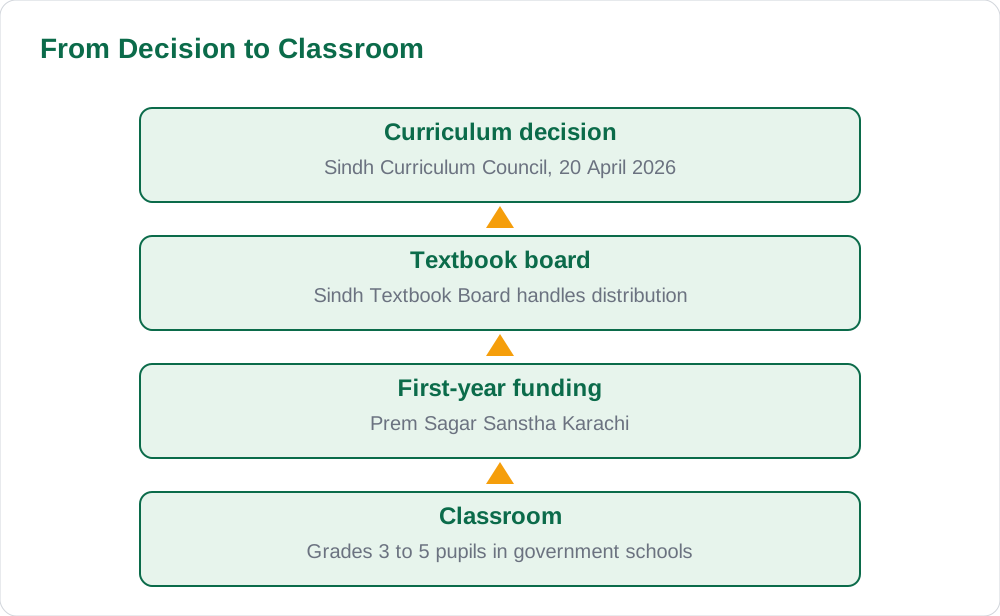
The Sindh School Education and Literacy Department decided to publish religious textbooks for Hindu students in government schools, covering Grades 3 to 5, for the academic year 2026-27. The decision was taken at the Executive Committee of the Sindh Curriculum Council meeting on 20 April 2026, and a letter was sent to the Sindh Textbook Board chairman dated 29 April 2026.
The decision was made on the directives of Sindh Education Minister Syed Sardar Ali Shah. It is a curriculum and textbook decision: the province will produce proper religious textbooks for Hindu pupils in the early primary grades, rather than leaving them with a general subject that does not teach their own faith. For families wondering how textbooks reach schools in general, our guide on how to get Sindh Textbook Board free textbooks explains the normal distribution route.
- Religious textbooks for Hindu students in government schools.
- Grades 3 to 5, for the academic year 2026-27.
- Decision taken at the Sindh Curriculum Council meeting on 20 April 2026.
- Letter to the Sindh Textbook Board chairman dated 29 April 2026.
How the Books Will Reach Schools
Distribution will run through the Sindh Textbook Board, the Sindh Textbook Board, which is the province's normal channel for getting textbooks into government schools. For the current academic year, the publication cost is borne by Prem Sagar Sanstha Karachi, and the Sindh Textbook Board is to allocate budget for the next academic year. In other words, the funding for the first year comes from that organisation, and the textbook board takes on the budget from the following year.
This matters because a textbook decision only helps pupils when the books actually arrive in classrooms. Parents and teachers should therefore watch for the books through the normal school channel: if your school has Hindu pupils in Grades 3 to 5, ask the school whether the new textbooks have been received, and report it if they have not. The books are part of the government's school textbook system, not something families are expected to buy privately.
- Distribution through the Sindh Textbook Board (Sindh Textbook Board).
- Publication cost for the current academic year borne by Prem Sagar Sanstha Karachi.
- Sindh Textbook Board to allocate budget for the next academic year.
- Books reach pupils through their government schools.
What Changes for Pupils
Previously, minority-religion students were taught Ethics instead of their own faith's education. Under the new decision, Hindu pupils in Grades 3 to 5 will study a religious textbook for their own faith. That is a meaningful change for young pupils: at this age, children are forming their understanding of their family's beliefs, festivals, and values, and a proper textbook gives teachers a structured way to teach that content.
For pupils, the practical change is straightforward: in the subject period where Ethics was taught, they will now use the new religious textbook. Pupils do not need to do anything special. Parents can help by asking the school whether the book has arrived, and by encouraging their child to read it with the same seriousness as any other subject. Good study habits — regular reading, making simple notes, and asking the teacher questions — apply to this subject just as they do to every other.
Why This Matters for Schools
For schools, the decision brings a practical task: making sure the right pupils receive the right books, and that teachers know how to use them. Head teachers should check their textbook deliveries, confirm that Grades 3 to 5 Hindu pupils have been counted, and make sure the books are given out rather than left in a store room. Teachers who will teach the new subject should read the textbook fully before the term begins, so they can plan lessons and answer pupils' questions with confidence.
The decision also reflects a wider principle: that every child in a government school deserves textbooks that respect their family's faith. Officials said over 129,000 Hindu students study in Sindh public schools, with the highest numbers in Tharparkar (26,642) and Umerkot (21,584). Those figures show why a proper textbook matters — this is not a small group, and the early primary years are exactly when a good textbook has the most effect.
- Schools must check deliveries and count eligible pupils in Grades 3 to 5.
- Teachers should read the new textbook fully before teaching it.
- Books must reach pupils, not sit in a store room.
- Over 129,000 Hindu students study in Sindh public schools, per officials.
What Parents Should Do
If your child is a Hindu pupil in Grades 3 to 5 at a government school, the steps are simple. First, ask the school whether the new religious textbook has been received for your child's class. Second, once the book arrives, help your child read it regularly, just as you would with any school subject. Third, if the book has not arrived, raise it politely with the school and, if needed, with the district education office — a decision only helps when delivery follows.
Parents of other pupils do not need to worry that this changes their children's subjects. The decision concerns religious textbooks for Hindu pupils; other pupils continue with their existing subjects. If you want to understand how Sindh's textbook system works more broadly, see our article on Sindh Textbook Board new books changes and our books page.
- Ask the school whether the new textbook has arrived for your child's class.
- Help your child read the new book regularly.
- Raise missing books politely with the school, then the district office if needed.
- Other pupils' subjects are unchanged by this decision.
AI Help: Muse AI
Muse AI is Meta's personal AI assistant. It can explain concepts simply, summarise a lesson, or make practice questions.
Muse AI can help a young pupil understand a lesson from the new religious textbook by explaining it in simple words and making gentle practice questions.
Join Muse with invite code LTGSWD — in the Muse app, go to Settings > Redeem token and enter the code.
Disclosure: LTGSWD is the author's Muse invite code.
Muse AI does not give official Sindh Textbook Board answers — always verify against your Sindh Textbook Board book and your teacher.
5 key points you must know
- Sindh will publish Hindu religious textbooks for Grades 3 to 5 in government schools for 2026-27.
- Previously, minority-religion students were taught Ethics instead of their own faith's education.
- Distribution runs through the Sindh Textbook Board; first-year publication cost is borne by Prem Sagar Sanstha Karachi.
- Officials said over 129,000 Hindu students study in Sindh public schools.
- Parents should ask the school whether the book has arrived and help their child read it regularly.
Frequently asked questions
Which grades get the new Hindu religious textbooks?
Grades 3 to 5 in government schools, for the academic year 2026-27.
What did Hindu pupils study before this decision?
Previously, minority-religion students were taught Ethics instead of their own faith's education.
Who distributes the new textbooks?
Distribution runs through the Sindh Textbook Board (Sindh Textbook Board), the province's normal textbook channel for government schools.
Who pays for the books?
The publication cost for the current academic year is borne by Prem Sagar Sanstha Karachi, and the Sindh Textbook Board is to allocate budget for the next academic year.
Does this change other pupils' subjects?
No. The decision concerns religious textbooks for Hindu pupils in Grades 3 to 5. Other pupils continue with their existing subjects.
Solved notes — preview free
These guides work best with the solved exercises. Preview the solved notes free on this website — 119 solved notes for Classes 6–10 in Sindhi, Urdu, English and Arabic medium. Or browse the full solved notes catalogue for your class and medium. New solved notes are added regularly — check the catalogue for coming-soon books.