How to Read Tashreeh Passages in Sindhi-Medium Islamiat
Tashreeh passages in Islamiat deserve slow, careful reading. They explain the meaning of a verse or a saying, and rushing through them leaves only half the lesson behind. This guide teaches a respectful method for Sindhi-medium pupils: read the key verse, study the explanation, draw out the lesson, and keep short Sindhi margin notes so the meaning stays with you long after the book is closed.
Why Tashreeh Needs Slow Reading
Tashreeh is not like a story you read once for the plot. Each sentence carries meaning, and one missed word can change the lesson. Many pupils read tashreeh quickly, the way they read a news paragraph, and then wonder why they cannot answer questions about it. The answer is pace: tashreeh rewards slow reading, pausing, and re-reading.
Slow reading is not a weakness. It is the right method for sacred and scholarly text. Read a short passage, stop, and ask yourself what it says and what it teaches. If you cannot answer in your own Sindhi words, read it once more before moving on. For general Islamiat study habits, see how to study Islamiat effectively.
- Read short passages, not whole pages at once.
- Pause after each paragraph and restate the meaning.
- Underline only the key words, not every line.
- Re-read a passage the next day before starting a new one.
The Three-Part Tashreeh Method: Verse, Explanation, Lesson
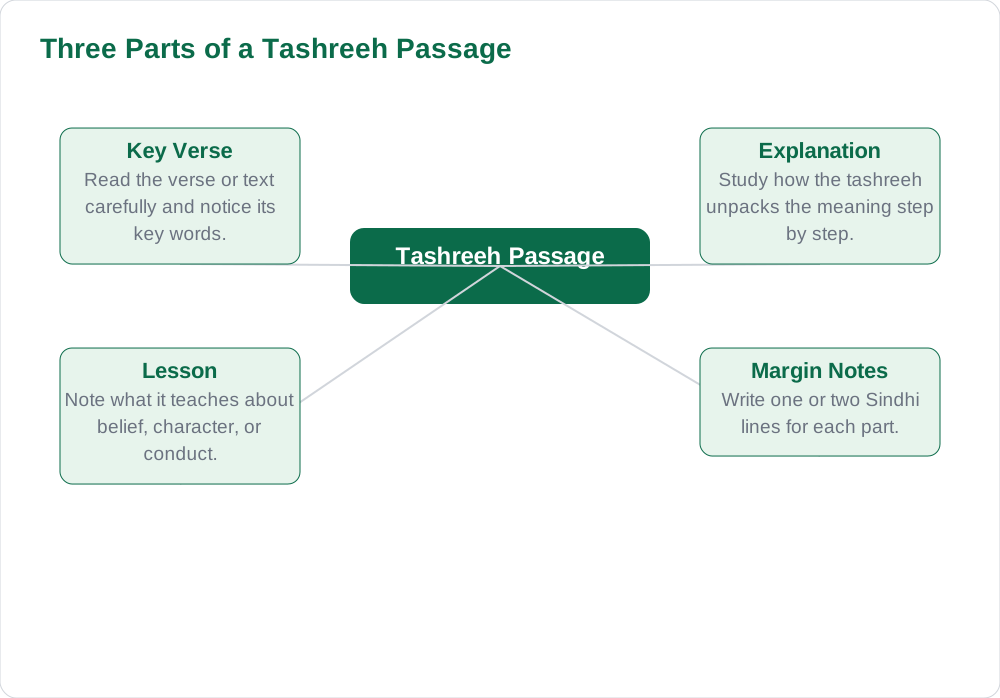
Every tashreeh passage can be read in three parts. First, the key verse or text: read it carefully and notice the words it uses. Second, the explanation: read how the tashreeh unpacks the verse, word by word or idea by idea. Third, the lesson: ask what the passage teaches about belief, character, or daily conduct, and how it applies to a pupil's life.
Write these three parts as three short notes in the margin: verse, explanation, lesson. Keep each note to one or two lines in Sindhi. When you revise, read the margin notes first; they should remind you of the whole passage. If they do not, re-read the passage and shorten the notes until they do.
Margin Notes in Sindhi That Actually Help
Good margin notes are short, personal, and written in your own Sindhi words. A note that copies the whole paragraph is useless; a note that says the meaning in one line is gold. Use simple markers: a star for the main lesson, an arrow for a cause-and-effect link, and a question mark where you need the teacher's help.
Keep a separate tashreeh notebook too. After each lesson, copy your margin notes into the notebook under three headings: verse, explanation, lesson. This second writing fixes the meaning in memory. Before exams, revise from the notebook first, and open the textbook only when a note feels unclear.
- One line per idea, in your own Sindhi words.
- Star the main lesson of each passage.
- Mark doubts with a question mark and ask your teacher.
- Copy margin notes into a tashreeh notebook the same day.
Answering Questions on Tashreeh Passages
Exam questions on tashreeh usually ask for meaning, explanation, or lesson. A strong answer follows the same three-part shape: state what the verse says in brief, explain its meaning in two or three sentences, and close with the lesson it teaches. Keep the answer focused; adding unrelated material does not earn extra marks.
Practise by turning each tashreeh passage into one question and answering it in writing. For example: what does this passage teach about honesty? Answer in four or five short sentences using your margin notes. For answer structure in general, read how to write a perfect answer and how to score full marks in Islamiat.
- Open with the brief meaning of the verse.
- Explain in two or three short sentences.
- Close with the lesson for daily life.
- Use clean handwriting and short paragraphs.
A Weekly Tashreeh Reading Routine
Read tashreeh little and often rather than in one long sitting. Read one passage slowly on the first day, re-read it and write margin notes on the second day, and explain it aloud to a family member or friend on the third day. Explaining aloud is the best test: if you can teach the passage simply, you understand it.
Keep a weekly page in your notebook: passage name, one-line lesson, and one question you still have. Over a term, these pages become a personal summary of the whole tashreeh portion. For solved exercises in Islamiat, you can also consult the solved notes on the solved notes page.
- Day one: slow reading of one passage.
- Day two: re-reading plus margin notes.
- Day three: explain it aloud to someone.
- Weekend: revise the week's one-line lessons.
AI Help: Muse AI
Muse AI is Meta's personal AI assistant. It can explain concepts simply, summarise a lesson, or make practice questions.
For this topic, ask Muse AI to help you restate a tashreeh passage in your own simple words and to suggest one practice question about its lesson.
Join Muse with invite code LTGSWD — in the Muse app, go to Settings > Redeem token and enter the code.
Disclosure: LTGSWD is the author's Muse invite code.
Muse AI does not give official Sindh Textbook Board answers — always verify against your Sindh Textbook Board book and your teacher.
5 key points you must know
- Read tashreeh slowly in short passages, pausing after each paragraph.
- Use the three-part method: key verse, explanation, lesson.
- Keep margin notes short, personal, and in your own Sindhi words.
- Answer tashreeh questions in the same three-part shape.
- Explain each passage aloud to test whether you truly understand it.
Frequently asked questions
What is tashreeh in Islamiat?
Tashreeh is the explanation of a verse or saying. It unpacks the meaning word by word or idea by idea and draws out the lesson it teaches.
How long should I spend on one tashreeh passage?
Quality matters more than minutes. Read one short passage slowly, write margin notes, and re-read it the next day. Twenty focused minutes beats an hour of rushed reading.
Should margin notes be in Sindhi or English?
Write them in Sindhi, in your own words. Sindhi notes capture the meaning fastest and are easier to recall during revision.
How do I answer a tashreeh question in an exam?
State the brief meaning, explain it in two or three sentences, and close with the lesson. Keep the answer focused and neatly paragraphed.
What if I cannot understand a tashreeh passage?
Mark it with a question mark, re-read it slowly the next day, and ask your teacher. Do not skip it or memorise it without understanding.
Solved notes — preview free
These guides work best with the solved exercises. Preview the solved notes free on this website — 119 solved notes for Classes 6–10 in Sindhi, Urdu, English and Arabic medium. Or browse the full solved notes catalogue for your class and medium. New solved notes are added regularly — check the catalogue for coming-soon books.