Learning Science Concepts in Sindhi Medium Through Mother Tongue

Science feels hard when it is taught only through unfamiliar English words. The ideas themselves are often simple: water changes with heat, plants need light, magnets pull iron. This guide shows how Sindhi-medium pupils can anchor each science concept in familiar Sindhi words and everyday village and city examples first, and only then attach the English term. When the idea is already clear in the mother tongue, the English label sticks easily.
Start With the Idea, Not the English Word
A pupil who hears evaporation before understanding the idea has two problems at once: a new word and a new concept. Reverse the order. First, describe what happens in Sindhi: wet clothes dry in the sun because water turns into invisible vapour and rises. Once that picture is clear, the English word evaporation becomes a short label for an idea the pupil already owns.
Teachers and parents can help by asking for the Sindhi explanation first. Ask, what happened here, in your own words? Let the pupil answer in Sindhi. Then supply the English term and write both side by side. This keeps science a subject about the world, not a memory test for foreign words. For study routines that support this approach, see how to make notes from Sindh Textbook Board books.
- Observe first: what did you see happen?
- Explain in Sindhi: why do you think it happened?
- Name it in English: now attach the textbook term.
- Give one more example from home or school.
Familiar Sindh Examples Make Abstract Ideas Concrete
Science is everywhere in Sindh life. The Indus river shows erosion and flow. A clay matka keeps water cool through evaporation. A bicycle pump warms up because squeezing air produces heat. A cotton field shows how plants use sunlight, water, and air to grow. When lessons start from these familiar scenes, pupils do not need to imagine a laboratory far away; they can picture their own street, farm, or courtyard.
Use the same trick for topics that feel abstract. For the water cycle, start with a puddle drying after rain, clouds forming over the river, and rain returning to the fields. For forces, start with pushing a cart, pulling a rope, and a ball rolling downhill. The textbook diagram then becomes a neat drawing of something the pupil has already seen, not a mystery to memorise.
- Water cycle: puddle, sun, cloud, rain, river, field.
- Heat: sun on a rooftop, warm pump, matka cooling.
- Plants: cotton, wheat, or a school garden plant.
- Forces: cart, rope, ball, bicycle brake.
A Three-Step Method for Every Science Lesson
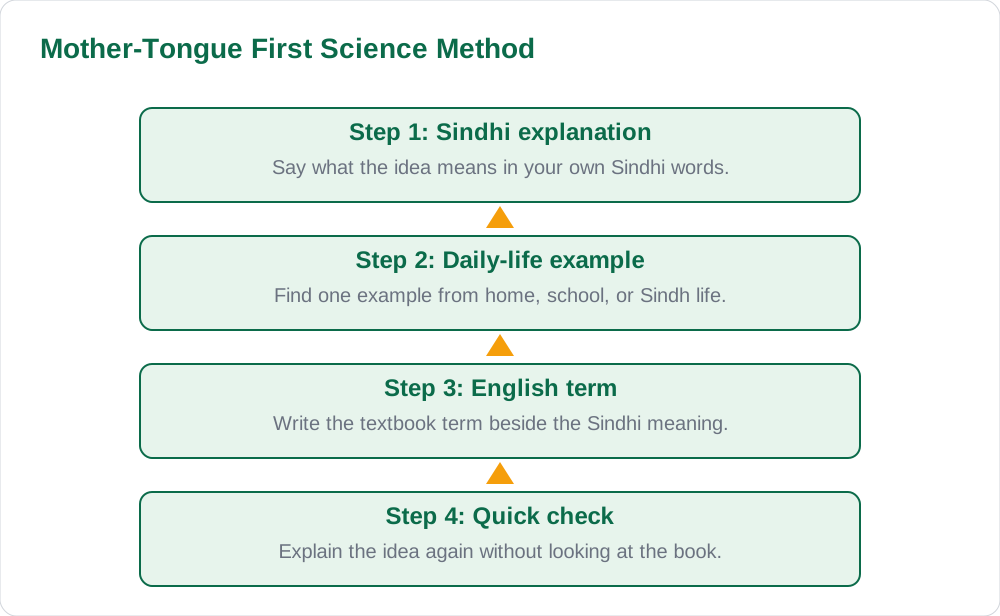
Use the same three steps for every lesson so science becomes predictable. Step one: read the lesson heading and say in Sindhi what you think the lesson is about. Step two: find one example from daily life that matches the idea, and explain it in two Sindhi sentences. Step three: learn the English terms from the lesson and write each beside its Sindhi meaning with one example.
This method works for definitions too. Do not memorise a definition before you can explain it. First explain the idea in Sindhi, then read the textbook definition and underline the words that match your explanation. Finally, rewrite the definition in your own short English sentences. That rewritten version is what you revise before tests, because it carries both meaning and language.
Common Science Terms With Sindhi Anchors
Some terms cause trouble because they sound similar or because the English word hides a simple idea. Photosynthesis sounds long, but the idea is plain: a green plant uses sunlight, water, and air to make its own food. Condensation sounds technical, but it is the dew on grass and the droplets on a cold glass. Magnetism is the pull you feel when a magnet lifts an iron nail.
Keep a small glossary page in the back of your science notebook. Write the English term, the Sindhi meaning, and one Sindh example. Revise five terms a day by covering the English column and recalling it from the Sindhi explanation. For exam-time revision, pair this with the method in how to revise before exam night.
- Photosynthesis: plant making food from sunlight, water, and air.
- Evaporation: water turning into vapour and rising, like clothes drying.
- Condensation: vapour cooling back into droplets, like dew.
- Friction: the grip that slows things down, like shoes on a rough road.
From Mother Tongue to Exam Answers
Exams ask for answers in the paper's language, so the final step is to practise writing short English answers from your Sindhi understanding. Take one concept, say it in Sindhi, then write three short English sentences: what it is, one example, and why it matters. Keep sentences short and clear. A neat three-sentence answer with the right term earns more marks than a long paragraph copied without understanding.
Practise one such answer after each lesson. Over a month, you build a bank of short answers you truly understand. For answer structure and time habits, read how to write a perfect answer and how to manage time during exams.
- Sentence one: define the concept simply.
- Sentence two: give one daily-life example.
- Sentence three: state why it matters or what it causes.
AI Help: Muse AI
Muse AI is Meta's personal AI assistant. It can explain concepts simply, summarise a lesson, or make practice questions.
For this topic, ask Muse AI to explain one science concept first in simple Sindhi and then in short English sentences you can use in an exam answer.
Join Muse with invite code LTGSWD — in the Muse app, go to Settings > Redeem token and enter the code.
Disclosure: LTGSWD is the author's Muse invite code.
Muse AI does not give official Sindh Textbook Board answers — always verify against your Sindh Textbook Board book and your teacher.
5 key points you must know
- Understand the science idea in Sindhi first, then attach the English term.
- Anchor every concept in one familiar Sindh example from home, school, or the farm.
- Keep a glossary page: English term, Sindhi meaning, one example.
- Practise writing three-sentence English answers from your Sindhi understanding.
- Explain the idea aloud without the book before calling a lesson finished.
Frequently asked questions
Should science be studied in Sindhi or English?
Both, in order. First understand the idea in Sindhi, then learn the English term. Understanding in the mother tongue makes the English label easy to remember.
How do I remember long terms like photosynthesis?
Break the idea into parts: photo means light, synthesis means making. A plant uses light to make food. Remember the idea first and the word becomes a label, not a puzzle.
What if my textbook has no Sindhi explanation?
Write your own Sindhi meaning in the margin beside the English term, plus one example. Your own words are more memorable than a printed translation.
How can parents help if they do not know English science terms?
They can ask the pupil to explain the idea in Sindhi and give a home example. If the pupil can explain it clearly in Sindhi, the concept is understood.
How many science terms should I revise per day?
Five terms a day is enough. Revise by covering the English column, recalling the term from the Sindhi meaning, and then writing one short English sentence for each.
Solved notes — preview free
These guides work best with the solved exercises. Preview the solved notes free on this website — 119 solved notes for Classes 6–10 in Sindhi, Urdu, English and Arabic medium. Or browse the full solved notes catalogue for your class and medium. New solved notes are added regularly — check the catalogue for coming-soon books.