Social Studies Through Local Sindh Examples for Sindhi Medium
Social studies becomes memorable when it starts from the world pupils already know. A lesson on rivers means more when it starts with the Indus. A lesson on markets means more when it starts with the bazaar pupils walk through. This guide shows Sindhi-medium pupils how to ground every geography and civics lesson in Sindh towns, rivers, and markets, so textbook concepts feel real instead of distant.
Start From Your Own Town, Then Zoom Out
Every social studies topic has a local door. Before reading about a province, describe your own town: its river or canal, its main market, its school, its mosque or shrine, and the work most people do. Then read the textbook and ask: how is this bigger place like my town, and how is it different? The comparison turns abstract reading into a conversation with a place you know.
This zoom-out method works for geography and civics alike. A lesson on climate starts with your town's summer heat and winter mornings. A lesson on local government starts with your own union council or municipal office. The textbook then adds the wider picture to a foundation that is already solid.
- Describe your town first: river, market, school, work, transport.
- Compare each textbook place with your town.
- Ask: what is similar, and what is different?
Geography Through the Indus and Sindh Landscapes
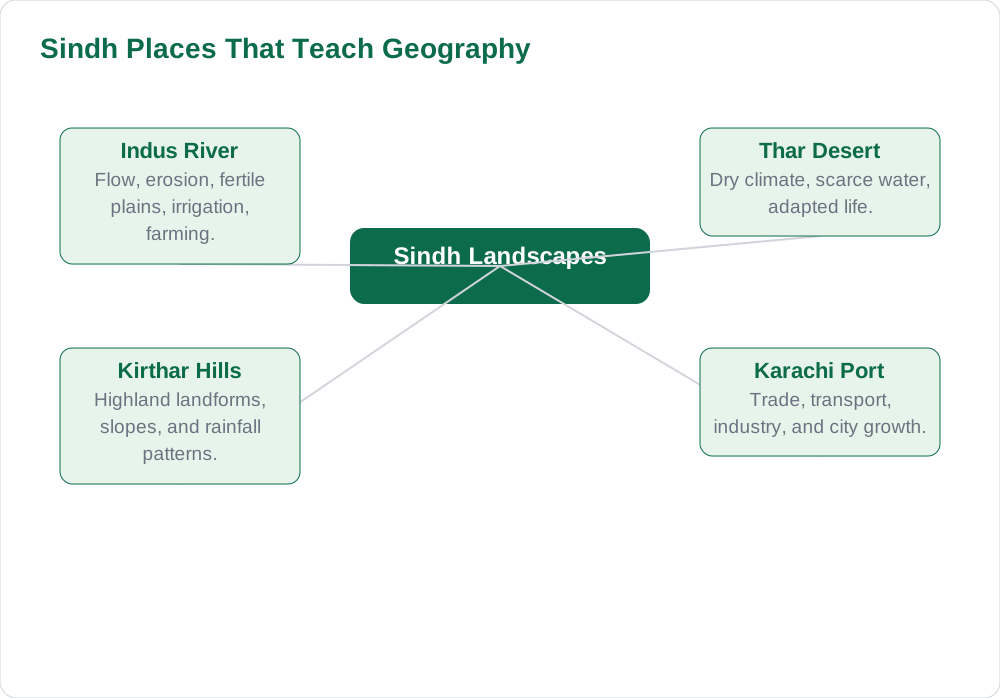
The Indus river is the best geography teacher in Sindh. It shows flow, erosion, fertile plains, irrigation, and the link between water and farming. When the textbook discusses rivers, trace the Indus in your mind from the north to the sea, and name the towns and fields along the way. When it discusses irrigation, think of the canals and watercourses that feed Sindh's wheat and cotton fields.
Use other Sindh landscapes the same way. The Thar desert shows dry climate and scarce water. The Kirthar hills show highland landforms. Karachi's port shows trade, transport, and industry. A concept tied to a place you can picture is a concept you will remember. For note-making that captures these links, see how to make notes from Sindh Textbook Board books.
Civics Through Markets, Schools, and Local Government
Civics is the study of how people live and govern together, and its examples are all around. A market shows buying and selling, prices, and rules that keep trade fair. A school shows organisation, rules, and responsibility. A local council office shows how decisions are made and services delivered. When the textbook names an institution, ask: what is the version of this in my town, and who runs it?
Try a short field observation. Visit a market with a parent and notice who sells what, how prices are set, and what rules keep the market orderly. Then write three sentences linking what you saw to the civics lesson. That observation will stay in your memory far longer than a paragraph memorised from the book.
- Market: trade, prices, fairness, rules.
- School: organisation, rules, responsibility.
- Local council: decisions, services, public duty.
- Observe one local example, then link it to the lesson.
History and Culture Through Sindh Stories
History becomes alive when it connects to places and people pupils know. A lesson on ancient sites means more when pupils know that Mohenjo-daro stands in Sindh. A lesson on culture means more when it mentions Sindhi ajrak, topi, folk tales, and the poetry of Shah Abdul Latif Bhittai. These are not decorations on the lesson; they are the evidence that history happened here.
When you study a historical topic, find its Sindh connection. Where did it happen? Who were the people? What can still be seen today? Write the connection in your notebook in two Sindhi sentences. That habit turns history from a list of dates into a story about a place you belong to.
- Mohenjo-daro: an ancient city in Sindh.
- Ajrak and topi: living symbols of Sindhi culture.
- Shah Abdul Latif Bhittai: poetry that carries Sindh's values.
- For every history topic, find the Sindh connection.
From Local Examples to Exam Answers
Local examples also strengthen exam answers. A geography answer that names the Indus and a Sindh canal shows real understanding. A civics answer that mentions the local market or council shows the pupil can apply the concept. Keep answers short and relevant: state the concept, give one local example, and explain what the example shows.
Practise one local-example answer after each lesson. Over a term, you build a bank of answers that are both correct and personal. For answer structure and time habits, read how to write a perfect answer and how to manage time during exams.
- State the concept in one sentence.
- Give one local Sindh example.
- Explain what the example shows about the concept.
AI Help: Muse AI
Muse AI is Meta's personal AI assistant. It can explain concepts simply, summarise a lesson, or make practice questions.
For this topic, ask Muse AI to suggest one Sindh example for a social studies concept from your lesson, such as a river, market, or local institution.
Join Muse with invite code LTGSWD — in the Muse app, go to Settings > Redeem token and enter the code.
Disclosure: LTGSWD is the author's Muse invite code.
Muse AI does not give official Sindh Textbook Board answers — always verify against your Sindh Textbook Board book and your teacher.
5 key points you must know
- Start each topic from your own town, then zoom out to the textbook's bigger picture.
- Use the Indus, Thar, Kirthar hills, and Karachi port as geography anchors.
- Learn civics through markets, schools, and local government you can observe.
- Find the Sindh connection in every history and culture lesson.
- Strengthen exam answers with one relevant local example per concept.
Frequently asked questions
Why use local examples in social studies?
Local examples turn abstract concepts into things pupils have seen. A concept tied to a known place is easier to understand, remember, and apply in answers.
What is the best local example for a river lesson?
The Indus river. It shows flow, erosion, fertile plains, irrigation, and the link between water and farming across Sindh.
How can a market teach civics?
A market shows trade, prices, fairness, and rules. Observing who sells what and how the market stays orderly illustrates how rules and institutions work.
How do I use local examples in exam answers?
State the concept, give one local example, and explain what it shows. Keep it short and relevant; one strong example beats three vague ones.
What if my town has no famous landmark?
Every town has a market, a school, a water source, and local work. Those everyday places are excellent examples for geography and civics.
Solved notes — preview free
These guides work best with the solved exercises. Preview the solved notes free on this website — 119 solved notes for Classes 6–10 in Sindhi, Urdu, English and Arabic medium. Or browse the full solved notes catalogue for your class and medium. New solved notes are added regularly — check the catalogue for coming-soon books.