STBB's 195 Textbooks for 2026-27: Inside the Benazir Bhutto Textbook Series
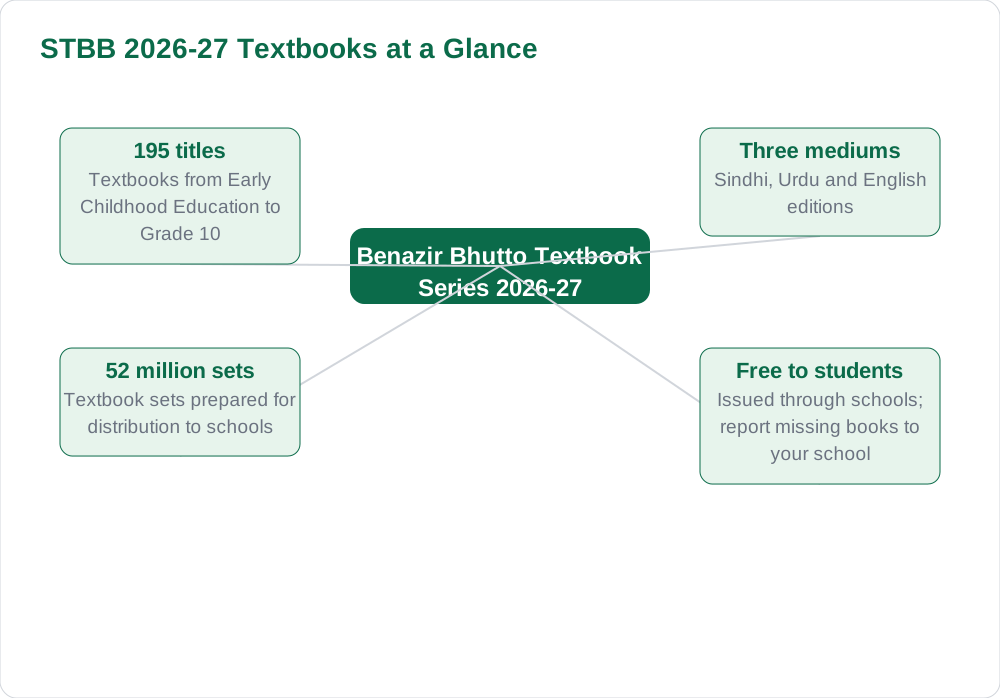
For the 2026-27 academic year, the Sindh Textbook Board completed publication of textbooks from Early Childhood Education through Grade 10 under the Shaheed Mohtarma Benazir Bhutto Textbook Series, a milestone that touches nearly every government school student in Sindh. The scale is remarkable: 195 titles published in Sindhi, Urdu and English, forming 52 million textbook sets for distribution to schools. Distribution was inaugurated on 19 February 2026 at the Government Girls Lower Secondary School in Neelam Colony, Clifton, Karachi, by Education Minister Syed Sardar Ali Shah. This article explains what the series covers, how free textbooks reach students, why the three-medium coverage matters, and what a student or parent should do if a book is missing, damaged or delayed.
What the Benazir Bhutto Textbook Series Covers
The series covers the full span from Early Childhood Education to Grade 10, which means it supports a child's entire primary and secondary journey in government schools, not just a single class or subject. With 195 titles, it includes the textbooks students need across grades and subjects, published for the 2026-27 academic year as a complete programme rather than a partial release. That completeness matters for teachers as well as students, because when every class has its books, lessons can follow the intended sequence instead of working around missing material. Parents sometimes ask whether a new series means old books are useless; in practice, students should use the textbook their school issues for the current academic year, and teachers will guide them if any edition question arises.
Naming the series after Shaheed Mohtarma Benazir Bhutto gives the programme a public identity that schools, parents and students can recognise, and it signals the government's commitment to free textbook provision as a core part of schooling. Beyond the name, what matters in classrooms is content quality, print clarity and availability, and the scale of this publication effort, 195 titles across three mediums, is designed to meet those needs together. Students should treat their issued textbooks as their primary study source, since examinations, classwork and solved exercises all follow the official book. The books page and solved notes on this site are built around official STBB material for exactly that reason.
Three Mediums, One Province: Sindhi, Urdu and English
Publishing in Sindhi, Urdu and English reflects Sindh's linguistic reality, where students learn in different mediums depending on their school and community. A Sindhi-medium student, an Urdu-medium student and an English-medium student all need the same curriculum content in the language they actually study in, and a series that covers all three mediums prevents the situation where some students wait longer or study from mismatched material. Mother tongue and medium choice are deeply connected to understanding, especially in early grades, where a child who reads in a familiar language learns faster and with more confidence. Sindh's long-standing approach of offering mother tongues as subjects sits alongside this medium coverage, giving students both access and identity in their education.
For students, the practical rule is simple: use the medium your school has assigned, and do not switch mediums mid-year because a friend's book looks easier. Each medium's book covers the same curriculum ground, but terminology, examples and exercises are prepared for that medium, and switching creates confusion rather than advantage. If your school issues a book in the wrong medium, raise it with your teacher promptly, because a medium error is much easier to correct at the start of term than after months of study. Parents should check the medium printed on each issued book when their child brings books home, and keep a list of what was received so that any gap is easy to report. Language should open learning, never block it.
52 Million Sets: What the Number Means for Your School
Fifty-two million textbook sets is a number so large it can feel abstract, but its meaning for an individual student is concrete: the programme is designed so that government school students receive their books free, without families having to buy them from the market. Distribution on this scale involves printing, packing by grade and medium, transport to districts, and delivery to schools, which is why inauguration events mark the start of a process that then unfolds school by school. The inauguration on 19 February 2026 at the Government Girls Lower Secondary School in Neelam Colony, Clifton, Karachi, by Education Minister Syed Sardar Ali Shah, formally launched that distribution for the academic year. After inauguration, the question for each family is practical, not ceremonial: has my child's school received and issued the books?
Large-scale distribution can still face local delays, because a set intended for one school may arrive late, in the wrong medium, or in incomplete numbers. That is why parents and students should treat book receipt as something to check actively, rather than assuming it will happen automatically. When your school announces book distribution, attend on the stated day if possible, check every book against your child's class and subject list, and report gaps immediately. Schools can usually resolve most issues from their own stock or through district channels, but they can only fix gaps they know about. Keeping a simple receipt list at home, with each book ticked off, turns a province-wide programme into a personal checklist that protects your child's studies.
How Students Receive Their Free Books
Free textbooks are issued through schools, so your school is the distribution point and your first contact for any book question. At the start of the academic year or term, schools typically announce distribution days by class, and students collect the set for their grade and medium, sometimes with a parent or guardian present. Bring any previous book-return requirement your school mentions, listen to the teacher's instructions about covering and caring for books, and check each book on the spot for missing pages or print defects before leaving. Teachers often record which books were issued to which student, so the school has a record if a later question arises. If you are new to a school, ask the office about book issuance during admission, so you are not left waiting for a distribution day that has already passed.
Caring for free books is part of respecting the programme that provides them. Cover books promptly, keep them dry and away from damage, write your name and class inside as your school directs, and return them if your school collects books at year end. A well-kept book can serve another student in a later year where reuse applies, and a damaged book may be harder to replace mid-year. If a book is lost, report it to your teacher honestly and promptly, and ask about the replacement procedure rather than trying to study without it. Studying without a textbook for weeks is one of the most avoidable causes of falling behind, and schools would much rather solve a lost-book problem early than discover it at examination time.
- Collect books on your school's announced distribution day, by class and medium
- Check every book on the spot for missing pages or print defects
- Keep a home list of books received so gaps are easy to report
- Cover and care for books; report a lost book to your teacher immediately
- Ask the school office about issuance if you join a school mid-year
If a Book Is Missing, Damaged or Delayed
If a book is missing from your set, first confirm exactly which book is missing by comparing your set with your class subject list and with classmates in the same medium. Then report it to your class teacher or school office the same week, giving the subject, class and medium clearly, so the school can check its stock or request the book through its channels. Do not wait until examinations approach, because replacement becomes harder and your study gap grows with every week. While waiting, borrow a classmate's book for the chapters you need, copy essential exercises, and attend every lesson, so that a missing book delays but does not stop your learning. Teachers can often provide photocopied pages or guidance for the interim period if they know about the problem.
If a book arrives damaged, with missing or misprinted pages, show it to your teacher rather than trying to repair it silently, because the school may be able to exchange it. If distribution to your whole school is delayed, parents can raise the matter collectively through the school management or parent representatives, since a school-wide delay is more visible and easier to escalate than an individual complaint. Keep your own record of what was reported and when, and follow up politely if a week passes without news. Free textbook provision is a right that the 2026-27 programme is designed to deliver, and calm, specific, documented follow-up is the most effective way to make sure it reaches your child. Your textbook is the foundation of your year's study, and securing it early is worth every bit of effort. Study tips for using it well are in the blog guides.
AI Help: Muse AI
Muse AI is Meta's personal AI assistant, and it can help you with your textbooks by explaining a difficult lesson in simple words, summarising a chapter you have just read, or helping you make revision notes from your STBB book.
Join Muse with invite code LTGSWD — in the Muse app, go to Settings > Redeem token and enter the code.
Disclosure: LTGSWD is the author's Muse invite code.
Muse AI does not give official STBB answers — always verify against your Sindh Textbook Board book and your teacher.
4 key points you must know
- STBB completed 195 textbooks from Early Childhood Education to Grade 10 for 2026-27 under the Benazir Bhutto Textbook Series
- The series is published in Sindhi, Urdu and English, with 52 million textbook sets prepared
- Distribution was inaugurated on 19 February 2026 in Neelam Colony, Karachi, by Minister Syed Sardar Ali Shah
- Students receive books free through schools; missing or damaged books should be reported to the school promptly
Frequently asked questions
How many textbooks did STBB publish for 2026-27?
STBB completed 195 textbook titles from Early Childhood Education to Grade 10 for 2026-27, under the Shaheed Mohtarma Benazir Bhutto Textbook Series, in Sindhi, Urdu and English.
How many textbook sets were prepared for 2026-27?
Fifty-two million textbook sets were prepared for distribution to schools for the 2026-27 academic year.
When was textbook distribution inaugurated?
Distribution was inaugurated on 19 February 2026 at the Government Girls Lower Secondary School, Neelam Colony, Clifton, Karachi, by Education Minister Syed Sardar Ali Shah.
What should I do if my child's textbook is missing?
Compare the set with the class subject list, report the exact subject, class and medium to the class teacher or school office promptly, and borrow a classmate's book for interim study while the school arranges a replacement.
Solved notes — preview free
These guides work best with the solved exercises. Preview the solved notes free on this website — 119 solved notes for Classes 6–10 in Sindhi, Urdu, English and Arabic medium. Or browse the full solved notes catalogue for your class and medium. New solved notes are added regularly — check the catalogue for coming-soon books.