The Treaty of Hudaibiya: A Lesson in Patience and Wisdom
The Treaty of Hudaibiya is one of the great lessons in Islamic history. It was a peace agreement made between the Muslims of Madinah and the Quraysh of Makkah at a place called Hudaibiya. At first, many Muslims felt disappointed by its terms, because the treaty seemed to favour the other side. Yet with time, everyone saw its wisdom. The treaty brought peace, opened the way for people to hear the message of Islam freely, and led to great good. For Class 6 pupils, the story of Hudaibiya teaches patience, wisdom, and the courage to choose peace over anger.
The Journey to Hudaibiya: A Peaceful Purpose
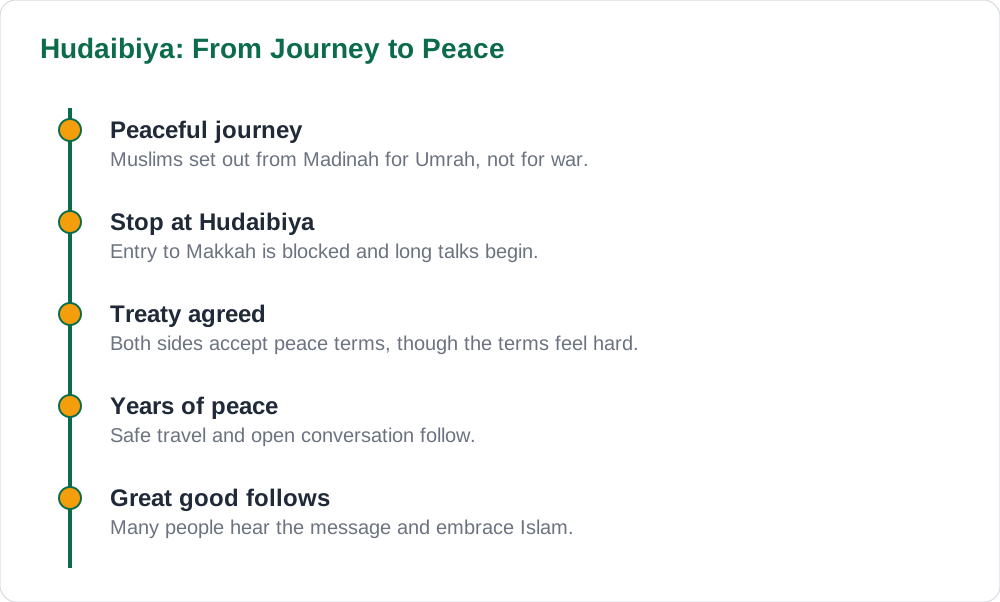
The story begins with a peaceful purpose. The Holy Prophet Muhammad (peace be upon him) set out from Madinah with his companions to perform Umrah, the lesser pilgrimage, in Makkah. They did not carry weapons for war. They carried the intention of worship, and they brought sacrificial animals for the pilgrimage. This peaceful purpose matters. The Muslims were not marching to fight. They were travelling to worship Allah in the Holy Kaaba, and they hoped to be allowed to enter Makkah in peace.
When they reached Hudaibiya, near Makkah, they were stopped, and long talks began. The Quraysh did not wish to let them enter Makkah that year. Messengers went back and forth, and the discussions were tense. Yet the Holy Prophet (peace be upon him) stayed calm and kept seeking a peaceful answer. Pupils can learn a first lesson here: a good leader does not rush to anger when blocked. He keeps talking, keeps listening, and keeps looking for a peaceful path, even when the wait is hard.
- The Muslims travelled to Makkah for Umrah, not for war.
- They carried no intention of fighting and sought a peaceful entry.
- Long talks at Hudaibiya tested patience on both sides.
- Calm leadership kept the door to peace open.
The Treaty: Terms That Tested Patience
In the end, a treaty was agreed. Its terms were hard for many Muslims to accept. The Muslims would return to Madinah that year without performing Umrah, and would return the following year for a short visit. There would be peace between the two sides for a fixed period, and other tribes would be free to join either side. Some companions felt that these terms were unfair, because they had come so far with such a peaceful purpose, only to turn back. Their disappointment was honest and human, and the story does not hide it.
This is where the lesson of patience becomes clear. Patience is not only waiting quietly. Patience is trusting Allah wisdom when the outcome does not look like what we wanted. The Holy Prophet (peace be upon him) accepted the treaty because he saw further than the moment. He saw that peace would give people safety, time, and freedom to think, learn, and choose. Pupils can discuss: have you ever accepted a decision that felt unfair at first, but later proved wise? How did patience help?
Why Peace Was the Wiser Choice
Peace is often stronger than fighting, and Hudaibiya shows why. When the fighting stopped, people could travel safely. Traders, travellers, and tribes could meet Muslims, hear their message, and see their character without fear. Many people who had only heard rumours about Islam now met Muslims face to face and were drawn to their honesty, kindness, and discipline. The message of Islam spread more in the years of peace than it had in years of conflict. The treaty that looked like a setback became a doorway to great good.
Wisdom means looking at long results, not only quick feelings. A quick fight might have satisfied anger, but it would have closed hearts and deepened hatred. A patient peace opened hearts and built understanding. This is a lesson pupils can use in school life too. When two pupils quarrel, a wise pupil does not answer insult with insult. He pauses, listens, and seeks a fair peace, even if it means giving up something small in the moment. Peace-making is not weakness. It is strength guided by wisdom.
- Peace allowed safe travel, meeting, and honest conversation.
- People could see Muslim character without fear.
- The message of Islam spread widely in the years of peace.
- Wisdom looks at long results, not quick feelings.
Lessons for Pupils: Patience, Wisdom, and Peace-Making
The first lesson of Hudaibiya is patience. Patience means holding steady when things do not go our way. A pupil shows patience by waiting calmly, by not shouting when a plan fails, and by trusting that Allah knows what is best. The second lesson is wisdom. Wisdom means thinking before acting, listening before answering, and choosing the path that brings lasting good rather than quick satisfaction. The third lesson is peace-making. A peace-maker is someone who brings quarrelling people together, who forgives when possible, and who prefers agreement to revenge.
Pupils can practise these lessons in small ways. When a game goes wrong, they can suggest a fair replay instead of arguing. When a classmate says something hurtful, they can answer calmly or walk away instead of returning the insult. When a group project hits a disagreement, they can listen to every voice and find a solution that is fair to all. Teachers can praise peace-making openly, so that pupils see it as a mark of strength. For more Islamic history and character lessons, see the blog and the solved notes page.
Study Method: Retelling Hudaibiya in Your Own Words
The best way to study Hudaibiya is to retell it. Pupils can work in groups of three: one tells the journey, one tells the treaty, and one tells the results and lessons. Each pupil speaks for one minute, in their own words, without reading. Then the group writes three lessons on a card: patience, wisdom, and peace-making, with one example for each from school life. This retelling method fixes the story in memory far better than copying notes.
For revision, pupils can answer questions such as: why did the Muslims travel to Hudaibiya? Why did the treaty feel hard at first? Why was peace wiser than fighting? What is one way I can be a peace-maker this week? Parents can ask one of these questions at home and listen to the answer. Further study help is available in the STBB books collection and the companion guide Ghazwa Khyber in Clear Sequence.
- Retell the story in your own words, in three parts.
- Write three lessons with one school example for each.
- Practise answering why peace was wiser than fighting.
- Ask: how can I be a peace-maker this week?
AI Help: Muse AI
Muse AI is Meta's personal AI assistant, and it can help with this topic by retelling the story of Hudaibiya in simpler words, explaining why patience and wisdom mattered, or making short practice questions about the treaty and its lessons.
Join Muse with invite code LTGSWD — in the Muse app, go to Settings > Redeem token and enter the code.
Disclosure: LTGSWD is the author's Muse invite code.
Muse AI does not give official STBB answers — always verify against your Sindh Textbook Board book and your teacher.
5 key points you must know
- The Muslims travelled to Hudaibiya for peaceful Umrah, not for war.
- The treaty terms felt hard, but patience and trust in Allah wisdom carried the day.
- Peace opened the way for people to hear Islam and see Muslim character.
- Hudaibiya teaches patience, wisdom, and peace-making.
- Pupils practise these lessons by choosing fair peace over quick anger.
Frequently asked questions
What was the Treaty of Hudaibiya?
It was a peace agreement between the Muslims of Madinah and the Quraysh of Makkah, made at Hudaibiya. It set terms for peace and for a later visit for Umrah, and it brought a period of calm between the two sides.
Why did the treaty feel hard for the Muslims?
They had travelled far for Umrah with a peaceful purpose, yet the treaty asked them to return that year without entering Makkah. The terms felt disappointing at first, even though they later proved wise.
Why was peace wiser than fighting at Hudaibiya?
Peace allowed safe travel, open conversation, and honest meeting between people. Many who had only heard rumours about Islam could now see Muslim character and hear the message without fear.
What does Hudaibiya teach about patience?
Patience means holding steady when things do not go our way and trusting Allah wisdom. It is not passive waiting; it is calm, steady conduct while waiting for a better outcome.
How can a pupil be a peace-maker at school?
By listening to both sides of a quarrel, suggesting a fair solution, forgiving when possible, and refusing to answer insult with insult.
Solved notes — preview free
These guides work best with the solved exercises. Preview the solved notes free on this website — 119 solved notes for Classes 6–10 in Sindhi, Urdu, English and Arabic medium. Or browse the full solved notes catalogue for your class and medium. New solved notes are added regularly — check the catalogue for coming-soon books.