Translation Practice Between Urdu and English for School Pupils

Translation is not about swapping words one by one; it is about carrying the same meaning from one language into the other. School pupils often translate Urdu into English word by word and end up with sentences that sound strange or lose the original sense. This guide teaches translation practice between Urdu and English through short sentence pairs and back-translation checks. With a few minutes of daily practice, pupils build accurate two-way translation habits that help in English, Urdu, and every subject that uses both languages.
Why Translation Goes Wrong
Most translation errors come from following the word order of the first language too closely. Urdu often places the verb at the end, while English usually places it after the subject, so a word-by-word translation scrambles the sentence. Idioms cause a second problem: a phrase that makes sense in Urdu may sound odd when translated literally, and the pupil must find the natural English equivalent instead. A third problem is false friends, words that look similar in both languages but carry different meanings or levels of formality.
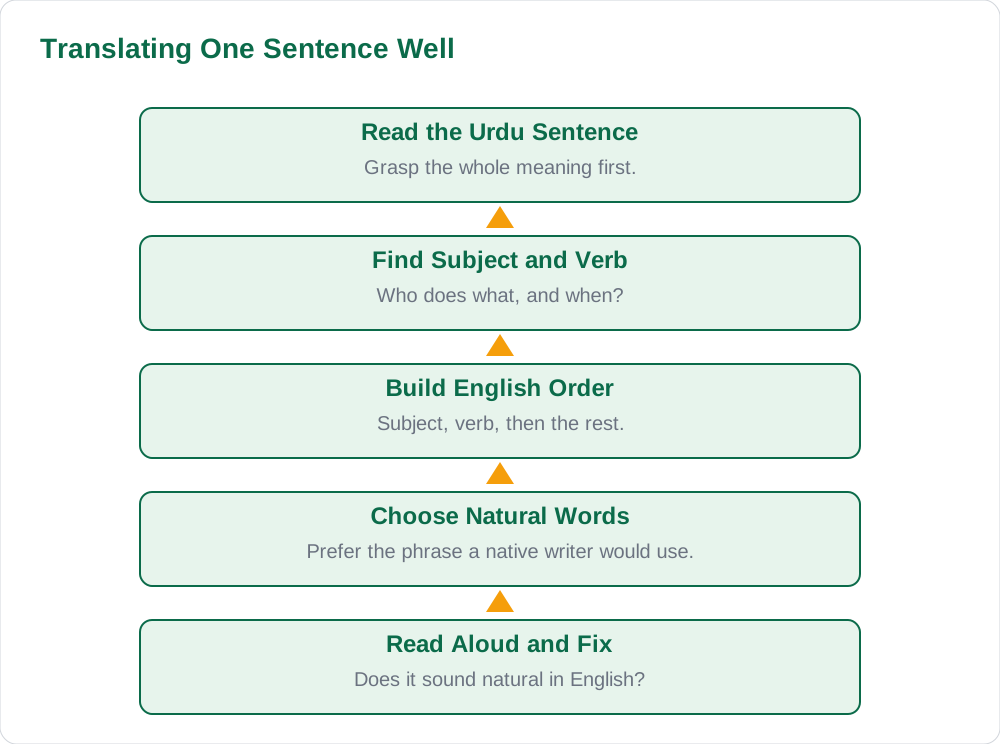
The cure is to translate meaning, not words. Read the whole Urdu sentence, ask what it is really saying, then build a fresh English sentence that says the same thing in natural English order. Short sentences are the best training ground because mistakes are easy to spot and fix. For general exam habits that reward clear expression, see how to avoid common exam mistakes.
- Translate meaning, not words: read the whole sentence first.
- Watch word order: Urdu verb-final versus English subject-verb-object.
- Treat idioms as whole units; find the natural equivalent, not a literal one.
- Short sentences first: master five-word sentences before long paragraphs.
The Sentence-Pair Method
The sentence-pair method is simple: take one short Urdu sentence, write its English translation, then keep both versions side by side. Start with everyday sentences such as the teacher explained the lesson clearly, or the pupils finished their homework on time. Say the Urdu sentence aloud, then build the English sentence from its meaning, checking subject, verb, and time reference as you go. Keeping pairs in a notebook creates a personal phrase bank that grows with each week.
Choose sentences from real school life rather than random examples. Sentences about homework, assembly, sports, family, and the weather are easy to remember because pupils already know what they mean. After writing ten pairs, read them aloud in both languages. Reading aloud exposes awkward phrasing that silent reading hides. Pupils can also compare their pairs with model sentences in solved notes to see how textbook writers phrase similar ideas.
- One Urdu sentence, one English translation, kept side by side.
- Use real school-life sentences you already understand.
- Check subject, verb, and time reference in every English sentence.
- Read pairs aloud: awkward phrasing shows up when spoken.
Back-Translation: Your Accuracy Check
Back-translation is the most powerful accuracy check a pupil can use. After translating an Urdu sentence into English, cover the Urdu original, translate the English version back into Urdu, and compare the two Urdu versions. If the back-translation matches the original meaning, the English version is probably accurate. If it drifts, the drift shows exactly where the English went wrong: a missing detail, a changed time reference, or a wrong word choice.
Use back-translation on every fifth sentence at first, then on every sentence as the habit strengthens. Work with a partner when possible: one pupil translates forward, the other translates back, and both compare notes. The discussion that follows teaches more than either translation alone, because each pupil must defend word choices in plain language. Keep a log of recurring slips so they can be targeted in later practice.
- Translate Urdu to English, then English back to Urdu without looking.
- Compare the two Urdu versions: drift shows where the English went wrong.
- Work in pairs: one translates forward, one translates back.
- Log recurring slips and drill them in the next session.
Common Traps: Word Order and Idioms
Word order traps appear in every practice session. Urdu sentences such as the book on the table is must become the book is on the table in English, with the verb moved forward. Time expressions also shift: yesterday school went to becomes went to school yesterday. Pupils should practise a small set of sentence frames until the English order feels automatic, rather than rebuilding every sentence from scratch. Frames such as I went to, she is reading, and they have finished give a reliable skeleton for new sentences.
Idiom traps need a different habit: never translate an idiom word by word. If an Urdu saying means working hard, the English equivalent might be burning the midnight oil or putting in hard work, depending on formality. Pupils should collect idioms as whole phrases with a plain meaning note, and use only the ones they have seen used correctly. When in doubt, choose the plain version over the fancy one; clear and correct always beats clever and wrong.
- Move the verb forward: English order is subject, verb, then the rest.
- Practise sentence frames until English order feels automatic.
- Learn idioms as whole phrases with a plain meaning note.
- When unsure, choose the plain correct version over a risky fancy one.
A Weekly Practice Plan
A weekly plan keeps translation practice steady without becoming a burden. Monday: write ten new sentence pairs from school life. Tuesday: back-translate five of them and log slips. Wednesday: drill one trap, such as word order or time expressions, with ten focused sentences. Thursday: translate a short paragraph of five sentences and check it with a partner. Friday: rewrite the week's worst three sentences correctly from memory. This cycle builds accuracy and confidence together.
Over a month, pupils can raise the difficulty gently: longer sentences, then short paragraphs, then passages from their own textbooks. Teachers can support the plan by marking meaning first and grammar second, so pupils stay willing to attempt translation. For note-making that supports this kind of steady practice, see how to make notes from Sindh Textbook Board books and keep the textbook guide nearby for model sentences.
- Monday: ten new pairs. Tuesday: back-translate five and log slips.
- Wednesday: drill one trap. Thursday: short paragraph with a partner.
- Friday: rewrite the week's worst three sentences from memory.
- Raise difficulty monthly: sentences, then paragraphs, then textbook passages.
AI Help: Muse AI
Muse AI is Meta's personal AI assistant. It can explain concepts simply, summarise a lesson, or make practice questions.
Ask Muse AI to give you five short Urdu sentences to translate into English, then check your translations and explain any word-order slips.
Join Muse with invite code LTGSWD — in the Muse app, go to Settings > Redeem token and enter the code.
Disclosure: LTGSWD is the author's Muse invite code.
Muse AI does not give official Sindh Textbook Board answers — always verify against your Sindh Textbook Board book and your teacher.
5 key points you must know
- Translate meaning, not words: read the whole sentence before building the translation.
- Keep Urdu-English sentence pairs side by side in a growing phrase bank.
- Use back-translation to catch drift and find exactly where a translation went wrong.
- Drill word order and idioms as separate traps with focused practice.
- A short weekly cycle builds accurate two-way translation habits steadily.
Frequently asked questions
Should I translate word by word from Urdu to English?
No. Word-by-word translation scrambles word order and mangles idioms. Read the whole Urdu sentence, grasp its meaning, then build a fresh English sentence in natural English order that says the same thing.
How does back-translation help?
Back-translation reveals errors your first translation hides. If translating your English back into Urdu gives a different meaning from the original, the English version drifted somewhere, and comparing the two versions shows you exactly where.
What should I do when I cannot find the English word I need?
Say the idea in simpler English first, then look up the precise word. A clear simple sentence earns more marks than a long pause or a guessed word. Add the new word to your phrase bank with an example sentence.
How many sentences should I practise each day?
Ten short sentences a day is plenty. Quality matters more than quantity: check each one with back-translation, log slips, and rewrite mistakes. Ten careful sentences beat fifty rushed ones.
Solved notes — preview free
These guides work best with the solved exercises. Preview the solved notes free on this website — 119 solved notes for Classes 6–10 in Sindhi, Urdu, English and Arabic medium. Or browse the full solved notes catalogue for your class and medium. New solved notes are added regularly — check the catalogue for coming-soon books.