Building History Timelines for Urdu-Medium Learners

History feels heavy when every chapter is a wall of dates and names copied into a notebook. Pupils read, forget, and reread without ever seeing how events connect. This guide teaches a better method for Urdu-medium learners: building one single-page history timeline per chapter, with causes and effects marked on it. A timeline turns a long chapter into a visible story, and a visible story is far easier to remember and to write about in exams.
Why Copying Notes Fails for History
Copying notes fails because it stores information in the same order as the book, without showing why events happened. A pupil can copy three pages about a movement yet still be unable to answer which event caused which, because the copied pages hide the chain. History questions rarely ask for copying; they ask for causes, effects, reasons, and results. A pupil who has only copied cannot answer those questions, however neatly the notebook looks.
A timeline fixes this by forcing selection. You cannot fit a whole chapter on one page, so you must choose the turning points: the events that changed what happened next. That choosing is real learning. For note-making habits that support selection over copying, see how to make notes from Sindh Textbook Board books. For remembering dates themselves, see how to remember history dates.
- Copying stores information without showing why events happened.
- History questions ask for causes, effects, reasons, and results, not copying.
- A one-page timeline forces you to choose the turning points.
- Choosing is learning: selection builds understanding.
The Single-Page Timeline Method
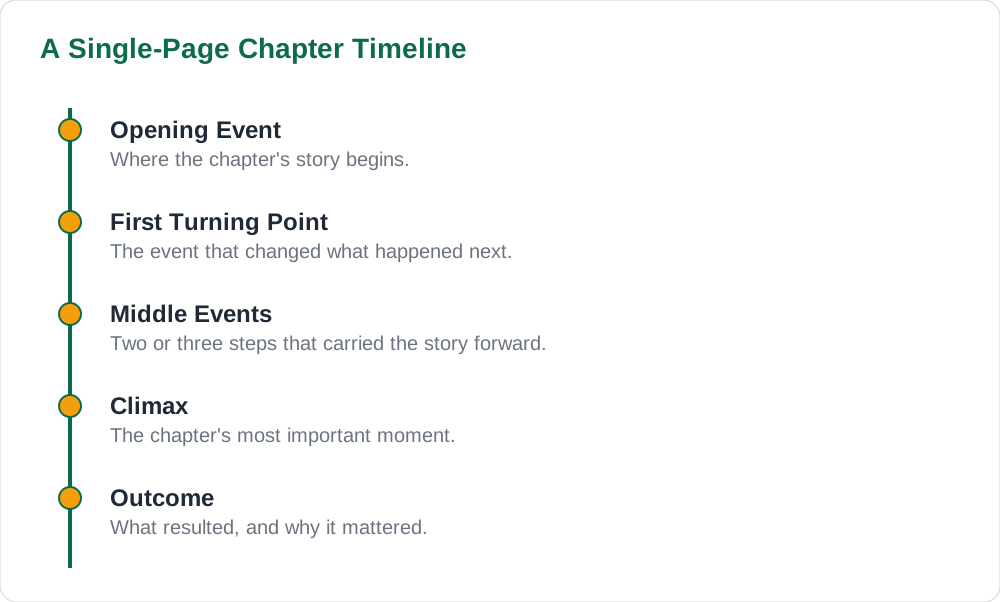
Take one blank page in landscape orientation and draw a horizontal line across the middle. Mark the chapter's events on the line in time order, earliest on the left and latest on the right, with one short label per event: two to five words, plus a year or date if the book gives one. Keep labels short so the whole story fits on one page. Under each event, add one line explaining why it mattered. The page now shows the chapter's shape at a glance.
Colour helps but should stay simple: one colour for political events, one for social or economic events, and one for turning points that changed everything. Pupils who colour every event differently create a rainbow that hides the story, while pupils who use two or three colours create a map that guides the eye. Keep the textbook guide open while building the timeline so dates and labels stay accurate to the lesson.
- One page, landscape, one horizontal line across the middle.
- Earliest event on the left, latest on the right, in time order.
- Short labels: two to five words plus a date if the book gives one.
- One line under each event explaining why it mattered.
Adding Causes and Effects
A timeline without causes and effects is only a list of dates. Above each event, write one cause: why did this happen. Below each event, write one effect: what changed because of it. Draw a small arrow from each effect to the next event it helped cause, so the chain becomes visible. A pupil who can trace arrows from the first event to the last can explain the chapter, not just recite it.
Causes and effects should be short and specific. Instead of writing many reasons, write the strongest one: a new law, a leader's decision, a drought, or a protest. Instead of writing everything changed, name one concrete change: a tax was removed, a school opened, or a movement spread to a new city. Specific causes and effects are what examiners reward, because they prove the pupil understands the chain.
- Above each event: one cause, why it happened.
- Below each event: one effect, what changed because of it.
- Draw arrows from each effect to the next event it helped cause.
- Keep causes and effects short and specific, not vague.
Turning Your Timeline into Answers
A timeline becomes an exam answer in three moves. First, read the question and find the part of the timeline it asks about. Second, walk along the timeline and collect the causes and effects in order, like beads on a string. Third, write the answer as a short story: this happened because of that, which led to this, which resulted in that. The timeline's order becomes the answer's order, so the answer reads logically without extra planning.
This method also prevents the most common history fault: jumping between events without connection. Words such as because, therefore, as a result, and this led to are the glue of history answers, and a timeline supplies them naturally. Pupils should practise turning one timeline into three different answers: a causes question, an effects question, and a why-it-mattered question. For general answer-writing habits, see how to write a perfect answer.
- Find the part of the timeline the question asks about.
- Collect causes and effects in time order along the line.
- Write the answer as a short chain: this led to that, which led to this.
- Use linking words: because, therefore, as a result, this led to.
A Worked Chapter Plan
Build each chapter's timeline in four short sittings. Sitting one: read the chapter and mark the five or six turning points. Sitting two: draw the line, place the events, and add short labels. Sitting three: add one cause above and one effect below each event, with arrows between them. Sitting four: cover the page and retell the chapter from memory, then check. This plan takes less time than copying the chapter, and it leaves the pupil with a page that can be revised in five minutes before the exam.
Keep finished timelines in a thin folder, one per chapter, in the order the book teaches them. Before a test, flip through the folder and retell each chapter from its timeline. Pupils who revise this way find that history stops feeling like memorisation and starts feeling like storytelling. Keep solved notes nearby to compare timeline answers with model lesson answers.
- Sitting 1: read and mark five or six turning points.
- Sitting 2: draw the line and place short labels.
- Sitting 3: add causes, effects, and arrows.
- Sitting 4: retell the chapter from memory, then check.
AI Help: Muse AI
Muse AI is Meta's personal AI assistant. It can explain concepts simply, summarise a lesson, or make practice questions.
Ask Muse AI to help you turn one history chapter into a five-event timeline with one cause and one effect for each event.
Join Muse with invite code LTGSWD — in the Muse app, go to Settings > Redeem token and enter the code.
Disclosure: LTGSWD is the author's Muse invite code.
Muse AI does not give official Sindh Textbook Board answers — always verify against your Sindh Textbook Board book and your teacher.
5 key points you must know
- A one-page timeline turns a long history chapter into a visible story.
- Choose five or six turning points; the choosing itself is real learning.
- Add one cause above and one effect below each event, with arrows between them.
- Turn the timeline into answers by walking the chain in order.
- Four short sittings build a timeline that revises in five minutes.
Frequently asked questions
How many events should a chapter timeline have?
Usually five or six turning points. More events crowd the page and hide the story. If a chapter feels longer, group small details under one turning point rather than adding a box for each one.
What if I cannot find the cause of an event?
Reread the paragraphs just before the event in the book; the cause usually sits there. Ask why this happened at this time and not earlier. If the book gives several causes, write the strongest one on the timeline and keep the rest in your notes.
Should I memorise every date on the timeline?
Learn the order first and the key dates second. A timeline you can retell in order is worth more than a list of dates you cannot connect. Add dates the book emphasises, and revise them with the timeline's story, not alone.
Can I use the timeline method for other subjects?
Yes. The same one-page shape works for science processes, Islamiat seerah sequences, and geography changes over time. Any chapter that is a story in time order becomes clearer as a timeline with causes and effects.
Solved notes — preview free
These guides work best with the solved exercises. Preview the solved notes free on this website — 119 solved notes for Classes 6–10 in Sindhi, Urdu, English and Arabic medium. Or browse the full solved notes catalogue for your class and medium. New solved notes are added regularly — check the catalogue for coming-soon books.