The Respiratory System and How Breathing Works
The respiratory system how breathing works question is about how air moves into and out of your body and how oxygen reaches your blood. Breathing is not just about the lungs. It involves your nose, windpipe, ribs, diaphragm, and the tiny air sacs where gases are exchanged. You breathe all day without thinking about it, yet the system is precise: it brings in oxygen for energy release and removes carbon dioxide, a waste gas. This guide explains inhalation and exhalation, gas exchange, and why exercise makes you breathe faster and deeper, with simple diagrams and revision tips for STBB biology.
The Path of Air
Air enters through the nose, where it is warmed, moistened, and cleaned by tiny hairs and mucus. It then passes through the pharynx and larynx, down the trachea, or windpipe, and into two bronchi, one to each lung. Inside each lung, the bronchi divide into smaller and smaller tubes called bronchioles. At the ends of the bronchioles are tiny air sacs called alveoli. This branching pattern looks like an upside-down tree and gives the lungs a huge surface area for gas exchange.
The trachea is held open by rings of cartilage so air can pass freely. If you place your fingers on the front of your neck, you can feel the firm trachea. The lungs sit inside the chest, protected by the ribs. A thin membrane covers each lung and the inside of the chest wall, allowing smooth movement as you breathe. When you draw the system, label the nose, trachea, bronchi, lungs, and diaphragm. A clear path diagram is the foundation for every other question on this topic.
Inhalation and Exhalation
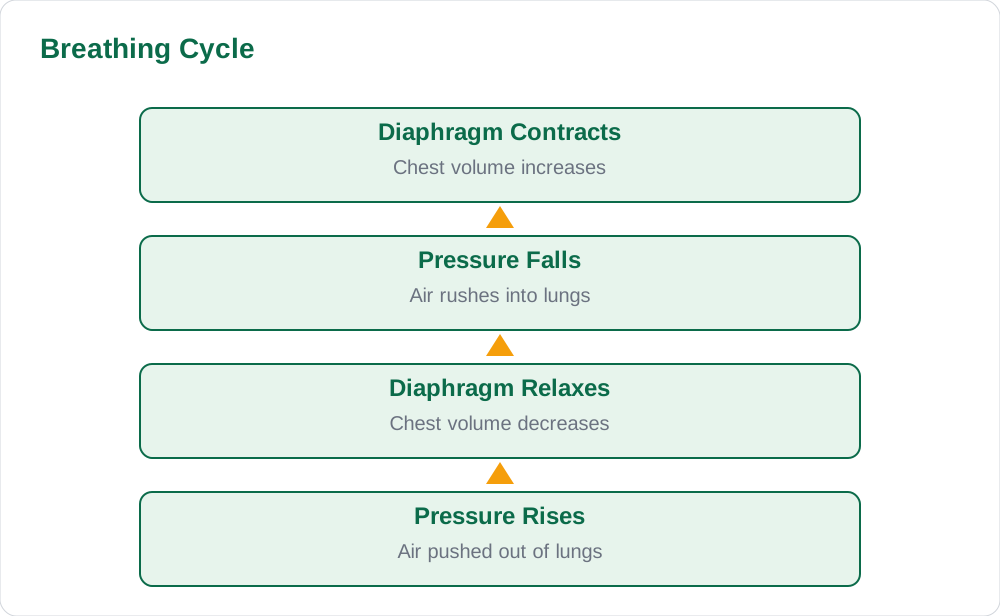
Inhalation is breathing in. The diaphragm, a dome-shaped muscle under the lungs, contracts and moves down. At the same time, the muscles between the ribs contract and lift the ribcage up and out. The chest volume increases, so air pressure inside the lungs falls below the outside pressure, and air rushes in. This is a physical process: air moves from higher pressure to lower pressure. You do not need to pull air in; you make space, and air follows.
Exhalation is breathing out. The diaphragm relaxes and moves up, and the rib muscles relax so the ribcage falls. Chest volume decreases, pressure inside rises, and air is pushed out. Normal exhalation is mostly passive, which means it does not need much effort. During exercise or forced breathing, extra muscles help push air out faster. A common exam mistake is to say the lungs pull air in. It is more accurate to say the chest expands, pressure falls, and air moves in. Remember that sequence for full marks.
Gas Exchange in the Alveoli
Gas exchange happens in the alveoli, where oxygen moves from air into blood and carbon dioxide moves from blood into air. Each alveolus is surrounded by tiny blood vessels called capillaries. The walls of both the alveolus and the capillary are very thin, so gases can diffuse quickly. Diffusion is the movement of particles from a place where they are more concentrated to a place where they are less concentrated. Oxygen is more concentrated in the air, so it diffuses into blood. Carbon dioxide is more concentrated in blood, so it diffuses into air.
The design of the alveoli is perfect for this job. There are millions of them, giving a very large surface area. Their walls are one cell thick, so the distance gases must cross is tiny. The blood supply is rich, so oxygen is carried away quickly and fresh carbon dioxide arrives. When you answer a question about why alveoli are suited to gas exchange, list these three features: large surface area, thin walls, and rich blood supply. Also note that oxygen binds to haemoglobin in red blood cells for transport around the body.
Why Exercise Changes Breathing
During exercise, your muscles work harder and need more energy. Energy is released by respiration, which uses oxygen and glucose and produces carbon dioxide. As muscles use more oxygen, the body must breathe faster and deeper to bring in more oxygen and remove extra carbon dioxide. You may notice your heart also beats faster, because blood must carry oxygen to muscles and carbon dioxide away more quickly. This is a normal and healthy response.
After exercise, breathing stays fast for a short time while the body recovers and repays its oxygen needs. If you measure breathing rate before and after exercise in a school practical, count breaths for 30 seconds and double the number to get breaths per minute. Record the resting rate, the rate just after exercise, and the rate after two minutes of rest. Always change only one variable and keep the counting method the same. This links breathing to energy needs and to Energy Flow in Ecosystems for Biology Pupils, where energy moves through living things.
Keeping Lungs Healthy and Revision Tips
Healthy lungs depend on clean air and good habits. Avoid smoke and dusty air, because smoke damages the airways and alveoli. Regular exercise strengthens breathing muscles and improves lung capacity. Breathing through the nose helps filter and warm air. If you have persistent cough, difficulty breathing, or chest pain, tell a parent or teacher and seek medical advice. Biology teaches you to notice these warning signs early.
To revise, practise three tasks: label the air path from nose to alveoli, explain inhalation and exhalation using pressure and volume, and describe gas exchange with the three alveoli features. Then explain why breathing rate rises during exercise in two sentences. Check your answers against your Sindh Textbook Board book and the solved notes on Solved Notes. You can also compare the respiratory system with the digestive journey in A Journey Through the Human Digestive System.
AI Help: Muse AI
Muse AI is Meta's personal AI assistant, and it can help with breathing revision by asking you to explain inhalation, gas exchange, and exercise effects in your own words. Muse AI does not give official Sindh Textbook Board answers — always verify against your Sindh Textbook Board book and your teacher.
Join Muse with invite code LTGSWD — in the Muse app, go to Settings > Redeem token and enter the code.
Disclosure: LTGSWD is the author's Muse invite code.
5 key points you must know
- Air travels from nose to trachea to bronchi to bronchioles to alveoli.
- Inhalation happens when chest volume increases and pressure falls, so air rushes in.
- Gas exchange in alveoli uses diffusion across thin walls.
- Alveoli have large surface area, thin walls, and rich blood supply.
- Exercise raises breathing rate because muscles need more oxygen and make more carbon dioxide.
Frequently asked questions
What is the difference between breathing and respiration?
Breathing is the movement of air in and out of the lungs. Respiration is the chemical process in cells that releases energy from glucose using oxygen.
Where does gas exchange happen?
Gas exchange happens in the alveoli, tiny air sacs in the lungs surrounded by capillaries.
Why do we breathe faster during exercise?
Muscles need more oxygen and produce more carbon dioxide, so breathing becomes faster and deeper to meet that demand.
What does the diaphragm do?
The diaphragm contracts and moves down during inhalation to increase chest volume, and relaxes during exhalation.
Solved notes — preview free
These guides work best with the solved exercises. Preview the solved notes free on this website — 119 solved notes for Classes 6–10 in Sindhi, Urdu, English and Arabic medium. Or browse the full solved notes catalogue for your class and medium. New solved notes are added regularly — check the catalogue for coming-soon books.