Balancing Chemical Equations: The Counting Method
Balancing chemical equations is the skill that turns chemistry from word descriptions into precise science, and many pupils find it harder than it needs to be. The secret is that balancing is not guessing — it is counting. A balanced equation has the same number of each type of atom on both sides, because atoms are never created or destroyed in a chemical reaction; they only rearrange. In this guide you will learn the counting method: a systematic, step-by-step way to balance any equation you meet in school chemistry. We start with the one rule that matters, then work through examples of increasing difficulty using a tally table — a simple counting grid that keeps track of every atom. You will learn which elements to balance first, how to use brackets for groups like sulfate, and the mistakes that cost marks even when the chemistry is understood. By the end, balancing will feel like bookkeeping: slow and careful at first, then fast and automatic with practice.
The One Rule: Atoms Are Conserved
In a chemical reaction, atoms are rearranged but never created or destroyed. This is the law of conservation of mass, and it is the reason equations must balance: if an equation shows three oxygen atoms on the left and only two on the right, it cannot describe a real reaction, because an oxygen atom has vanished. Balancing means adjusting the numbers in front of formulae — the coefficients — until every element has the same total on both sides. The coefficients tell you how many units of each substance react.
One rule must never be broken: you may change coefficients, but you may never change the formulae themselves. Turning H2O into H3O changes the substance from water to something else; writing 2H2O instead means two water molecules, which is allowed. This is the most common balancing error, and examiners check for it carefully. If you ever feel tempted to change a subscript, stop — the answer is to change a coefficient somewhere else instead.
The Tally Table: Count Before You Balance
The counting method starts with a tally table: a small grid listing each element, how many atoms of it are on the left, and how many are on the right. Take the formation of water: H2 + O2 -> H2O. The tally shows hydrogen 2 on the left and 2 on the right — balanced — but oxygen 2 on the left and 1 on the right — not balanced. The table makes the problem visible: we need one more oxygen atom on the right.
To fix it, put a 2 in front of H2O: H2 + O2 -> 2H2O. Now oxygen balances at 2 each side, but hydrogen is now 2 on the left and 4 on the right. Put a 2 in front of H2: 2H2 + O2 -> 2H2O. The new tally shows hydrogen 4 and 4, oxygen 2 and 2 — balanced. Always rebuild the tally after every change, because fixing one element usually disturbs another. The tally table is your proof that the equation balances, and writing it out in rough work prevents the most common slips.
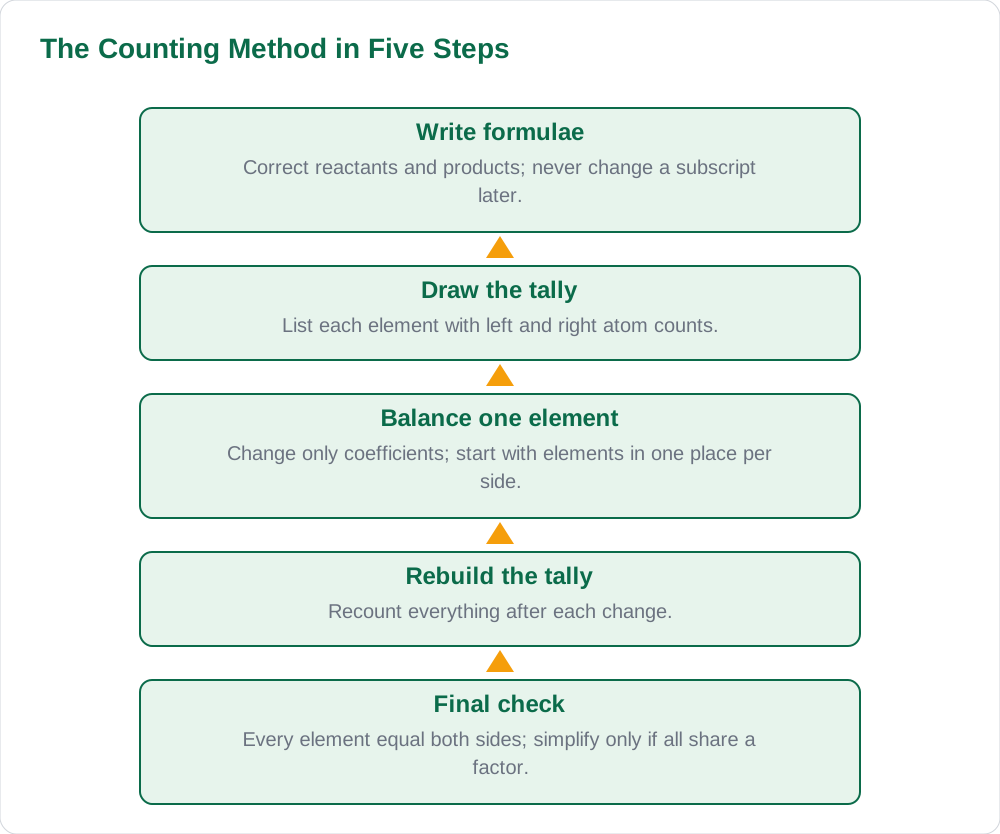
- Step 1: Write the correct formulae for reactants and products.
- Step 2: Draw a tally table: each element, left count, right count.
- Step 3: Balance one element at a time by changing coefficients only.
- Step 4: Rebuild the tally after every change.
- Step 5: Check every element and simplify coefficients if they share a factor.
Worked Example: Magnesium and Oxygen
Consider magnesium burning in oxygen: Mg + O2 -> MgO. The tally shows magnesium 1 and 1, balanced, but oxygen 2 on the left and 1 on the right. Put a 2 in front of MgO: Mg + O2 -> 2MgO. Now oxygen is 2 and 2, but magnesium is 1 on the left and 2 on the right. Put a 2 in front of Mg: 2Mg + O2 -> 2MgO. The final tally reads magnesium 2 and 2, oxygen 2 and 2 — balanced.
Notice the order of work: we balanced oxygen first because it appeared in only one compound on each side, and magnesium followed naturally. A good habit is to balance elements that appear in only one place on each side first, leave hydrogen and oxygen until later when they appear in several compounds, and leave elements that appear as pure elements (like O2 or Mg) until last. This order keeps the tally stable and reduces the number of corrections you need.
Working with Groups and Brackets
Some equations contain groups of atoms that stay together, such as sulfate (SO4) or nitrate (NO3). Treat a group as a single unit in your tally when it appears unchanged on both sides. For example, in zinc + sulfuric acid -> zinc sulfate + hydrogen, the sulfate group appears once on each side, so you can count it as one sulfate unit rather than counting sulfur and oxygen separately. This shortcut keeps tally tables short and reduces arithmetic errors.
Another useful habit is to finish by checking that the coefficients have no common factor. If an equation balances as 2H2 + 2O2 -> 2H2O, all coefficients share a factor of two, and the simplest form is H2 + O2 -> 2H2O — wait, that last form does not balance, which shows why you must recheck after simplifying. Only simplify when the balanced equation genuinely shares a factor across all coefficients, and always re-verify the tally afterwards. For more on presenting working clearly, see How to Avoid Common Exam Mistakes.
Mistakes That Cost Marks
The most damaging mistake is changing subscripts instead of coefficients — it changes the substance and makes the whole equation wrong. The second is forgetting that elements like oxygen, hydrogen, nitrogen, and chlorine exist as diatomic molecules (O2, H2, N2, Cl2) when written alone; writing O instead of O2 throws every count off. The third is stopping too early: balancing one element and forgetting to recheck the rest, which leaves the equation unbalanced somewhere else.
A fourth mistake is messy working. Balancing in your head feels faster but produces far more errors than a written tally table. Write the tally, cross it out, and rewrite it — examiners reward correct final equations, and clear working lets you spot your own slips. Practise with five equations a day for a week, mixing combination, decomposition, and displacement reactions, and the method will become automatic. You can build the underlying arithmetic confidence with Maths Word Problem Language and Class 11 Chemistry Mole Concept.
AI Help: Muse AI
Muse AI is Meta's personal AI assistant, and it can help with this topic by checking your tally tables: show it your unbalanced equation and your counts, and ask it to point out which element is still unbalanced and why. Muse AI does not give official Sindh Textbook Board answers — always verify against your Sindh Textbook Board book and your teacher.
Join Muse with invite code LTGSWD — in the Muse app, go to Settings > Redeem token and enter the code.
Disclosure: LTGSWD is the author's Muse invite code.
5 key points you must know
- Atoms are never created or destroyed, so equations must balance.
- Change coefficients only — never change a formula's subscripts.
- A tally table makes unbalanced elements visible and checkable.
- Balance elements in one place per side first; hydrogen and oxygen often last.
- Rebuild the tally after every change and check every element at the end.
Frequently asked questions
Why must chemical equations be balanced?
Because atoms are conserved in a reaction — none are created or destroyed. A balanced equation shows the same number of each type of atom on both sides, matching what actually happens.
Can I change a subscript to balance an equation?
No. Changing a subscript changes the substance itself — H2O becomes something else. Only change the coefficients, the numbers in front of the formulae.
What order should I balance elements in?
Balance elements that appear in only one compound on each side first, then the rest, leaving hydrogen and oxygen until later if they appear in several compounds, and pure elements until last.
What is a tally table?
A small grid listing each element with its atom count on the left and on the right of the equation. Rebuild it after every coefficient change so you can see what is balanced and what still needs fixing.
Why is oxygen written as O2 and not O?
Oxygen, hydrogen, nitrogen, and chlorine exist as diatomic molecules — two atoms joined together — when written as pure elements. Writing O instead of O2 makes every oxygen count wrong.
Solved notes — preview free
These guides work best with the solved exercises. Preview the solved notes free on this website — 119 solved notes for Classes 6–10 in Sindhi, Urdu, English and Arabic medium. Or browse the full solved notes catalogue for your class and medium. New solved notes are added regularly — check the catalogue for coming-soon books.