Science or Computer Science Group in Class 9: How to Decide
In Class 9, pupils in many schools must choose between the science group and the computer science group. The choice feels large, and it is — it shapes the subjects you study for two years, the skills you build, and the doors that open after matric. Yet many pupils choose on the basis of a friend's choice, a rumour about which group is easier, or pressure at home, without ever comparing the two properly. This article compares the Class 9 science and computer science groups by subjects, skills, workload, and future options, and offers a practical way to decide. It does not declare a winner. The right group is the one that matches your interests, your strengths, and the kind of work you want to do next.
What the Two Groups Have in Common
Both groups share a strong core. Pupils in both study Urdu, English, Islamiat or Ethics, Pakistan Studies, Mathematics, and Physics and Chemistry. The daily experience of school — the teachers, the timetable, the examination system — is largely the same. The choice is not between a hard group and an easy group; it is between two versions of a science education with different emphases.
Understanding this common core helps to calm the decision. Whichever group you choose, you will build a solid foundation in mathematics and science. The difference lies in the subjects that define each group and in the skills those subjects develop.
The Science Group: Biology at the Centre
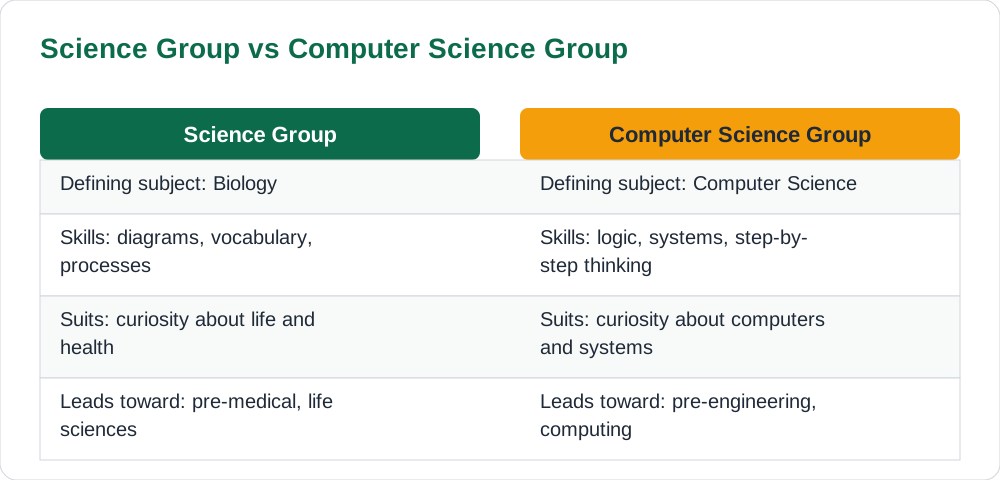
The science group centres on Biology alongside Physics and Chemistry. Pupils study living systems in detail — cells, plants, animals, and the human body — with diagrams, terminology, and processes that must be learned accurately. The group suits pupils who are curious about life and health, who enjoy reading and diagram work, and who can sustain careful revision over time.
The science group is the natural route toward pre-medical studies in Class 11, and it keeps the door open to health and life-science careers. It also keeps general science options open, because the mathematics and physics foundation remains strong. Pupils who already dream of medicine, nursing, pharmacy, or biological sciences usually find this group the natural fit.
The Computer Science Group: Computing at the Centre
The computer science group replaces Biology with Computer Science. Pupils study how computers work, how data is stored and processed, and how to think in steps — the logical thinking behind programs and systems. The group suits pupils who enjoy computers, puzzles, and building things, and who like the feeling of making something work.
The computer science group is the natural route toward pre-engineering or computer science studies in Class 11, and it keeps the door open to computing, engineering, and technology careers. Pupils who enjoy using computers, who tinker with devices, or who are curious about how apps and systems work usually find this group the natural fit. A first taste of the subject's thinking style is in our guide to flowcharts and algorithms basics.
Skills Each Group Builds
The science group builds careful observation, diagram and labelling skills, precise vocabulary, and the ability to explain living processes in order. These are the skills of the health and life sciences, and they reward patience and thorough revision.
The computer science group builds logical step-by-step thinking, comfort with systems and data, and the habit of testing and fixing errors. These are the skills of computing and engineering, and they reward persistence through trial and error. Neither set of skills is better; they are different, and they suit different minds. Think about which kind of task you enjoy: drawing and explaining a system, or building and debugging one.
Workload: An Honest Look
Both groups are demanding. The science group's Biology carries a large amount of content to learn and retain, with diagrams that must be practised until they are accurate. The computer science group's computing content requires regular practice too — concepts that are not practised fade quickly, and practical work rewards pupils who sit down and try things rather than only reading about them.
The honest question is the same as for any stream choice: which kind of hard work can you sustain for two years? If you enjoy reading, drawing, and revising, the science group's workload may feel natural. If you enjoy experimenting, solving, and working with computers, the computer science group's workload may feel natural. Choose the work you can keep doing, not the work that sounds easiest.
How to Decide: Three Practical Steps
First, look at your own record. Which subjects have you enjoyed and done well in during Classes 6 to 8 — life-science topics, or computer and logic topics? A pattern across several years is more reliable than a single test. Second, talk to a teacher who knows your work, and ask which group's daily demands match your strengths. Third, think about the future honestly: do you picture yourself in health or life sciences, or in computing and technology? You do not need a final career plan, but a general direction helps.
Finally, discuss the choice with your parents with facts on the table. Share what each group studies, what it leads toward, and why you lean one way. A decision made with information and agreement is far easier to sustain than one made under pressure. For a wider view of stream choice later on, see our guide on stream choice for Classes 11 and 12, and explore the solved notes for the subjects that interest you.
- Review your pattern of interest and marks across Classes 6 to 8.
- Ask a teacher which group's daily work matches your strengths.
- Picture your general direction: life and health, or computing and technology.
- Decide with your parents, using facts rather than rumours.
AI Help: Muse AI
Muse AI is Meta's personal AI assistant. If you are choosing a Class 9 group, you can ask Muse AI to explain what Biology and Computer Science each involve, or to help you list your interests and strengths before you talk to a teacher. Muse AI does not give official Sindh Textbook Board answers — always verify against your Sindh Textbook Board book and your teacher.
Join Muse with invite code LTGSWD — in the Muse app, go to Settings > Redeem token and enter the code.
Disclosure: LTGSWD is the author's Muse invite code.
5 key points you must know
- Both groups share Urdu, English, Islamiat, Pakistan Studies, Mathematics, Physics, and Chemistry.
- The science group centres on Biology; the computer science group centres on Computer Science.
- Science builds diagram, vocabulary, and process skills; computing builds logic and systems skills.
- Choose by sustained interest and strengths, not by rumours about which group is easier.
- Discuss the choice with a teacher and your parents, using facts.
Frequently asked questions
Which group is easier: science or computer science?
Neither is generally easier. The science group's Biology carries a large amount of content and diagrams to retain, while the computer science group requires regular practice of concepts and practical work. Choose the kind of hard work you can sustain.
If I choose the computer science group, can I still go into medicine later?
In general, medical paths require Biology, so pupils aiming for medicine usually choose the science group. If medicine is your goal, discuss the requirements honestly with a teacher before choosing your Class 9 group.
If I choose the science group, can I still study computing later?
The science group keeps a strong mathematics and physics foundation, and many pupils develop computing interests alongside it. However, the computer science group gives a head start in computing. Discuss your goals with a teacher if you are torn.
Can I change groups after Class 9?
Changing groups later is sometimes possible but usually means catching up on a year's syllabus in the new group's defining subject. It should not be the plan. Choose carefully at the start.
What should I do if my friends all choose the other group?
Choose for yourself. Friends change classes, but your group shapes your subjects, skills, and future options for two years. A good friend will respect a decision made with honest thought.
Solved notes — preview free
These guides work best with the solved exercises. Preview the solved notes free on this website — 119 solved notes for Classes 6–10 in Sindhi, Urdu, English and Arabic medium. Or browse the full solved notes catalogue for your class and medium. New solved notes are added regularly — check the catalogue for coming-soon books.