First Steps in Algebra: Variables as Labelled Boxes
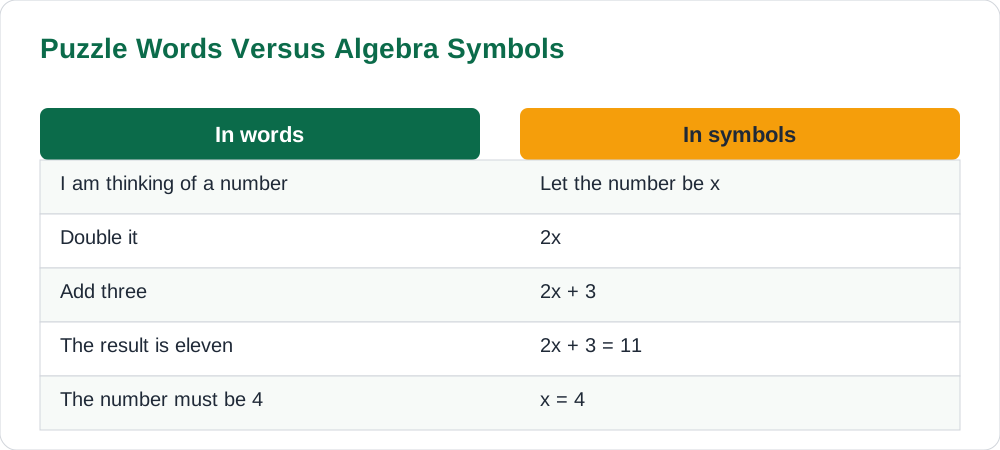
Algebra frightens many pupils, but the fear is almost never about the mathematics itself. It is about the letters. A pupil who can solve the puzzle I am thinking of a number, I double it and add three, and I get eleven can freeze completely when the same puzzle is written as 2x plus 3 equals 11. The numbers did not change; only the packaging did. That is why the best first step in algebra is to keep the meaning visible and introduce the symbols slowly. This article treats variables as labelled boxes, equations as puzzles, and solving as the steady work of undoing. Pupils who meet algebra this way usually discover that they already knew how to do it — they were just waiting for someone to translate it.
What a Variable Really Is: A Labelled Box
A variable is a box with a label on it, and inside the box sits a number we do not know yet. The label, usually a letter like x or n, is just a name so we can talk about the box. In the puzzle I am thinking of a number, the box holds that number. Doubling it means two boxes with the same contents; adding three means putting three more alongside. Nothing mysterious has happened. When pupils draw the box, or imagine it, the letter stops being a threat and becomes a tool, which is exactly what it is.
Teachers can make this concrete with real containers. Put a fixed number of counters in a closed box, label the box n, and ask pupils what n plus 2 would look like: the same box with two counters beside it. Ask what 2n looks like: two identical boxes. Pupils can then invent their own box expressions and swap them with partners. The habit of reading an expression as a description of boxes and counters is the foundation of all later algebra, and it is worth a full lesson before any formal solving begins. The solved notes on this site follow the same concrete-first pattern.
- A letter stands for a number we do not know yet — it is a label, not a secret code.
- The same letter in one problem always means the same number throughout that problem.
- Different letters can hold different numbers, or by coincidence the same number.
- Expressions describe actions: 3n means three boxes, n + 5 means a box plus five.
Equations as Puzzles: Both Sides Must Match
An equation is a puzzle with a promise: the left side and the right side are equal, and our job is to find the number that makes the promise true. A balance scale is the perfect picture for this. If the scale balances with a box and three counters on one side and eleven counters on the other, then the box must hold eight counters, because eight plus three is eleven. Pupils who picture the balance understand the most important rule of solving equations without being told it: whatever you do to one side, you must do to the other, or the balance breaks.
This balance picture also explains why guessing and checking is a respectable first strategy. A pupil who tries x equals 5 in 2x plus 3 equals 11 gets thirteen, which is too big, so the answer must be smaller. Trying x equals 4 gives eleven exactly, so the box holds four. Guessing and checking is slow for harder equations, but it builds the number sense that makes formal methods meaningful. Teachers should praise a correct guess that is checked properly, because checking by substitution is a habit that protects pupils at every level of algebra.
Undoing: The Heart of Solving Equations
Solving an equation is undoing, step by step, in reverse order. If the puzzle was double the number and add three, the undoing is subtract three, then halve. Take 2x plus 3 equals 11 as an example: subtract three from both sides and the balance shows 2x equals 8; halve both sides and x equals 4. Each step is shown on the balance, and each step is checked by putting the answer back into the original equation. Pupils who can narrate their undoing — I am removing the three, then splitting the double — are doing real algebra, even if their notation is still rough.
The reverse-order idea deserves its own moment in class. Ask pupils to describe getting dressed: socks before shoes. Then ask them to describe getting undressed: shoes before socks. Undoing always runs the film backwards. In 3x minus 5 equals 10, the last thing done to x was subtracting five, so the first undoing step is adding five, giving 3x equals 15, and then dividing by three gives x equals 5. Pupils who remember the getting-dressed story rarely undo in the wrong order, and the story is far more memorable than a rule about inverse operations.
Common First Mistakes and How to Prevent Them
Three mistakes appear in almost every first algebra class, and all three are preventable. The first is doing something to only one side of the equation, which breaks the balance. The cure is to write the same step on both sides every time, even when the step feels obvious. The second is treating the letter as an object, so that 3a plus 2b becomes 5ab. The cure is the box picture: three boxes of apples plus two boxes of bananas cannot be combined into five boxes of anything, because the boxes hold different things. The third is sign errors when moving terms, which the balance picture also prevents, because nothing is ever moved — both sides are changed equally.
A fourth habit is worth watching: pupils who write long chains of equals signs, such as 2x plus 3 equals 11 equals 8 equals 4. Each equals sign is a promise that both sides match, and 11 does not equal 8. Teachers should insist on one equation per line, with the new line showing the result of one balance step. It feels slower at first, but it prevents a whole family of errors, and it trains the clear working that examiners reward. For exam-day habits, see the guide to checking maths answers in exams.
- Never do something to one side only — the balance must be kept at every step.
- Different letters are different boxes: 3a + 2b cannot be combined.
- One equation per line, one balance step per line.
- Always check by putting the answer back into the original equation.
From Boxes to Confidence: A Week of First Steps
A sensible first week of algebra needs no rush. Day one: box puzzles in words, with counters and containers. Day two: writing box puzzles as expressions, still with drawings. Day three: the balance picture and guessing-and-checking. Day four: formal undoing with one-step and two-step equations. Day five: pupils inventing puzzles for each other and checking the solutions. By the end of the week, symbols feel like shorthand for ideas pupils already own, which is exactly the right relationship. Pupils who race to formal methods in one lesson often stall later, because the symbols never attached to meaning.
Parents can support this at home without any special materials. Ask the child to invent a number puzzle, solve it together by undoing, and then write it with a letter. Cooking gives natural examples: a recipe that serves four people needs doubling for eight, and the multiplier is a variable in action. The message to send is that algebra is not a new subject invented to confuse anyone; it is a shorter way of writing puzzles people have solved for centuries. Pupils who believe that message approach the next topic — the balance method for linear equations — with confidence instead of dread. The blog carries more step-by-step guides in the same style.
AI Help: Muse AI
Muse AI is Meta's personal AI assistant, and it can help with this topic by turning a word puzzle into a labelled-box equation, or by making extra two-step equations for practice and walking through the undoing steps one at a time.
Join Muse with invite code LTGSWD — in the Muse app, go to Settings > Redeem token and enter the code.
Disclosure: LTGSWD is the author's Muse invite code.
Muse AI does not give official STBB answers — always verify against your Sindh Textbook Board book and your teacher.
5 key points you must know
- A variable is a labelled box holding a number we do not know yet.
- An equation is a balance: both sides must stay equal at every step.
- Solving is undoing in reverse order — undo the last operation first.
- Guessing and checking is a valid first strategy and builds checking habits.
- One equation per line, one balance step per line, always check by substitution.
Frequently asked questions
Why do pupils find letters in maths so scary?
Because the letter looks like a new kind of object, when it is really just a label for a number we do not know yet. Drawing the labelled box, or using a real container with counters, removes the mystery. Once pupils see that 2x + 3 = 11 is the same puzzle as 'double my number, add three, get eleven', the fear usually fades quickly.
What is the difference between an expression and an equation?
An expression, like 2x + 3, is a description of a quantity — it has no equals sign and no single answer to find. An equation, like 2x + 3 = 11, contains an equals sign and makes a claim: the two sides match. Solving an equation means finding the value of the variable that makes the claim true.
Is guessing and checking real algebra?
Yes, and it is a valuable first strategy. Trying values and checking them by substitution teaches pupils what a solution means: the number that makes both sides equal. Formal undoing is faster for harder equations, but guessing and checking builds the understanding that formal methods later rely on.
Why must we do the same thing to both sides?
Because the equals sign promises that both sides are the same quantity. If you subtract three from one side only, the promise is broken and the new equation describes a different puzzle. The balance picture makes this obvious: take weight off one pan only, and the scale tips.
When should pupils stop drawing boxes?
When they no longer need them. Some pupils drop the drawings after a lesson or two; others keep sketching a quick box for harder problems, and that is fine. A drawing that helps a pupil think clearly is a tool, not a crutch. The goal is understanding, and pupils reach it at different speeds.
Solved notes — preview free
These guides work best with the solved exercises. Preview the solved notes free on this website — 119 solved notes for Classes 6–10 in Sindhi, Urdu, English and Arabic medium. Or browse the full solved notes catalogue for your class and medium. New solved notes are added regularly — check the catalogue for coming-soon books.