Linear Equations: The Balance Method, Step by Step
Every linear equation is a balance, and solving it means keeping that balance while stripping the equation down to a single letter on one side and a single number on the other. Pupils who picture the balance rarely go wrong, because the picture enforces the one rule that matters: whatever you do to one side, you must do to the other. This article teaches the balance method from the ground up — one-step equations, two-step equations, equations with brackets, and equations with the variable on both sides — with each move shown as a balance step and every answer checked by substitution. Worked examples are clearly illustrative, so pupils learn the method itself rather than memorising answers to particular questions.
The Balance Picture: One Rule That Covers Everything
Imagine an old-fashioned balance scale with two pans. The left pan holds the left side of the equation and the right pan holds the right side. The equals sign means the scale is level. If you remove three counters from the left pan only, the scale tips — so you must remove three from the right pan too. If you double the contents of one pan, you must double the other. That is the entire method: any operation applied to one side must be applied to the other, so the balance survives every step. Pupils who keep this picture in mind understand why the rules exist, instead of reciting them blindly.
The balance picture also explains the goal. Solving means getting the variable alone on one pan with nothing else beside it, while the other pan holds just a number. Each step removes one piece of clutter from around the variable — a constant added, a coefficient multiplying — always by doing the matching operation on both sides. When pupils can narrate their steps as balance moves — I am taking three from both sides; I am halving both sides — they are solving equations properly, even before their written notation is perfect. The solved notes on this site show the same balanced working, and the books page lists the official texts to check against.
- The equals sign means the scale is level — both sides are the same quantity.
- Whatever you do to one side, you must do to the other side.
- The goal: the variable alone on one side, a single number on the other.
- One balance step per line, with the step written beside the equation.
One-Step Equations: Undo One Operation
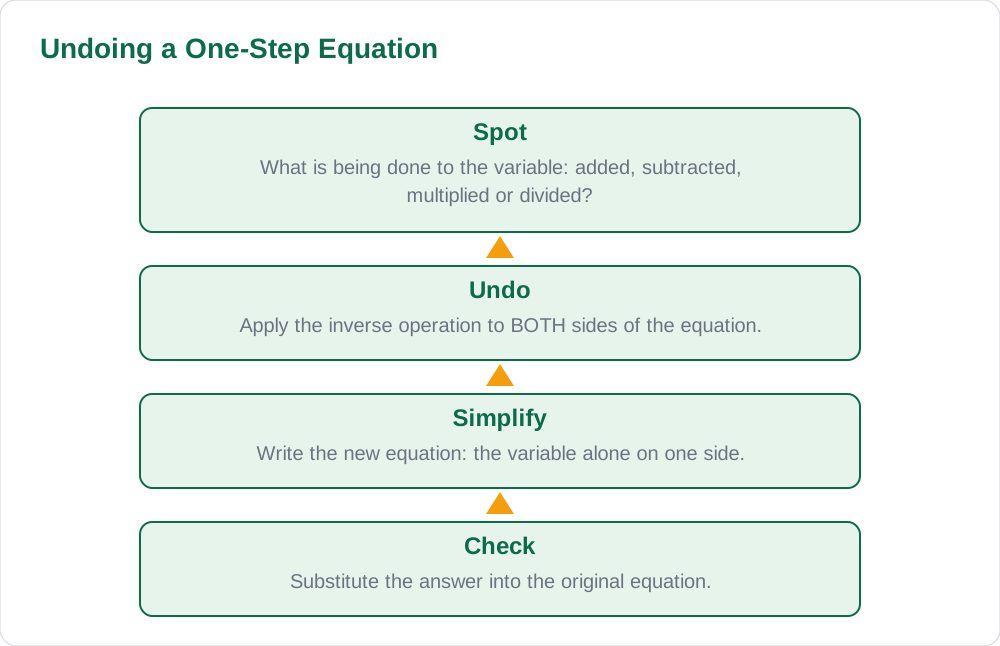
One-step equations need a single undoing move. If x plus 7 equals 15, the variable is buried under adding seven, so subtract seven from both sides: x equals 8. If x minus 5 equals 11, add five to both sides: x equals 16. If 4x equals 32, divide both sides by four: x equals 8. If x divided by 3 equals 9, multiply both sides by three: x equals 27. In each case the undoing operation is the inverse of the operation hiding the variable, and it is applied to both sides. Pupils should say the move out loud as they write it, because the habit of narrating prevents silent slips.
The check is substitution: put the answer back into the original equation and confirm both sides match. For x plus 7 equals 15 with x equals 8, the left side becomes 8 plus 7, which is 15, matching the right side. A check that matches is strong evidence the answer is right. Teachers should insist on the check from the very first lesson, because pupils who check one-step equations will check harder ones too, and checking is the habit that separates reliable solvers from careless ones.
Two-Step Equations: Undo in Reverse Order
Two-step equations hide the variable under two operations, and the undoing must run in reverse order — last operation first, like taking off shoes before socks. Take 3x plus 5 equals 20 as an illustrative example. The last thing done to x was adding five, so the first undoing step is subtracting five from both sides, giving 3x equals 15. Then divide both sides by three, giving x equals 5. The check: 3 times 5 plus 5 equals 20, which matches. Two steps, two balance moves, one check — the method is calm and repeatable.
Pupils make two common mistakes here, and both are preventable. The first is undoing in the wrong order: dividing by three first would give x plus 5 equals a fraction, which is messier and error-prone. The second is forgetting to apply the step to both sides, which breaks the balance. The cure for both is narration: pupils should write beside each line what they did, for example minus 5 from both sides, divide both sides by 3. Written narration slows pupils down by seconds and saves them from the errors that cost marks. For the labelled-box thinking behind this, see the guide to first steps in algebra.
Brackets and the Variable on Both Sides
Brackets add one preliminary step: expand first, then solve as usual. Take 2(x plus 3) equals 16 as an illustrative example. Expanding gives 2x plus 6 equals 16. Subtract six from both sides to get 2x equals 10, then divide both sides by two to get x equals 5. The check: 2 times (5 plus 3) equals 16, which matches. Pupils who forget to expand and instead divide by two at the start can still succeed — dividing both sides by two gives x plus 3 equals 8 — but they should be aware they are choosing an alternative route, not skipping a step. Either route is valid if the balance is kept.
Equations with the variable on both sides need one extra idea: gather the variables onto one side first. Take 5x plus 4 equals 2x plus 16 as an illustrative example. Subtract 2x from both sides, and the equation becomes 3x plus 4 equals 16 — a familiar two-step equation. Subtract four from both sides to get 3x equals 12, then divide by three to get x equals 4. The check: 5 times 4 plus 4 is 24, and 2 times 4 plus 16 is 24, so both sides match. Gathering variables first turns an unfamiliar problem into a familiar one, which is one of the most useful tricks in all of algebra.
- Brackets: expand first, then solve the resulting equation normally.
- Variable on both sides: subtract the smaller variable term from both sides first.
- Keep the balance at every step — both sides, every time.
- Check by substituting into the ORIGINAL equation, not a simplified one.
Word Problems and Common Pitfalls
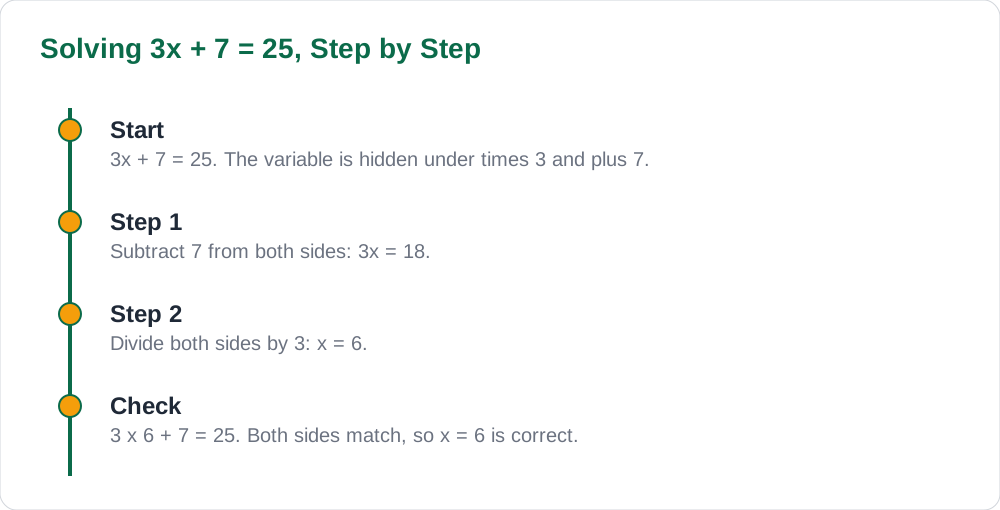
Word problems test whether pupils can translate words into equations, and the balance method only helps once the equation is written. The routine is: choose a letter for the unknown, write the equation in words first, then in symbols. For example: a number tripled and added to 7 gives 25 becomes 3x plus 7 equals 25. Subtracting seven from both sides gives 3x equals 18, and dividing by three gives x equals 6. The final step is a sentence answer: the number is 6. Pupils who skip the words-first stage often write equations that describe a different problem, so the extra sentence is worth its time.
Three pitfalls deserve attention. Sign errors appear when pupils move terms carelessly; the balance method avoids moving entirely, since both sides change equally. Fraction answers tempt pupils to round too early; keeping fractions exact until the final line is safer. And the equals-chain error — writing 3x plus 7 equals 25 equals 18 equals 6 — breaks the meaning of the equals sign, because 25 does not equal 18. One equation per line, one step per line, and a check at the end: that discipline carries pupils through every linear equation they will meet. For exam-day checking habits, see the guide to checking maths answers in exams, and browse the blog for more step-by-step guides.
AI Help: Muse AI
Muse AI is Meta's personal AI assistant, and it can help with this topic by walking through a linear equation one balance step at a time, or by turning a word problem into an equation and checking the answer by substitution.
Join Muse with invite code LTGSWD — in the Muse app, go to Settings > Redeem token and enter the code.
Disclosure: LTGSWD is the author's Muse invite code.
Muse AI does not give official STBB answers — always verify against your Sindh Textbook Board book and your teacher.
5 key points you must know
- The balance rule: whatever you do to one side, you must do to the other.
- One-step equations need one inverse operation applied to both sides.
- Two-step equations undo in reverse order: last operation first.
- Brackets: expand first. Variables on both sides: gather them on one side first.
- Always check by substituting the answer into the original equation.
Frequently asked questions
Why must I do the same thing to both sides?
Because the equals sign means both sides are the same quantity, like a level balance scale. Changing only one side tips the scale and creates a different equation with a different answer. Every step in the balance method preserves the equality, so the final answer solves the original equation.
In what order do I undo a two-step equation?
In reverse order: undo the last operation first. In 3x + 5 = 20, adding 5 was the last thing done to x, so subtract 5 first, giving 3x = 15, then divide by 3 to get x = 5. Undoing in the wrong order usually creates messy fractions and extra errors.
What do I do with brackets in an equation?
Expand them first. In 2(x + 3) = 16, expanding gives 2x + 6 = 16, which is a standard two-step equation. Alternatively, you may divide both sides by 2 first to get x + 3 = 8. Both routes are valid as long as the balance is kept at every step.
How do I solve an equation with x on both sides?
Gather the variable terms onto one side first by subtracting the smaller variable term from both sides. In 5x + 4 = 2x + 16, subtracting 2x from both sides gives 3x + 4 = 16, a familiar two-step equation that solves to x = 4. Always check in the original equation.
Why is checking by substitution so important?
Because it catches sign slips, arithmetic errors and wrong-order undoing in seconds. Putting the answer back into the original equation and confirming both sides match is the strongest evidence the answer is right. Pupils who check every equation lose far fewer marks to careless errors.
Solved notes — preview free
These guides work best with the solved exercises. Preview the solved notes free on this website — 119 solved notes for Classes 6–10 in Sindhi, Urdu, English and Arabic medium. Or browse the full solved notes catalogue for your class and medium. New solved notes are added regularly — check the catalogue for coming-soon books.