Geometry Proofs: One Logical Step at a Time
For many pupils, a geometry proof feels like being asked to write an essay in a language they have only just started learning. They know the facts — angles in a triangle add to 180 degrees, opposite angles are equal — but they do not know how to arrange those facts into an argument that convinces anyone. The secret is that a proof is not a performance; it is a short walk from what is given to what must be shown, with each step small enough to be obviously true. This article teaches a steady method: list the givens, mark the diagram, decide the destination, and then build the argument one logical step at a time. Pupils who follow this method find that proofs are slower than they expected, and far more doable.
What a Proof Actually Is
A proof is a chain of reasons that starts from facts we accept and ends at the statement we want to show. Each link in the chain must be justified: by a given fact, by a definition, or by a theorem the class has already established. Nothing is allowed to rest on because it looks true in the diagram. Diagrams can mislead — a triangle that looks isosceles may not be — so the words must carry the argument and the picture must only support it. When pupils grasp this, they stop guessing and start reasoning, because they know exactly what counts as a reason.
It helps to compare a proof with an argument in everyday life. If a pupil claims their friend took their pen, the claim needs evidence: the friend was near the desk, the pen is in the friend's bag. A geometry proof works the same way, except the evidence is mathematical: given facts and proven theorems. The standard of evidence is higher, but the structure is familiar. Teachers who frame proofs as careful arguments rather than mysterious rituals find that pupils engage more willingly, because arguing is something every young person already knows how to do. The solved notes on this site model the same one-step-at-a-time reasoning.
- A proof starts from givens and ends at the statement to be shown.
- Every step needs a reason: a given, a definition, or a known theorem.
- Never trust the picture alone — a diagram can be drawn inaccurately.
- A proof convinces a sceptical reader, not just the person who wrote it.
Step One: List the Givens and Mark the Diagram
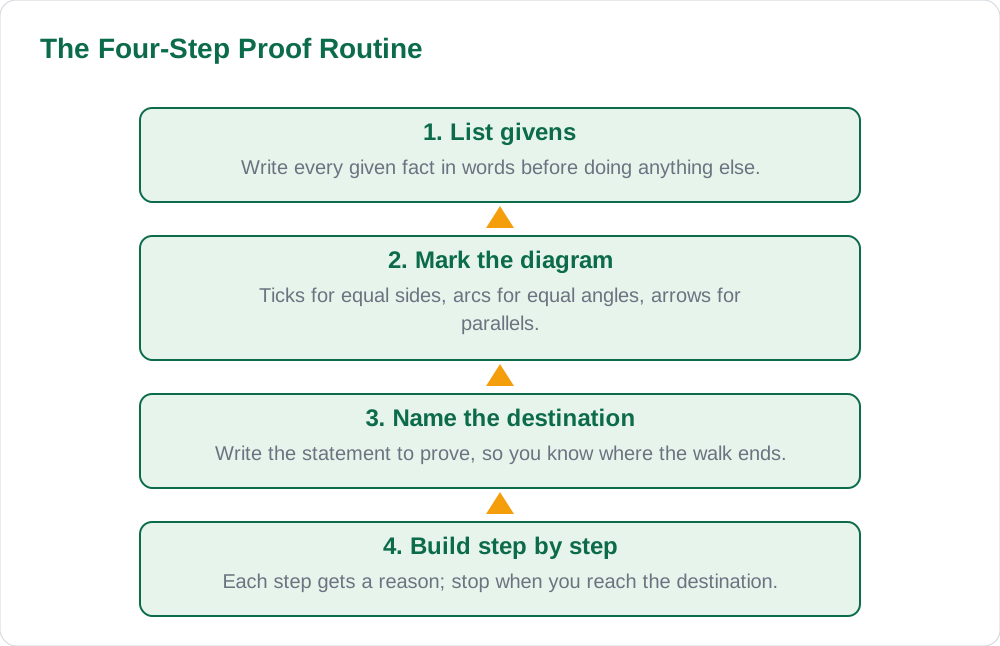
Every proof begins with two actions: write down exactly what is given, and mark those facts on the diagram. If the problem says AB equals AC, mark the two sides with matching ticks. If it says two lines are parallel, draw the arrows. If an angle is a right angle, mark the square. This marking turns the diagram into a working tool instead of a decoration, and it often reveals the path to the proof: a marked diagram shows which triangles share sides, which angles are vertical, and where parallel lines create alternate angles.
Listing the givens in words matters just as much. Pupils should write Given: followed by the facts, in full sentences, before attempting anything else. This forces them to read the question carefully, and it gives them a checklist to refer back to. A surprising number of proof failures are really reading failures: a pupil who missed that a line bisects an angle was never going to find the proof. Two minutes spent listing givens and marking the diagram saves twenty minutes of wandering, and it is the habit that separates confident proof-writers from stuck ones.
Step Two: Know the Destination Before You Walk
A proof is a walk, and nobody walks well without knowing the destination. Pupils should write the statement to be proved at the top of their working, in their own words if the textbook wording is dense. If the goal is to show that two triangles are congruent, the pupil knows to look for matching sides and angles. If the goal is to show that an angle is 90 degrees, the pupil knows to look for a route through angle sums or Pythagoras. The destination shapes the search, and pupils who skip this step often collect true but irrelevant facts and wonder why the proof never arrives.
Working backwards from the destination is a legitimate and powerful strategy. Ask: what would prove this? To show two angles equal, it would be enough to show two triangles congruent, or to show that the angles are alternate angles between parallel lines. Then ask: what would prove that? Each backwards question shortens the gap between the givens and the goal. Pupils should be told openly that mathematicians work backwards all the time, and that a proof written forwards usually began as a backwards search. Knowing this removes the shame of not seeing the whole proof at once.
Step Three: One Logical Step at a Time
The body of a proof is a numbered list of statements, each with its reason. For example: angle A equals angle B because they are vertically opposite angles; angle B equals angle C because they are alternate angles between parallel lines; therefore angle A equals angle C. Each step is small, each reason is named, and the conclusion follows without a leap. Pupils should write the reason in brackets beside each statement, because the reason is half of the proof. An examiner reading a proof with reasons can follow the thinking even if a small slip appears; a proof without reasons is just a list of claims.
Pupils should also learn to value short proofs. A proof with three clear steps beats a proof with ten muddled ones, and padding a proof with irrelevant facts does not earn marks. When a pupil finishes, they should read the proof back from the top and ask of each step: is this true, and is the reason correct? If a step says angles in a triangle add to 180 degrees when the angles in question are not in the same triangle, the check catches it. This self-review habit is the closest thing to a proof-reading superpower, and it improves every other kind of mathematical writing too.
- Number each statement and give its reason in brackets beside it.
- Keep each step small enough that its truth is obvious.
- Use therefore only when the conclusion genuinely follows from the steps before it.
- Read the proof back and check every reason before handing it in.
A Worked Example: Angles on Parallel Lines
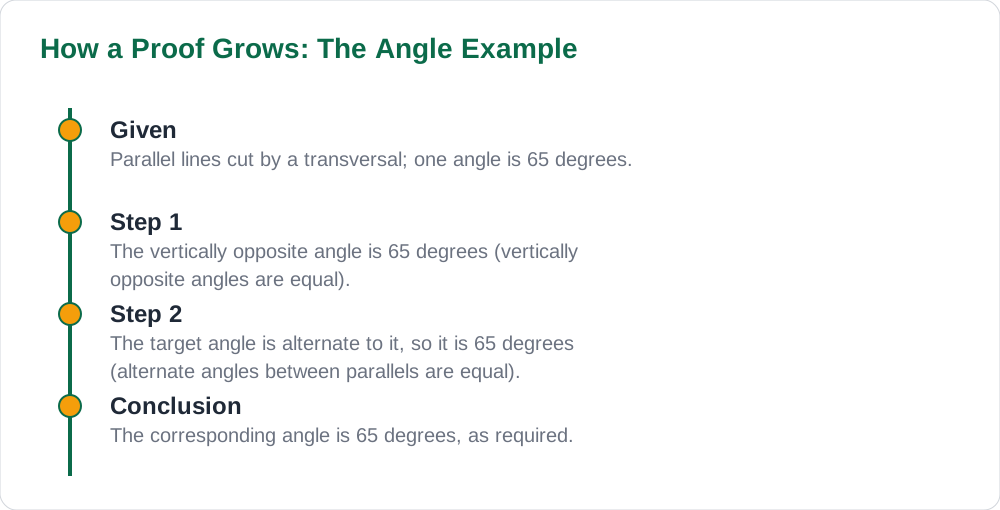
Consider this illustrative example, not copied from any textbook: two parallel lines are cut by a transversal, and one of the angles formed is 65 degrees. Prove that the angle in the corresponding position on the other line is also 65 degrees. Start with the givens: the lines are parallel, the transversal cuts them, one angle is 65 degrees. Mark the diagram: arrows on the parallel lines, an arc on the 65-degree angle, and an arc on the angle to be found. The destination is clear: show the second angle equals 65 degrees.
The proof itself is two steps. First, the angle vertically opposite the 65-degree angle is also 65 degrees, because vertically opposite angles are equal. Second, the angle we want is an alternate angle with that vertically opposite angle, and alternate angles between parallel lines are equal, so it is 65 degrees too. Two steps, two reasons, done. Pupils who expected a long ordeal often laugh at how short this is. Longer proofs are simply longer chains of the same kind of step, and the method scales: list givens, mark the diagram, know the destination, and build one step at a time. For more reasoning practice, see the guide to first steps in algebra and the blog.
AI Help: Muse AI
Muse AI is Meta's personal AI assistant, and it can help with this topic by checking a proof draft step by step — asking whether each statement has a reason and suggesting the missing theorem when a step feels like a leap.
Join Muse with invite code LTGSWD — in the Muse app, go to Settings > Redeem token and enter the code.
Disclosure: LTGSWD is the author's Muse invite code.
Muse AI does not give official STBB answers — always verify against your Sindh Textbook Board book and your teacher.
5 key points you must know
- A proof is a chain of reasons from givens to the statement to be shown.
- Always list the givens and mark the diagram before attempting a proof.
- Write the destination down, and consider working backwards from it.
- Each statement needs a reason: a given, a definition, or a known theorem.
- Read the finished proof back and check every step and every reason.
Frequently asked questions
How long should a geometry proof be?
As long as it needs to be, and no longer. A short proof with three justified steps is better than a long proof padded with irrelevant facts. Pupils should aim for the smallest number of steps that genuinely connect the givens to the destination, with a reason beside every step.
Can I work backwards in a proof?
Yes — working backwards is a standard way to FIND a proof. Ask what would prove the goal, then what would prove that, until you reach the givens. Then write the proof forwards, from the givens to the goal, so the reader can follow it in the natural direction.
What counts as a valid reason in a proof?
A given fact from the question, a definition (such as the definition of a midpoint), or a theorem the class has already established (such as vertically opposite angles being equal). 'It looks equal in the diagram' is never a valid reason, because diagrams can be drawn inaccurately.
What if I cannot see the whole proof at once?
That is normal, even for strong mathematicians. Write down what you know, mark the diagram, and find one true step. Then find the next. Proofs are built one step at a time, and the first step is often a small observation about the marked diagram, such as two angles being vertically opposite.
How do I check my proof before handing it in?
Read it from the top and ask two questions of every line: is this statement true, and is the reason correct? Then check that the final line is exactly the statement you were asked to prove. If any step fails the test, repair or replace that step rather than hoping the examiner will not notice.
Solved notes — preview free
These guides work best with the solved exercises. Preview the solved notes free on this website — 119 solved notes for Classes 6–10 in Sindhi, Urdu, English and Arabic medium. Or browse the full solved notes catalogue for your class and medium. New solved notes are added regularly — check the catalogue for coming-soon books.