Forces and Motion in Daily Life: Cycling, Cricket and Trolleys

Forces are pushes and pulls, and they are at work in every movement you see. When you pedal a bicycle, your legs push the pedals and the wheels push against the road. When a cricketer hits a ball, the bat pushes the ball and changes its speed and direction. When you push a trolley in class, your hands push it forward while friction with the floor tries to slow it down. Motion is the result of those forces working together. This article explains forces and motion using cycling, cricket, and trolleys, so the ideas feel familiar instead of abstract. You will learn what friction does, why heavier things need bigger pushes, and how speed, direction, and stopping distance fit together. For more study support, see the [solved notes](/books.html) and the [books page](/books.html).
What a Force Does: Start, Stop, Speed Up, Slow Down
A force can start a still object moving, stop a moving object, make it go faster, make it go slower, or change its direction. A football sitting on the ground stays still until a foot pushes it. A rolling ball keeps rolling until friction, air, or a hand stops it. A cyclist pedals harder to speed up and squeezes the brakes to slow down. A cricket ball hit by a bat changes both speed and direction in a fraction of a second. In each case, the force does not need to be large to be real; even a gentle push counts as a force. The important question in science is not only how big the force is, but what it does to the motion.
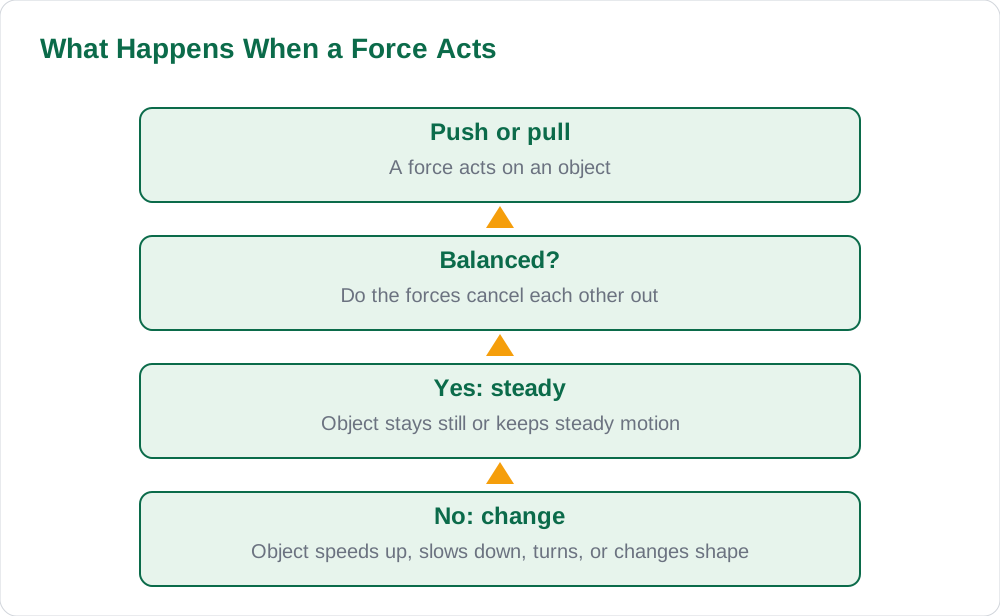
Forces can also change shape. Squeezing a rubber ball, stretching a spring, or pressing a lump of clay all show forces changing shape without causing motion. In school science, most examples focus on motion, but remembering shape helps you recognise forces in places where nothing moves. A book resting on a table is not force-free: gravity pulls it down while the table pushes it up, and the two forces balance so the book stays still. Balanced forces keep things still or moving steadily, while unbalanced forces change the motion. That idea explains why a trolley pushed gently on a smooth floor keeps rolling, while the same push on a rough floor soon stops.
- A force can start, stop, speed up, slow down, or turn motion.
- Forces can also change shape, such as squeezing a ball.
- Balanced forces keep things still or moving steadily.
- Unbalanced forces change the motion of an object.
Cycling: Pedals, Friction, and Brakes
Cycling shows forces clearly because you can feel them. Your legs push the pedals, the chain turns the wheel, and the tyre pushes backward against the road. The road pushes forward on the tyre, and that forward push is what moves the bicycle. Air pushes against you as you ride faster, which is why cycling into a strong wind feels harder. Friction between the tyres and the road helps you grip and move, while friction in the chain and wheels wastes a little energy. A well-oiled bicycle feels easier to ride because less energy is lost to friction inside the moving parts.
Brakes show a force that slows motion. When you squeeze the brake lever, brake pads press against the wheel and friction slows it down. The harder you squeeze, the stronger the friction and the faster you stop. That is also why stopping distance matters: a fast bicycle needs more time and more road to stop than a slow one. A wet road reduces grip, so braking takes longer and the bicycle may skid. Good cyclists read the road ahead, slow down early, and avoid sudden braking on wet or loose surfaces. The same ideas appear in road safety lessons, and they are worth remembering every time you ride.
- Pedalling pushes the wheel against the road; the road pushes the bicycle forward.
- Air resistance grows as you ride faster and makes pedalling harder.
- Brake pads use friction to slow the wheels.
- Wet roads reduce grip, so stopping takes longer.
Cricket: Hitting, Throwing, and Catching
Cricket is full of forces that change speed and direction. When a batter hits a ball, the bat applies a large force for a very short time. A straight bat sends the ball back in a new direction, while a timed shot uses the ball's own speed plus the bat's push. When a bowler throws the ball, the hand gives it speed and the ball then moves under gravity and air resistance. A fielder who catches a fast ball pulls the hands backward as the ball arrives. That backward movement spreads the force over a longer time and makes the catch less painful, which is a practical example of how time and force are linked.
Fielding also shows friction at work. A ball rolling on smooth outfield grass keeps rolling further than a ball on rough, wet grass, because friction is weaker on the smooth surface. A ball thrown high into the air slows as it rises, stops for an instant, and then speeds up as it falls. Gravity pulls it down throughout the flight, while air resistance pushes against the motion. Pupils can watch a slow throw and describe the forces at each stage: the hand pushes, then gravity and air act, then the hands or the ground stop the ball. Naming the forces at each stage turns a game you love into a science lesson.
- The bat applies a large force for a short time and changes the ball's direction.
- A catch feels softer when hands move back and spread the force over more time.
- Friction with the ground decides how far a rolling ball travels.
- Gravity pulls a thrown ball down throughout its flight.
Trolleys: Mass, Push, and Fair Comparisons
A classroom trolley is a simple way to see how mass affects motion. Push an empty trolley gently and it speeds up easily. Load it with books and push with the same effort, and it speeds up more slowly. That difference is not because the push changed, but because the mass changed. Heavier objects need a bigger push to gain the same speed in the same time. This is a safe, clear classroom test that any group can run with a trolley, a spring balance, and a measuring tape. Keep the push the same, change only the load, and measure how far the trolley travels or how quickly it speeds up.
Trolleys also show friction clearly. A trolley on a smooth floor rolls further than the same trolley on a rough mat, even with the same push. Pupils can test this by marking a start line, giving the same gentle push each time, and measuring the stopping distance. Repeating the push three times and finding the average makes the result more trustworthy. If the pushes are not the same, the comparison is unfair, so using a ramp of the same height to start the trolley is a better method than pushing by hand. That fair-test habit is the same one used in the article on observation and hypothesis.
- Heavier trolleys need a bigger push to speed up by the same amount.
- Keep the push the same and change only the load for a fair test.
- Smooth floors give longer rolls than rough surfaces.
- Repeat each test and average the results for a fair comparison.
Speed, Direction, and Stopping Safely
Speed tells you how far something travels in a certain time. A cyclist who covers 100 metres in 10 seconds is moving faster than a walker who covers 10 metres in the same time. In class, speed is often found by dividing distance by time, and the answer needs units such as metres per second. Direction matters too: two cyclists moving at the same speed in opposite directions are not doing the same thing. A change in direction is a change in motion, even if the speed stays the same. That is why a car going around a bend needs a force to keep turning, even when the speedometer does not change.
Stopping safely depends on speed, friction, and reaction time. A faster object needs more distance to stop, a slippery surface needs more distance, and a distracted person takes longer to start braking. Pupils can test stopping distance with a trolley on different surfaces and record the results in a table. In real life, the lesson is practical: walk, do not run, in corridors; slow down on wet floors; and leave space when cycling behind someone. Science is not only about describing motion, but about using that description to stay safe. For more on careful recording, see the science write-up guide.
- Speed is distance divided by time, with units such as metres per second.
- A change in direction is a change in motion, even at steady speed.
- Faster motion and slippery surfaces both increase stopping distance.
- Slow down early on wet floors and leave space when cycling.
AI Help: Muse AI
Muse AI is Meta's personal AI assistant, and it can help you describe the forces in a cycling, cricket, or trolley example step by step and check your explanation of friction and motion.
Join Muse with invite code LTGSWD — in the Muse app, go to Settings > Redeem token and enter the code.
Disclosure: LTGSWD is the author's Muse invite code.
Muse AI does not give official STBB answers — always verify against your Sindh Textbook Board book and your teacher.
5 key points you must know
- Forces are pushes and pulls that can start, stop, speed up, slow down, turn, or reshape motion.
- Friction helps grip and braking but also slows rolling objects and wastes energy.
- Heavier objects need a bigger push to gain the same speed in the same time.
- Speed is distance divided by time; direction is part of motion too.
- Stopping distance grows with speed and with slippery surfaces.
Frequently asked questions
What is friction in simple words?
Friction is a force that opposes sliding or rolling between two surfaces. It helps your shoes grip the floor and brakes slow a bicycle, but it also slows a rolling ball and makes a trolley stop. Whether friction helps or hinders depends on the situation.
Why does a heavier trolley need a bigger push?
A heavier trolley has more mass, so the same push changes its speed less. To make it speed up as quickly as a light trolley, you need a larger force. In class you can test this by keeping the push the same and changing only the load.
Why do fielders move their hands back when catching?
Moving the hands back spreads the stopping force over a longer time, so the catch feels softer and the ball is less likely to bounce out. It is a practical example of how force and time work together.
Does an object need a force to keep moving?
On Earth, friction and air resistance usually slow objects down, so a push is needed to keep them moving steadily. Without those opposing forces, an object would keep moving at the same speed and direction until a force acted on it.
How do I calculate speed in a class experiment?
Measure the distance travelled and the time taken with the same tools each time, then divide distance by time. For example, 20 metres in 5 seconds is 4 metres per second. Always include the unit in your answer.
Solved notes — preview free
These guides work best with the solved exercises. Preview the solved notes free on this website — 119 solved notes for Classes 6–10 in Sindhi, Urdu, English and Arabic medium. Or browse the full solved notes catalogue for your class and medium. New solved notes are added regularly — check the catalogue for coming-soon books.