Surah Ash-Sharh: Hifz and Meaning for Class 6
Surah Ash-Sharh hifz meaning class 6 becomes much easier when pupils memorise in small chunks and learn the message at the same time. This short Surah comforts the reader with the promise that hardship is followed by ease, and that steady effort brings relief. Many Class 6 pupils try to memorise the whole Surah at once and then forget it quickly. A slower method works better. In this guide, you will split the Surah into short parts, repeat each part with understanding, and then join the parts together. Read every verse from your own mushaf or STBB book, and let meaning support your memory.
What Surah Ash-Sharh Is About
Surah Ash-Sharh is a short Makki Surah that speaks about comfort, courage, and hope. It reminds the reader that Allah opened the heart of the Prophet, lifted a heavy burden, and raised his name.
Before you begin hifz, read a simple translation from your STBB book or a trusted translation with your teacher. Notice how the Surah moves from comfort to encouragement to action. The ending encourages the believer to keep working hard and to turn to Allah with hope. Keeping this flow in mind helps you recall the order of the verses. You can also find more study help in the solved notes and on the books page.
Breaking the Surah Into Small Chunks
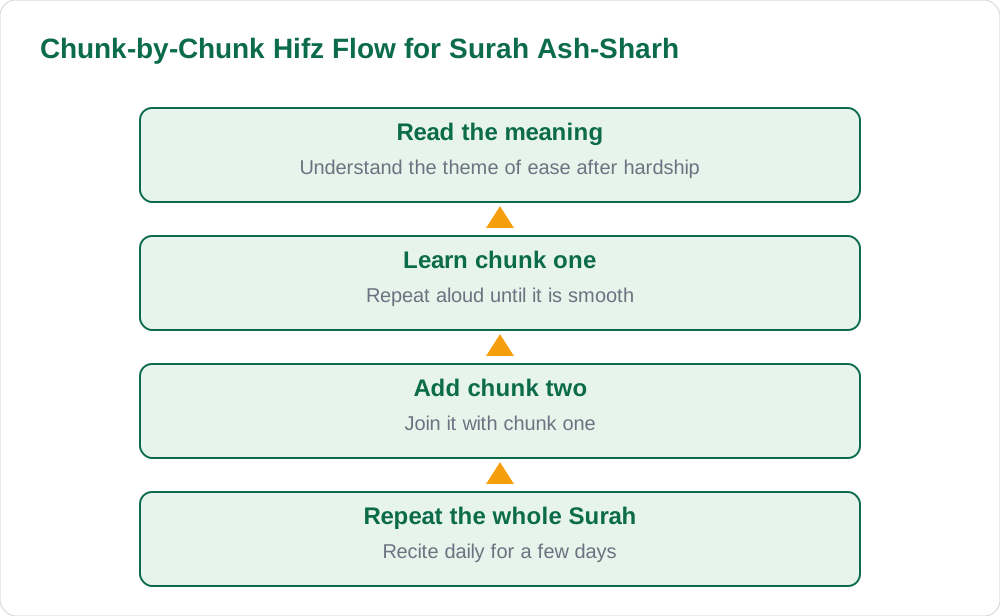
The best way to memorise Surah Ash-Sharh is to divide it into three or four short chunks. Each chunk should be short enough to repeat comfortably without strain. Learn one chunk fully before you move to the next.
Read the first chunk aloud from your mushaf five to seven times, looking at the words. Then try to say it from memory three times. If you make a mistake, look again and repeat.
How to Practise Each Chunk
Short daily practice beats one long session. Spend about ten minutes on hifz, then take a break. Say each chunk slowly and clearly, listening to your own voice.
Ask a parent, elder, or classmate to listen to your recitation once a day. A listener can catch small mistakes that you may not notice yourself.
- Practise each chunk aloud five to seven times before testing yourself.
- Repeat difficult words separately, then say the full chunk again.
- Ask someone to listen and correct your recitation daily.
- Keep sessions short, calm, and regular rather than long and tiring.
Linking Meaning to Memory
Meaning is a strong memory aid. When you know what a chunk means, your mind has a reason to remember its order.
You can also use a small notebook to write one short meaning line beside each chunk. Do not copy the Arabic text from memory; instead, write the meaning in Urdu or English in your own words.
- Learn one simple meaning idea for each chunk before memorising it.
- Say the meaning in your own words after each recitation.
- Write short meaning notes in a notebook for quick revision.
- Use the same approach in the Surah At-Teen guide for your next Surah.
A Simple Seven-Day Practice Plan
A short daily plan keeps Surah Ash-Sharh fresh without pressure. On day one, learn the first chunk and its meaning. On day two, revise chunk one and add chunk two. On day three, revise both chunks and add the next part.
On days six and seven, focus on revision only. Recite the Surah once in the morning and once in the evening, and recite it to a listener at least once. If you forget a part, look at your mushaf, repeat the chunk, and continue. For more revision ideas, visit the blog and try the daily loop method for keeping hifz fresh.
- Day one to three: learn one new chunk each day and revise old chunks.
- Day four to five: join all chunks and recite the full Surah.
- Day six to seven: revise twice daily and recite to a listener.
- After one week, revise the Surah twice a week to keep it strong.
AI Help: Muse AI
Muse AI is Meta's personal AI assistant, and it can help you explain the message of Surah Ash-Sharh in simple words or make short practice questions about its theme of ease after hardship. Muse AI does not give official STBB answers — always verify against your STBB book and your teacher. Always check any explanation against your Sindh Textbook Board book and ask your teacher if anything is unclear.
Join Muse with invite code LTGSWD — in the Muse app, go to Settings > Redeem token and enter the code.
Disclosure: LTGSWD is the author's Muse invite code.
5 key points you must know
- Surah Ash-Sharh teaches that ease follows hardship and effort brings relief.
- Split the Surah into three or four short chunks for steady memorisation.
- Learn the meaning of each chunk before memorising its words.
- Practise daily in short sessions and recite to a listener.
- Revise for a full week so the Surah stays fresh.
Frequently asked questions
How long should a Class 6 pupil spend memorising Surah Ash-Sharh each day?
About ten to fifteen minutes a day is enough. Short daily sessions build stronger memory than one long session, especially when you revise the previous chunk before learning a new one.
Should I learn the meaning before memorising the verses?
Yes. Learning one simple meaning idea for each chunk helps you remember the order and keeps your recitation thoughtful. Read the translation from your STBB book or with your teacher.
What should I do if I keep forgetting the same chunk?
Slow down and practise that chunk on its own. Repeat the difficult words separately, then say the full chunk again. Revise it in the morning and evening for two days before joining it with the rest.
How can I test my memorisation of Surah Ash-Sharh?
Recite the Surah to a parent, teacher, or classmate who can follow along in a mushaf. A listener can catch small mistakes and confirm that your recitation is smooth and correct.
Solved notes — preview free
These guides work best with the solved exercises. Preview the solved notes free on this website — 119 solved notes for Classes 6–10 in Sindhi, Urdu, English and Arabic medium. Or browse the full solved notes catalogue for your class and medium. New solved notes are added regularly — check the catalogue for coming-soon books.