Surah At-Takasur: Hifz and Meaning for Class 8

Surah At-Takasur hifz meaning class 8 gives pupils a short but serious Surah to memorise and think about. The Surah warns against rivalry in worldly increase, when people compete for more wealth, more status, or more praise and forget what truly matters. Its message is direct: the race for more distracts us until the grave, and on the Day of Judgement we will be asked about the blessings we enjoyed. In this guide, you will memorise Surah At-Takasur in small parts, learn its meaning in plain words, and revise it steadily. Always read from your own mushaf or STBB book.
The Warning in Surah At-Takasur
Surah At-Takasur opens with the idea that competing for increase diverts people from higher purposes. The Surah does not forbid owning things; it warns against making more and more the centre of life.
Before memorising, read a simple translation with your teacher and discuss what rivalry looks like in school life. It can appear as showing off marks, clothes, phones, or followers. Naming these everyday examples helps you understand the Surah deeply. You can find more study support in the solved notes and on the books page.
Memorising in Small Parts
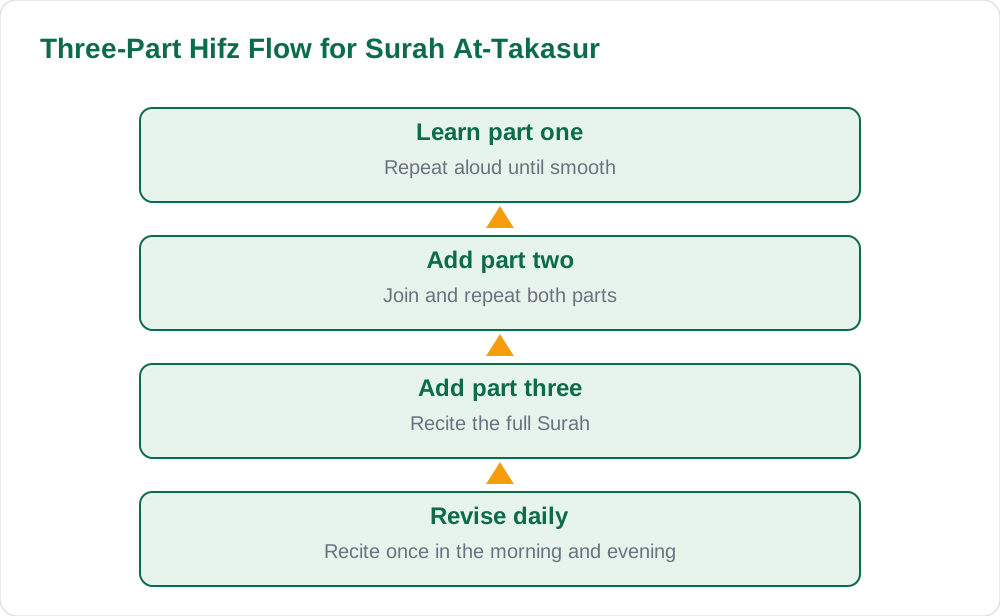
Divide Surah At-Takasur into three short parts. Learn the first part by reading it aloud from your mushaf five to six times, then trying it from memory three times. Join the second part only when the first part is smooth. Then join the third part and repeat the whole Surah.
Practise for about ten to fifteen minutes a day in a quiet place. Say each part slowly and clearly, and check any doubtful word in your mushaf at once. Ask a listener to follow along once a day. A second pair of ears catches small mistakes before they become habits.
Understanding Real Priorities
The Surah asks pupils to think about real priorities. Wealth, comfort, and praise are not evil in themselves, but they become a distraction when they replace gratitude, learning, worship, and kindness. A useful exercise is to write three blessings you already have and one way to use each blessing well.
In class, you can discuss the difference between healthy effort and harmful rivalry. Healthy effort means improving yourself and helping others. Harmful rivalry means trying to look better than others at any cost. When you link each part of the Surah to one of these ideas, the verses become easier to remember and more meaningful.
- Rivalry for increase distracts from gratitude and purpose.
- Healthy effort improves you; harmful rivalry compares you to others.
- List three blessings and one good use for each blessing.
- Choose one habit this week that puts character before showing off.
Avoiding Common Memorisation Mistakes
Pupils often memorise Surah At-Takasur quickly and then forget it because they skip revision. Another common mistake is reciting fast to finish sooner, which hides pronunciation errors. A third mistake is learning without meaning, which makes the verses feel like disconnected sounds. All three mistakes can be fixed with slow, meaning-based, repeated practice.
If you forget the middle of the Surah, do not guess. Stop, look at your mushaf, repeat the weak part, and start again from the previous part. Keep a small notebook with one meaning line for each part. Read those lines before revision so the meaning guides your memory.
A Six-Day Revision Plan
Use a six-day plan for Surah At-Takasur. On days one to three, learn one part each day and revise earlier parts. On day four, recite the whole Surah with the book open, then try without looking. On days five and six, revise twice daily and recite to a listener at least once.
After six days, revise the Surah twice a week. For a longer Surah method, see the Surah Al-Ghashiya guide and browse the blog for more hifz plans.
- Days one to three: learn one new part each day and revise old parts.
- Day four: join all parts and recite the full Surah.
- Days five to six: revise twice daily and recite to a listener.
- After one week, revise twice a week to keep the Surah fresh.
AI Help: Muse AI
Muse AI is Meta's personal AI assistant, and it can help you explain the warning against rivalry in worldly increase in simple words with everyday school examples. Muse AI does not give official STBB answers — always verify against your STBB book and your teacher. Always check any explanation against your Sindh Textbook Board book and ask your teacher if anything is unclear.
Join Muse with invite code LTGSWD — in the Muse app, go to Settings > Redeem token and enter the code.
Disclosure: LTGSWD is the author's Muse invite code.
5 key points you must know
- Surah At-Takasur warns against rivalry in worldly increase and distraction from purpose.
- Memorise in three short parts with a join-and-repeat method.
- Learn one meaning idea for each part before memorising it.
- Choose gratitude and character over showing off and comparison.
- Revise twice daily for a few days, then twice a week.
Frequently asked questions
Does Surah At-Takasur forbid owning things?
No. The Surah warns against making rivalry for more the centre of life. Owning things is fine; the danger is when competition, boasting, and comparison replace gratitude, learning, and kindness.
How long should I practise Surah At-Takasur each day?
About ten to fifteen minutes a day is enough. Learn one part at a time, revise earlier parts, and recite to a listener once a day for the best results.
What is the best way to remember the middle of the Surah?
Link the middle part to its meaning idea and repeat the growing chain after every new part. If it still feels weak, isolate it, practise it separately, and then place it back in the chain.
How can I apply Surah At-Takasur in school life?
Avoid comparing marks, clothes, or gadgets to show off. Focus on improving yourself, helping classmates, and being grateful for what you have. Choose one kind habit each week.
Solved notes — preview free
These guides work best with the solved exercises. Preview the solved notes free on this website — 119 solved notes for Classes 6–10 in Sindhi, Urdu, English and Arabic medium. Or browse the full solved notes catalogue for your class and medium. New solved notes are added regularly — check the catalogue for coming-soon books.