The Nervous System: How Signals Travel in the Body
The nervous system how signals travel body question asks how your body senses the world and reacts so quickly. When you touch something hot, you pull your hand away before you have time to think. When you hear your name, you turn your head. These fast responses happen because nerves carry electrical signals from sensors to the brain and spinal cord, and then to muscles. This guide explains neurons, the brain and spinal cord, and the reflex arc, with a simple example you can use for STBB biology revision in Classes 6 to 10, with clear steps you can practise at home.
What the Nervous System Does
The nervous system has three jobs: sense, decide, and respond. Sense organs such as eyes, ears, skin, nose, and tongue detect changes in the world. The brain and spinal cord process that information and decide what to do. Muscles and glands carry out the response by moving or releasing substances. This sense-decide-respond pattern happens thousands of times a day, often without you noticing. For example, your eyes sense light, your brain decides what you see, and your muscles move your hand to pick up a book.
The nervous system works together with the endocrine system, which uses hormones. Hormones travel more slowly in blood, while nerve signals travel quickly. That is why you pull your hand away from a hot object almost instantly: nerves carry the signal fast. In a slower process, such as growth, hormones play a larger role. For exam answers, focus on the nervous system: stimulus, receptor, coordination, and response. Those four words form the backbone of most questions on this topic.
Neurons: The Messengers
A neuron is a nerve cell that carries signals. It has three main parts: dendrites that receive signals, a cell body that contains the nucleus, and an axon that carries signals away. Many axons are covered by a fatty layer called myelin, which speeds up signal travel. At the end of the axon, the signal crosses a tiny gap called a synapse to the next neuron, muscle, or gland. Chemicals help the signal cross that gap.
There are three types of neurons. Sensory neurons carry signals from receptors to the brain and spinal cord. Motor neurons carry signals from the brain and spinal cord to muscles and glands. Relay neurons connect sensory and motor neurons inside the brain and spinal cord. When you draw a neuron, label dendrites, cell body, axon, and myelin. A neat labelled diagram is often worth marks. You can compare this to other body systems in The Respiratory System and How Breathing Works.
Brain and Spinal Cord
The brain and spinal cord form the central nervous system. The brain is the main control centre. The cerebrum is the largest part and handles thinking, learning, memory, and voluntary movement. The cerebellum helps balance and coordination. The medulla controls automatic actions such as breathing and heartbeat. The spinal cord runs down the back and carries signals between the brain and the rest of the body. It also controls some reflexes on its own, which is why a reflex can happen before the brain is involved.
The brain is protected by the skull, membranes, and fluid. The spinal cord is protected by the backbone. This protection matters because damage to the brain or spinal cord can affect movement and sensing. Healthy habits that protect the nervous system include wearing a helmet when cycling, avoiding head injuries, getting enough sleep, and avoiding harmful substances. If someone has a head injury or sudden weakness, seek medical help at once and tell a parent or teacher.
The Reflex Arc: A Fast Response
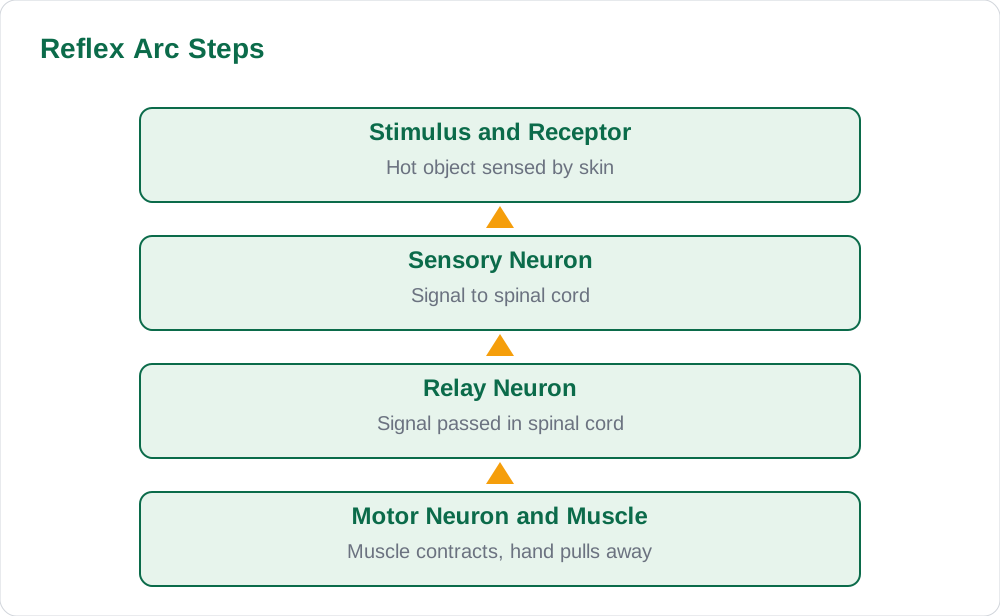
A reflex is a fast, automatic response that does not need conscious thought. The classic example is pulling your hand away from a hot object. The path of a reflex is called the reflex arc. It has five steps: stimulus, receptor, sensory neuron, relay neuron in the spinal cord, motor neuron, and effector. The receptor in the skin senses heat. The sensory neuron carries the signal to the spinal cord. The relay neuron passes it to a motor neuron. The motor neuron carries the signal to the muscle. The muscle contracts and pulls the hand away.
The reflex arc is fast because the signal does not need to travel all the way to the brain for a decision. The brain still learns what happened afterwards, which is why you feel pain after pulling away. Other reflexes include blinking when something comes near your eye, and the knee-jerk reflex. When you answer a reflex question, list the five steps in order and name the effector as muscle. A flow diagram of the reflex arc is the best way to show you understand the sequence.
Revision Tips and Everyday Examples
To revise, practise three tasks: label a neuron, name the three parts of the brain and one function of each, and write the reflex arc in order. Then explain in two sentences why a reflex is faster than a voluntary action. Voluntary actions need the brain to decide, while reflexes use the spinal cord for a quick path. This comparison often appears in exams. Use simple language and name each step.
Everyday examples help you remember. Touching a hot cup, blinking at dust, and catching a ball all use the nervous system. When you catch a ball, your eyes sense it, your brain judges its path, and your muscles move your hands. That is sense-decide-respond in action. Check your answers against your Sindh Textbook Board book and the solved notes on Solved Notes. For digestion links, see A Journey Through the Human Digestive System.
AI Help: Muse AI
Muse AI is Meta's personal AI assistant, and it can help with nervous system revision by asking you to list the reflex arc steps in order until you can write them from memory. Muse AI does not give official Sindh Textbook Board answers — always verify against your Sindh Textbook Board book and your teacher.
Join Muse with invite code LTGSWD — in the Muse app, go to Settings > Redeem token and enter the code.
Disclosure: LTGSWD is the author's Muse invite code.
5 key points you must know
- The nervous system senses, decides, and responds.
- Neurons carry signals via dendrites, cell body, and axon.
- The brain and spinal cord form the central nervous system.
- A reflex arc is stimulus, receptor, sensory neuron, relay neuron, motor neuron, effector.
- Reflexes are fast because they use the spinal cord without waiting for a brain decision.
Frequently asked questions
What is a neuron?
A neuron is a nerve cell that carries electrical signals, with dendrites, a cell body, and an axon.
What is a reflex arc?
A reflex arc is the path of a fast automatic response: stimulus, receptor, sensory neuron, relay neuron, motor neuron, and effector.
Why is a reflex faster than a voluntary action?
A reflex uses the spinal cord for a quick path, while a voluntary action needs the brain to decide first.
What does the cerebellum do?
The cerebellum helps with balance and coordination of movement.
Solved notes — preview free
These guides work best with the solved exercises. Preview the solved notes free on this website — 119 solved notes for Classes 6–10 in Sindhi, Urdu, English and Arabic medium. Or browse the full solved notes catalogue for your class and medium. New solved notes are added regularly — check the catalogue for coming-soon books.